Key Takeaways
- Google AI Mode now has over 1 billion monthly users, doubling every quarter
- New search interface hides organic results behind AI Overviews
- Google calls its new search box the biggest change in 25 years
Google has stopped pretending. At I/O 2026, the company made it official: Google search is AI search. The shift that began tentatively last year is now complete. AI Mode, the conversational search feature Google started testing just over a year ago, has reached 1 billion monthly users.
That number has been doubling every quarter, according to Google search VP Liz Reid. And Google is not slowing down. The company announced even deeper AI integration into its core search product, with changes Reid called the biggest in Google's 25-year history.
How Google Got Here
The growth numbers tell a clear story. AI Mode invites follow-up questions. Each follow-up counts as a new search. More searches mean more engagement, which means the metrics Google cares about all point the same direction.
Google has also been aggressive about pushing users toward AI Mode. Prominent links, nudges, and a complete redesign of the search experience all funnel users away from traditional search. Unlike other Google AI features, AI Mode is free. Everyone who uses Google search gets the full AI experience whether they want it or not.
AI Overviews Become a Gateway, Not a Destination
AI Overviews, the AI-generated summaries that appear above search results, are increasingly looking like a stepping stone. Google has launched what it calls a "seamless" search experience that ties AI Overviews directly into AI Mode.
Most Google searches now produce an AI Overview. A mobile feature that lets users jump from an Overview into AI Mode has expanded to desktop. The AI Mode prompt hovers at the bottom of the Overview, actually hiding the top of the organic search results below.
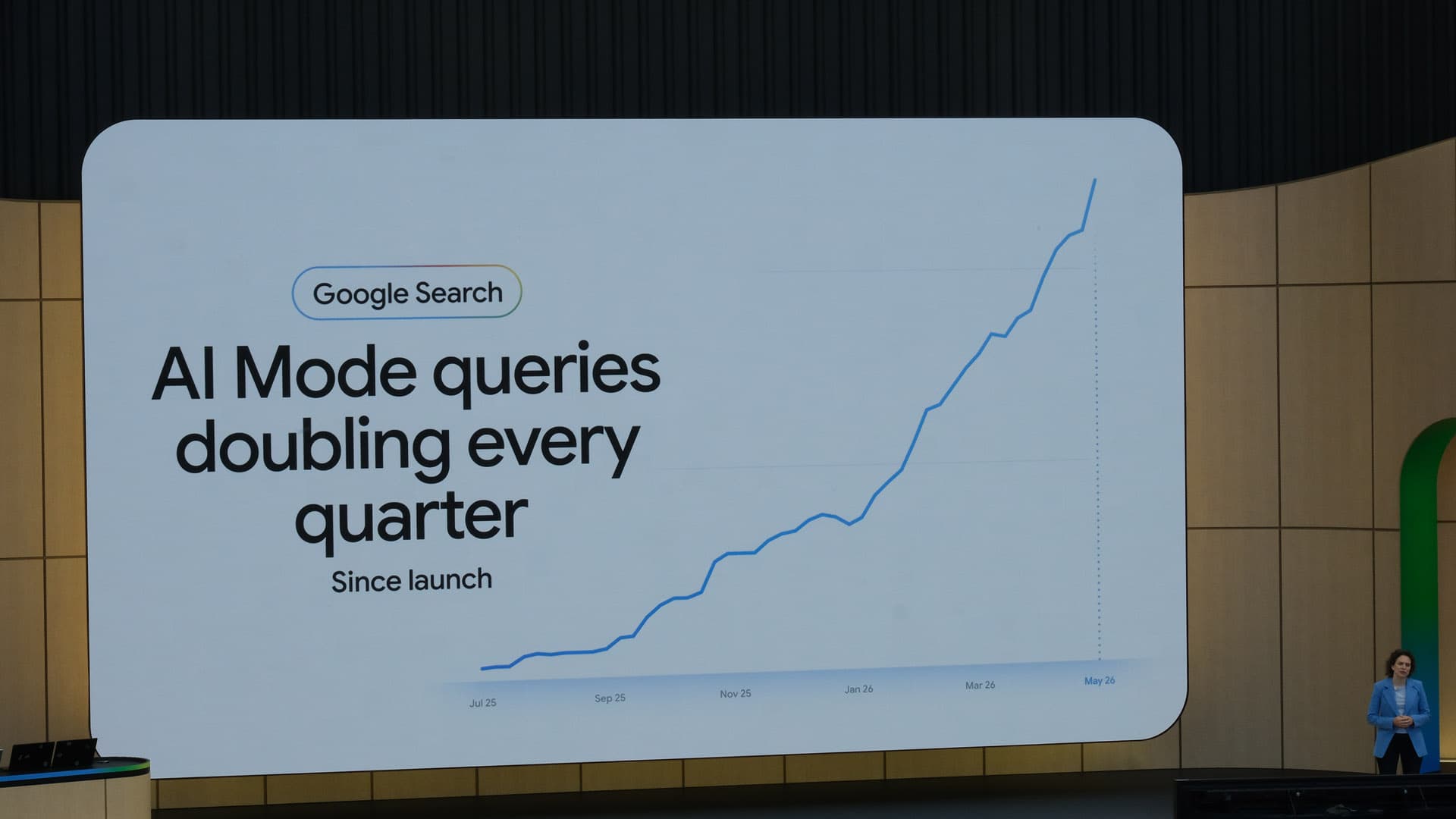
This design choice will inflate AI Mode search numbers further. It will also make it harder for users to scroll down to the traditional 10 blue links. Organic results are starting to feel like footnotes.
The Search Box Gets Smarter
Reid said the new search box is the biggest change in Google's entire history. That sounds like marketing speak, but the changes are real.
The search box now expands dynamically as you type. It attempts to complete your searches using generative AI. Google doesn't want you to call it autocomplete. The system uses Gemini to guess at your intent, guided by what the AI knows about you.
This is a departure from the old autocomplete, which pulled from aggregate search data. The new version is personalized and predictive. It steers users toward the conversational AI experience from the first keystroke.
What This Means for Search Traffic
The implications for anyone who depends on Google traffic are significant. When AI Overviews answer questions directly, users have less reason to click through. When the AI Mode prompt hides organic results, fewer people will see them at all.
Google can get whatever outcome it wants because of its dominance. The complaints about AI search are loud, but the usage numbers suggest most people are going along with the change. Or at least not leaving.
The company's message at I/O 2026 was clear: this is the direction search is going. The reasonable objections to this path will not change the outcome. All the metrics that matter to Google say this is the right move.

Logicity's Take
Frequently Asked Questions
How many people use Google AI Mode?
Over 1 billion people use Google AI Mode every month, with usage doubling every quarter according to Google's announcement at I/O 2026.
Is Google AI Mode free?
Yes. Unlike some of Google's other AI features, AI Mode is free for all Google search users.
What are Google AI Overviews?
AI Overviews are AI-generated summaries that appear above traditional search results. Most Google searches now produce an AI Overview.
Will Google search still show regular links?
Yes, but organic links are increasingly pushed below AI content. The new design places AI Mode prompts over the top of organic results, making them harder to see.
What changed in the Google search box?
The new search box expands as you type and uses Gemini AI to predict what you're searching for, personalizing suggestions based on what Google knows about you.
Another example of how platform dominance affects buying decisions
Need Help Implementing This?
Source: Ars Technica
Huma Shazia
Senior AI & Tech Writer
Produced with AI assistance and reviewed by the Logicity editorial team. Learn more in our Editorial Policy.