Google on August 19 launched a suite of AI-powered study features across Search and Gemini, including interactive 3D simulations, custom practice quizzes, and a dedicated learning hub inside the Gemini app. The rollout positions Google's consumer AI products directly against OpenAI and education-focused startups like Knowt and Gauth, all competing to become the default study companion for students.
What Search can now generate
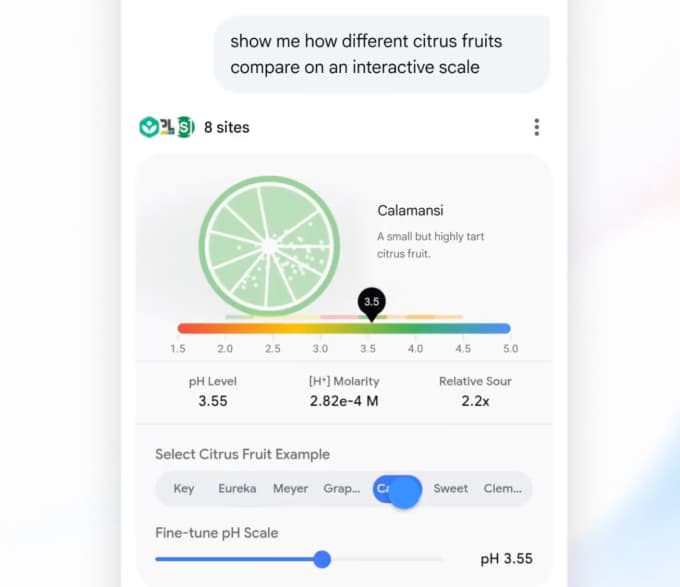
The most visible changes appear in Google Search. Students can now type a prompt and receive an interactive visual inside an AI Overview. Searching "pH scale" returns a manipulable diagram. A follow-up question, like plotting citrus fruits on that scale, triggers AI Mode to generate a custom interactive experience.
Custom quizzes work the same way. A prompt such as "Create a quiz with the most commonly tested vocabulary words to help me prep for the SAT" returns an interactive quiz directly in Search results. The feature covers science, math, humanities, and foreign languages.
Google is also expanding Lens for learning. In the coming weeks, students will be able to photograph a problem, upload it via the Lens camera icon in the Google app, and receive an AI explanation of the concept, identification of mistakes, and guidance for getting unstuck.
Study documents from uploaded files
Search now accepts file uploads, including PDFs, docs, slides, and photos of handwritten notes. Students can combine materials and ask for a synthesized study document. Google's example: upload handwritten notes alongside lecture slides to get a one-pager outlining the key concepts.
Gemini gets 3D models and background research
Inside Gemini, the additions lean heavier on interactivity. Gemini can now generate functional 3D simulations. A prompt like "show me how DNA works in 3D" returns a rotatable, zoomable DNA structure embedded in the response. Responses can also now include tables, grids, and simulations tailored to the specific question.
Gemini Live picks up a new asynchronous research mode. Students can request a multi-step research report, close the chat or switch apps, and receive a notification when the report is ready. They can then discuss findings or ask follow-ups using voice.
A new hub in the Gemini app consolidates these tools. From the hub, users can start a study notebook, create flashcards, take practice quizzes, and access other learning features in one place.
The competitive picture
Google explicitly frames the launch as an effort to make Gemini the AI assistant students turn to first. That puts it in direct competition with OpenAI's ChatGPT, which already sees heavy student usage, and with edtech startups like Knowt (flashcards, practice tests from notes) and Gauth (step-by-step homework help). The difference: Google can embed these features directly into Search, the default starting point for most queries.
For students, the value is immediacy. Instead of bouncing between a search engine, a separate AI chat, and a flashcard app, the workflow collapses into fewer steps. For Google, the value is retention: students who form habits around Gemini's study tools are less likely to defect to competing assistants.
Logicity's Take
The feature set is competitive but not exceptional. Knowt and Quizlet already generate flashcards from uploaded notes; Photomath and Gauth already solve photographed problems. Google's edge is distribution: these tools live inside Search and Gemini, not behind a separate app download. The real test is whether the 3D simulations and interactive visuals are accurate enough for actual exam prep, or if they become another AI party trick that degrades under academic rigor.
Google did not announce pricing changes. The features appear to be rolling out to free tiers, though the company has not clarified whether heavier usage, like repeated research reports, might require a Gemini Advanced subscription.
Related Google product update for enterprise infrastructure teams
Need Help Implementing This?
Reach out to the Logicity team if you're evaluating AI-powered learning tools for your organization or want to understand how these features compare to existing edtech solutions.
Source: TechCrunch / Aisha Malik
Manaal Khan
Tech & Innovation Writer
Produced with AI assistance and reviewed by the Logicity editorial team. Learn more in our Editorial Policy.