Google Cloud has detailed how its Lakehouse runtime catalog, introduced last year, can replace legacy Apache Hive Metastore deployments with a serverless, zero-copy migration path. The catalog implements the open Apache Iceberg REST specification, letting data teams register existing Hive tables and query them from Spark, BigQuery, and Trino without rewriting or moving underlying Parquet and ORC files.
Why legacy Hive Metastores break at scale
Knowledge Catalog, Cross-Cloud Lakehouse, BigQuery — Data Rebuilt for Agents
For more than a decade, Hive Metastore has been the default schema registry for big data workloads. It stores table definitions, partition lists, and storage locations in a MySQL or PostgreSQL backend. That design worked when clusters held thousands of tables. It stops working when partition counts climb into the hundreds of thousands.
At that scale, partition pruning and bulk listing operations hammer the relational database. A single Spark job requesting metadata can spike metastore CPU to 100 percent, stalling every query in the cluster or triggering out-of-memory failures. Data platform teams end up spending cycles tuning JDBC pools, patching HMS daemons, and paying for idle instance-based servers instead of building products.
Security adds another layer of friction. Hive Metastore was designed around Hadoop's perimeter-based model. Enforcing table-level access control across both Spark jobs and enterprise SQL engines like BigQuery means duplicating policies across two control planes, a recipe for drift and audit headaches.
What the Lakehouse catalog changes
The Lakehouse runtime catalog runs on Google's Spanner-backed infrastructure. It is fully serverless, so teams pay nothing for idle capacity and do not manage high-availability replicas. Table definitions remain pointers to existing files in Cloud Storage. Nothing moves, nothing duplicates.
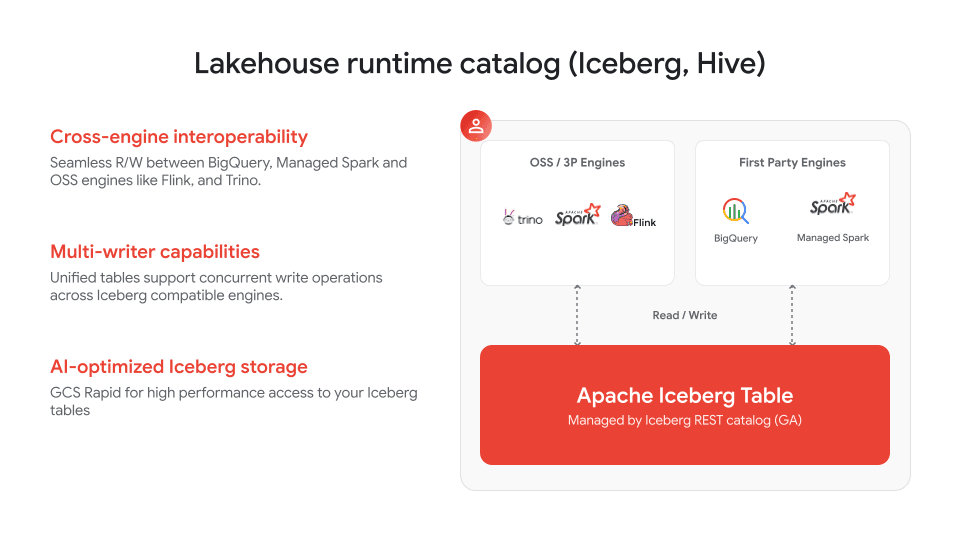
Because the catalog implements the Iceberg REST specification, any Iceberg-compatible engine can query the same tables through standard REST calls. That means Google Managed Spark, BigQuery, and open-source Trino can all read the same dataset without each team maintaining a separate copy. Credential vending lets users access tables without direct Cloud Storage permissions, simplifying IAM policies.
Google also integrates the catalog with Knowledge Catalog and Cloud IAM, so table-level security policies apply consistently across all compute engines. Support for dual-region and multi-region Cloud Storage buckets enables failover scenarios that legacy metastores cannot match without complex replication.
Migration in minutes, not months
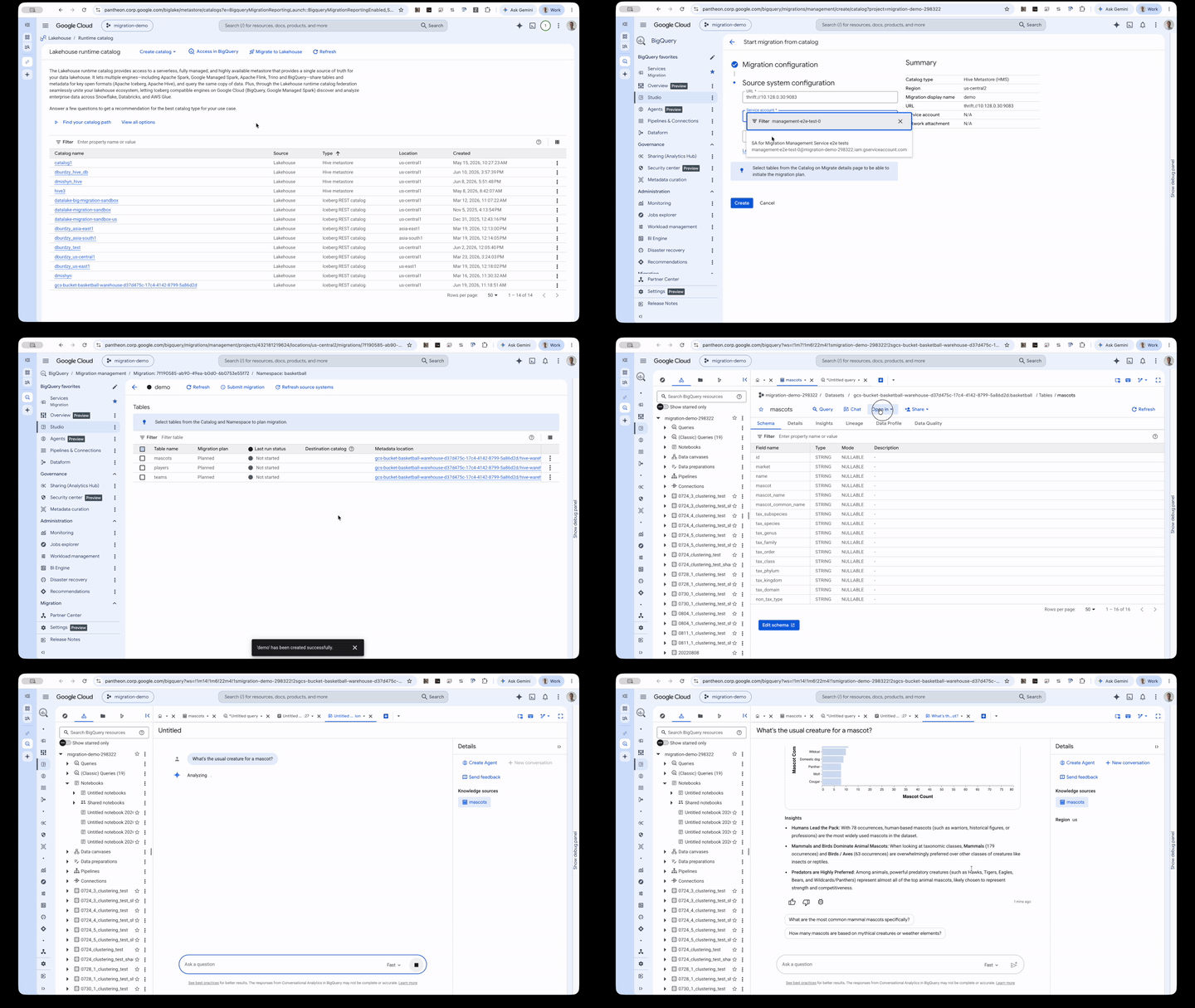
The practical selling point is speed. Google says production Hive tables can be registered in minutes. There is no ETL step, no schema rewrite, and no need to coordinate a fleet-wide maintenance window. Teams point the catalog at existing data, verify table definitions, and switch query engines to the new endpoint.
For engineering leaders weighing migration risk, the zero-copy model removes the largest variable: data movement. Existing pipelines continue writing to Cloud Storage in familiar formats. The catalog layer is additive, not a fork-lift.
Logicity's Take
Google is betting that most enterprises will not rearchitect petabyte-scale lakes just to adopt Iceberg. The Lakehouse catalog lets them keep legacy Parquet tables and still get multi-engine access. Competitors like Databricks Unity Catalog and AWS Glue Data Catalog offer similar interoperability, but Google's Iceberg REST native approach may appeal to teams standardizing on open formats. The real test is whether Google can match Databricks' performance tuning for Spark workloads while delivering on the serverless promise.
What Google did not say
The announcement does not disclose pricing beyond "serverless." Teams evaluating TCO against self-managed metastores need concrete per-query or per-table costs. Google also did not publish benchmark numbers comparing catalog latency to a tuned MySQL-backed HMS. Without those figures, performance claims remain qualitative.
The blog mentions AI-powered governance and "trusted context for your agents," a nod to Google's push toward agentic workloads. How that governance differs from existing IAM policies is unclear. Data teams should ask whether it is a new capability or a rebrand.
Need Help Implementing This?
If your team is evaluating a Hive-to-Lakehouse migration or comparing metadata catalog options, reach out to Logicity's consulting desk for architecture reviews and migration planning.
Source: Cloud Blog
Manaal Khan
Tech & Innovation Writer
Produced with AI assistance and reviewed by the Logicity editorial team. Learn more in our Editorial Policy.