
Key Takeaways

- GitHub Copilot moved from flat subscriptions to usage-based AI Credits on June 1, 2026
- Early reports show some users experiencing 300%+ cost increases within two weeks
- Indian startups with 27 million developers on GitHub are exploring alternatives like Cursor and Claude Code
The Pricing Shift
From June 1, GitHub moved its Copilot AI coding assistant from a flat subscription to a usage-based model. The new system measures consumption in AI tokens. That includes input, output, and cached tokens processed by the AI.
Microsoft announced the change on April 27. It took effect this week. The impact is already showing up in developer expenses.
GitHub launched Copilot in 2022. The tool helped pioneer AI-assisted software development. India hosts over 27 million developers on the platform. GitHub says nearly 80% of new Indian developers use Copilot within their first week.
How the New Credit System Works
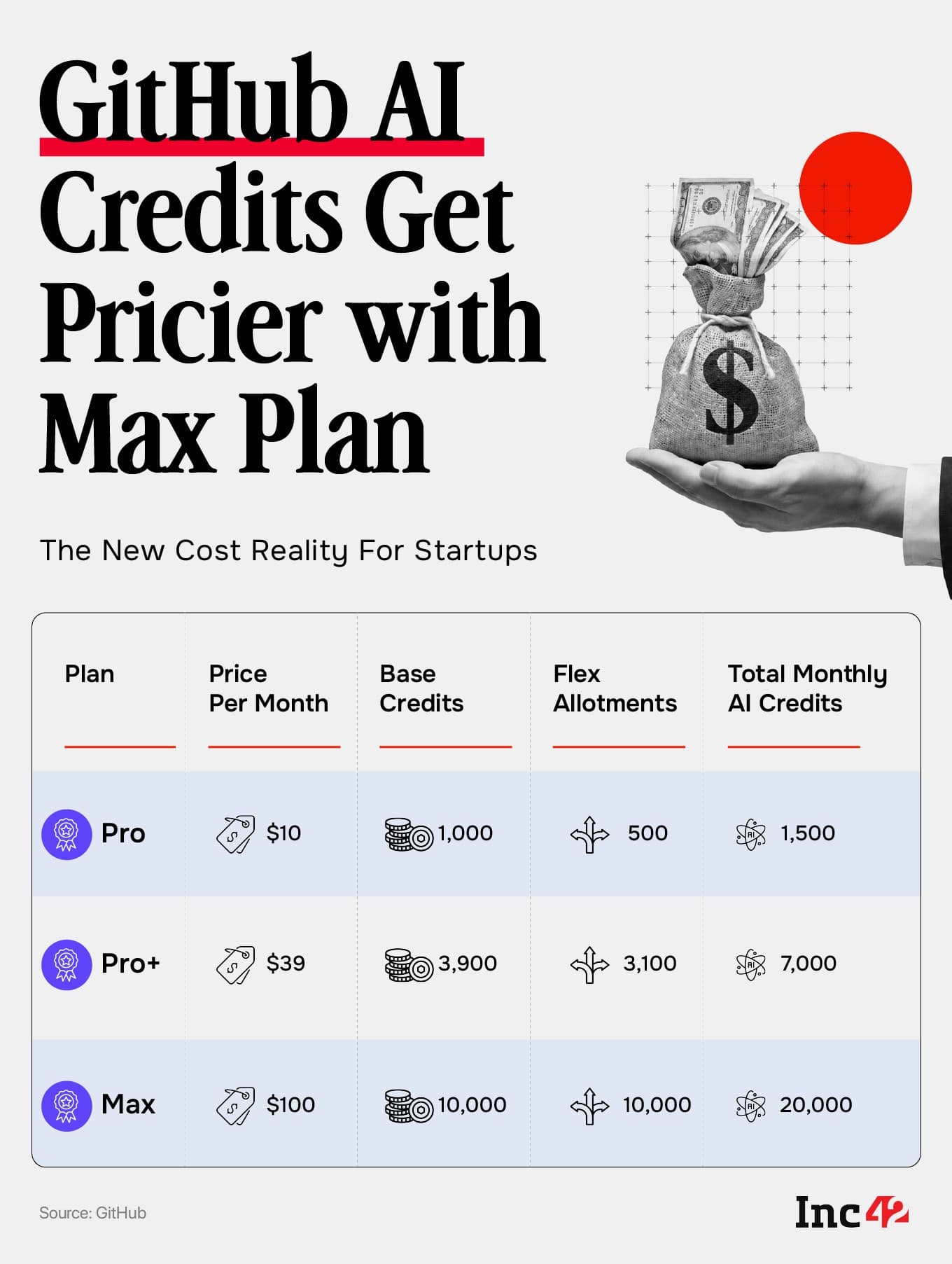
Under the new system, Copilot plans come with a monthly allocation of GitHub AI Credits. Users can buy more credits if they exceed their limits. Here's what each tier includes:
- $10 Pro plan: 1,500 AI credits per month
- $39 Pro+ plan: 7,000 AI credits per month
- $100 Max plan: 20,000 AI credits per month
Each credit equals $0.01. Basic code completions remain included. But advanced features now consume credits based on actual token usage. These include multi-file editing, repository-wide reasoning, and autonomous code review.
The problem: estimating credit consumption is difficult. Complex coding tasks, large codebases, and extended AI workflows burn through credits at unpredictable rates.
Startups Seeing Bills Jump
“We use Copilot extensively across our internal development workflows. Earlier, the pricing was fixed, straightforward, and highly predictable. However, in just the past one or two weeks, I've seen a significant spike in usage. At the current rate, my consumption has increased by more than 300%, and I could end up paying several times what I previously spent in an entire month.”
— Vikash Srivastava, cofounder and CTO of Vobiz
Srivastava said his company's monthly Copilot spending typically ranged between $500 and $700. Under the new pricing structure, that budget is getting exhausted much faster.
Reports suggest power users engaged in heavy agentic workflows are seeing 10x to 50x cost increases. One projection pegs the monthly bill for a single Pro+ user doing autonomous repository refactoring at $847.
GitHub's Response
GitHub told Inc42 that the new pricing model is designed to reflect actual usage rather than a flat subscription fee. The company added that users would have access to spending limits, usage dashboards, and model-selection controls to manage costs.
The Copilot Max plan targets users requiring higher usage capacity. But many developers argue this doesn't address the fundamental unpredictability.
“We are shifting AI from a software subscription expense to a variable cloud infrastructure cost. Developers must now treat prompts like API requests, not free features.”
— Satya Nadella, CEO at Microsoft
Community Pushback
Developers on Hacker News and Reddit are criticizing the move as an "AI Uber moment." The concern: a bait-and-switch where low initial prices hook users, then costs spike once they're locked in.
A dominant narrative is the "death of experimentation." When every complex prompt feels like an expense report, developers become hesitant to use the platform's most powerful features. Fear of surprise bills from autonomous agents is pushing some to avoid agentic workflows entirely.
Indian startups are actively exploring alternatives. Cursor and Claude Code are getting attention as developers look for more predictable pricing.
The Bigger Picture: AI Costs Becoming Infrastructure Costs
This shift signals a broader trend. Companies may soon manage AI budgets like cloud infrastructure costs rather than software subscriptions. The era of flat-fee AI tools might be ending.
For startups, this means new operational complexity. Engineering teams will need to monitor token consumption. Finance teams will need to forecast variable AI expenses. The predictability that made SaaS attractive is eroding.
With AI token consumption projected to surge as agentic workflows become standard, the billing question isn't going away. It's getting more urgent.

Logicity's Take
What Startups Can Do Now
- Audit current Copilot usage patterns before costs escalate further
- Set strict spending limits in GitHub's dashboard to avoid surprise bills
- Evaluate alternatives like Cursor, Claude Code, or local models for cost-sensitive tasks
- Train developers to use simpler prompts and avoid unnecessary multi-file operations
- Treat AI tool costs as a new line item in cloud infrastructure budgets
Related cost management strategies for startups and freelancers
Frequently Asked Questions
When did GitHub Copilot switch to usage-based pricing?
June 1, 2026. GitHub announced the change on April 27, 2026.
How much do GitHub AI Credits cost?
Each credit equals $0.01. The $10 Pro plan includes 1,500 credits, the $39 Pro+ plan offers 7,000 credits, and the $100 Max plan provides 20,000 credits per month.
Why are developers seeing higher Copilot costs?
Advanced features like multi-file editing, repository-wide reasoning, and autonomous code review consume credits based on token usage. Heavy users of agentic workflows report 10x to 50x cost increases compared to flat subscriptions.
What are alternatives to GitHub Copilot?
Developers are exploring Cursor, Claude Code, and local AI models as alternatives with more predictable pricing structures.
How can I control GitHub Copilot spending?
GitHub offers spending limits, usage dashboards, and model-selection controls. Set strict limits and monitor consumption patterns to avoid unexpected bills.
Need Help Implementing This?
Source: Inc42 Media / Shraddha Goled
Huma Shazia
Senior AI & Tech Writer
Produced with AI assistance and reviewed by the Logicity editorial team. Learn more in our Editorial Policy.