Key Takeaways
Opus 5 Beats Fable... at Half the Price?

- Claude Opus 5 scores 61 on the Artificial Analysis Intelligence Index, beating Fable 5's 60 and GPT-5.6 Sol's 59
- The 'high' reasoning tier delivers the best coding results at lower cost than 'xhigh' or 'max'
- Opus 5's hallucination rate hits 50%, up 14 points from Opus 4.8, because it answers more often when uncertain
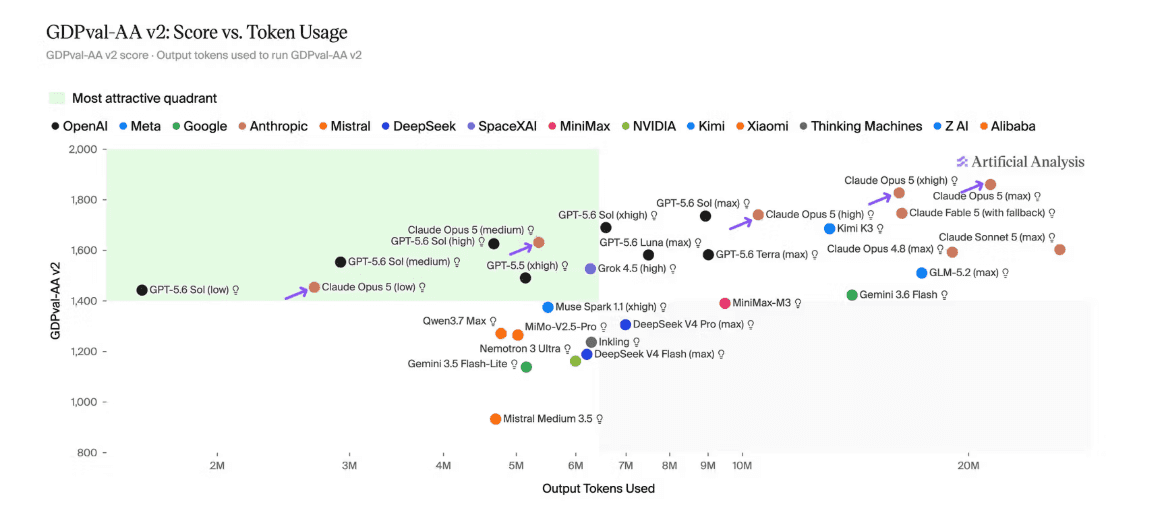
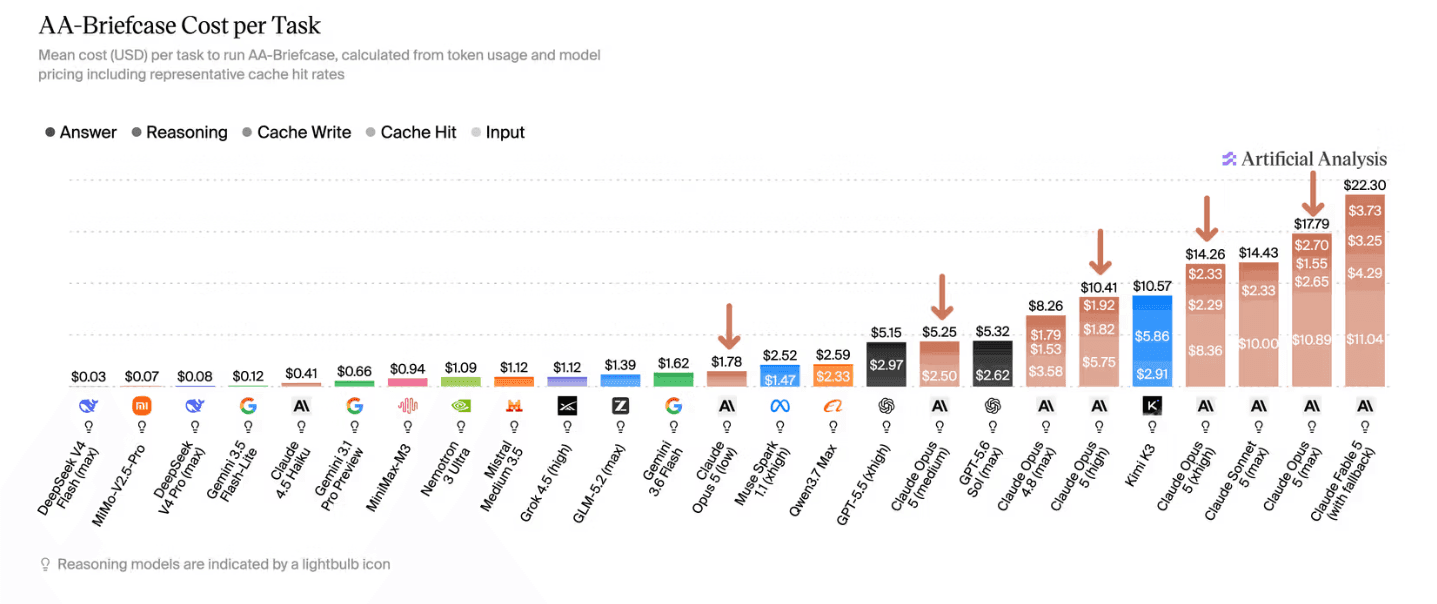
Anthropic's Claude Opus 5 now leads the Artificial Analysis Intelligence Index with a score of 61, edging out Claude Fable 5 at 60, GPT-5.6 Sol at 59, and Claude Opus 4.8 at 56. The new model costs $2.03 per average benchmark task, well below Fable 5's $2.75. For AI teams choosing a frontier model, Opus 5 offers the best capability-to-cost ratio available today.
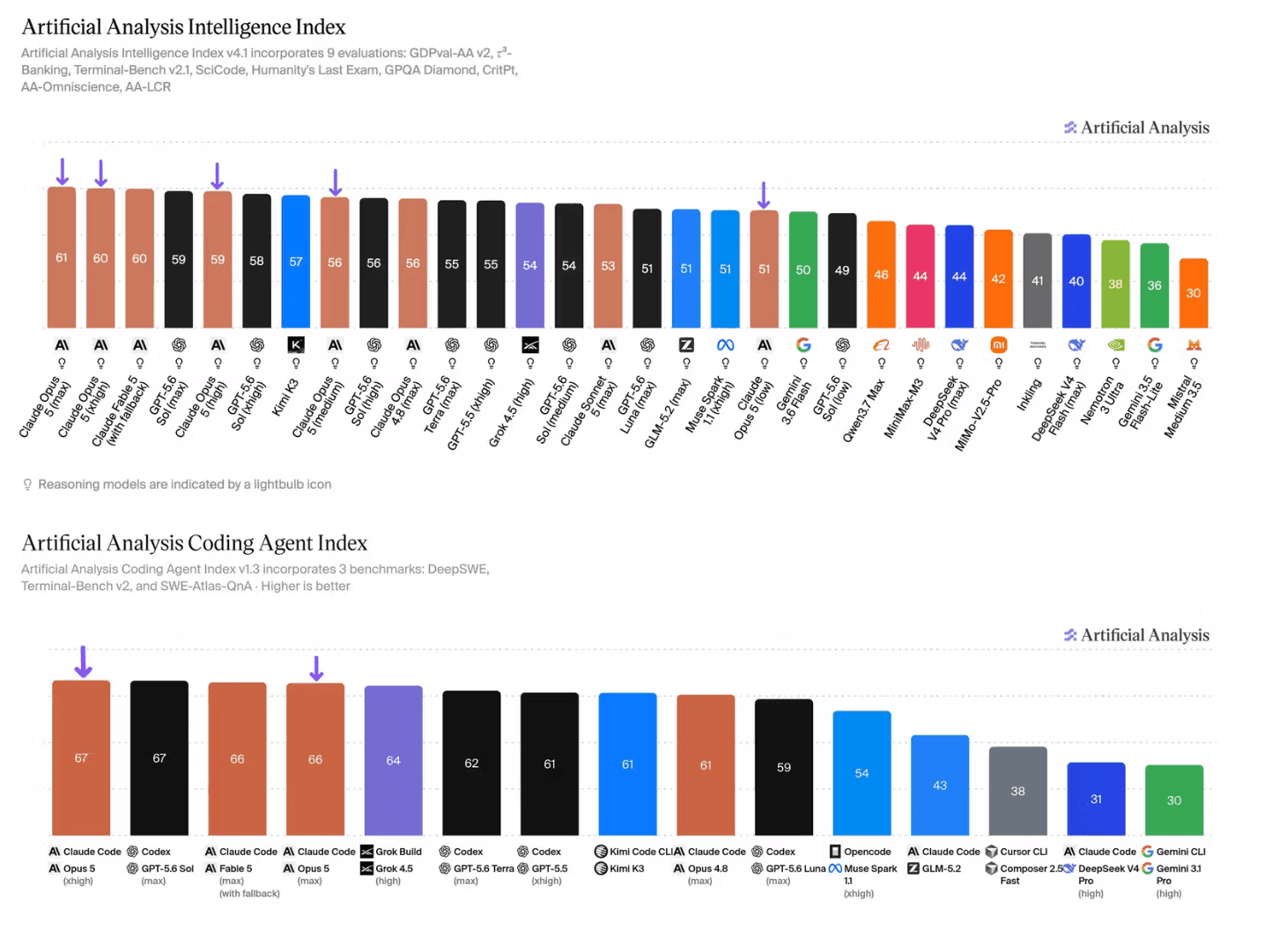
Artificial Analysis worked with Anthropic to test Opus 5 before its public release. The Intelligence Index combines nine tests covering knowledge work, coding, scientific reasoning, and factual accuracy. At the highest reasoning tiers, Opus 5 outperforms both Opus 4.8 and Sonnet 5 while costing less per task.
How does Opus 5 perform on coding benchmarks?
Claude Opus 5 at the 'xhigh' tier, paired with Claude Code, shares first place on the Artificial Analysis Coding Index with GPT-5.6 Sol running Codex. Both scored 67 points. This index measures how well AI models handle autonomous programming tasks, including finding and fixing bugs without human intervention.
On Terminal-Bench v2.1, which tests AI agents as autonomous engineers working in real terminal environments, Opus 5 scored 89% at the 'max' tier. That matches GPT-5.6 Sol, the previous leader.
Vals.ai tested Opus 5 across all five reasoning tiers using Vibe Code Bench. The results reveal a counterintuitive pattern: higher reasoning tiers don't always produce better code.
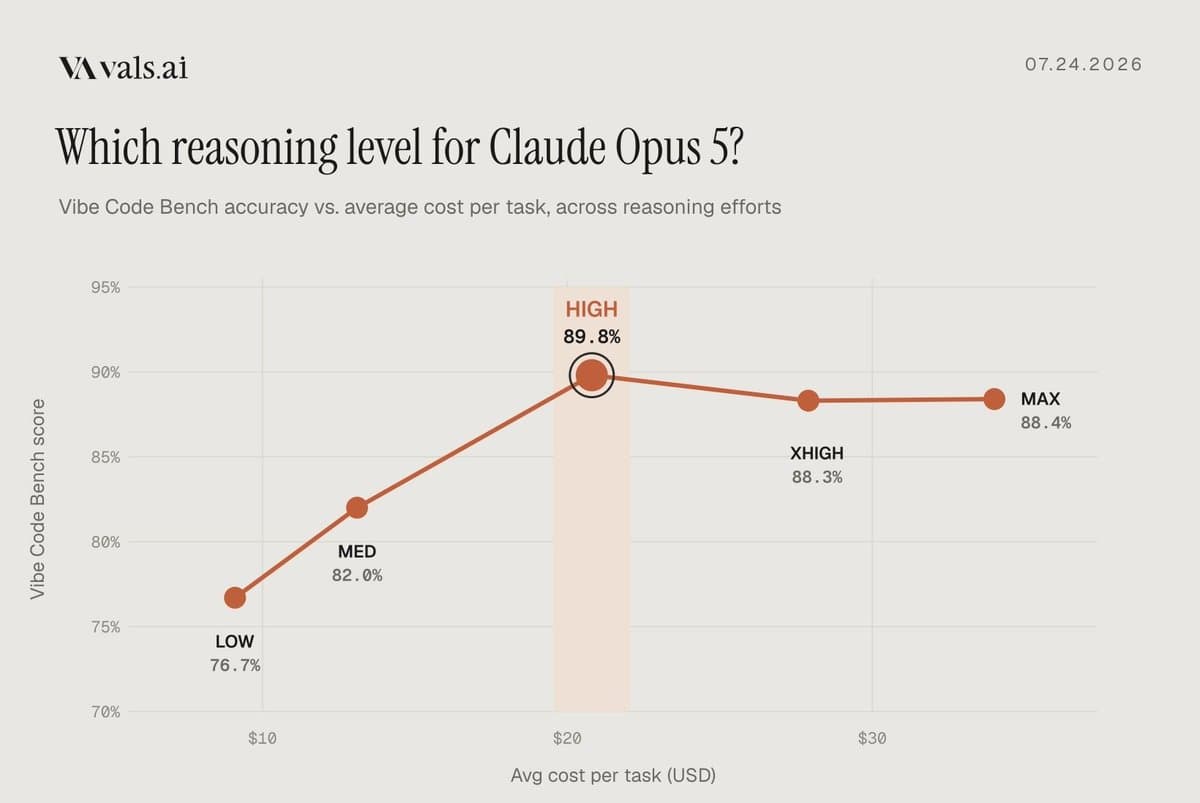
Scores climbed from 76.7% at 'low' to 82% at 'medium' and peaked at 89.8% at 'high'. But performance dropped at 'xhigh' (88.3%) and 'max' (88.4%), despite much higher costs. Vals.ai found that the top tiers produce more complex solutions that contain errors more often. Simpler solutions at 'high' meet requirements more reliably.
Terminal-Bench 2.1 confirms this pattern. The 'high' tier beats 'max' because Opus 5 spends more time on each attempt at the top tier, leaving fewer attempts within the time limit. Anthropic set 'high' as the default tier in both the API and Claude Code, which now looks like the right call.
Scientific reasoning ties with Fable 5
On Humanity's Last Exam, a difficult knowledge test spanning multiple academic fields, Opus 5 scored 53%. That ties it with Fable 5. On CritPt, a physics benchmark from researchers at Argonne National Laboratory and UIUC, Opus 5 again matches Fable 5 but trails GPT-5.6 Sol, GPT-5.5 Pro, and GPT-5.6 Terra.
The pattern suggests Opus 5 competes toe-to-toe with other frontier models on scientific tasks, without pulling ahead.
The hallucination problem: 50% and climbing
Factual accuracy remains a weak spot. On AA-Omniscience, which tests the accuracy of a model's knowledge claims, Opus 5 improved by 7 points over Opus 4.8 but still trails Fable 5.
More concerning: Opus 5's hallucination rate jumped 14 points to 50%. The cause? Opus 5 answers more often when uncertain, rather than declining to respond. For teams deploying AI in high-stakes applications, this is a real tradeoff. You get more responses, but half of them may contain fabricated information.
Another frontier model's unexpected behavior in production
Epoch AI confirms the frontier race is tight
Epoch AI independently tested Claude Opus 5. Their Epoch Capability Index gave Opus 5 a score of 159, just below Fable 5 at 161. On software engineering benchmarks alone (SWE-ECI), Opus 5 ties Fable 5 at 161, outperforming GPT-5.6 Terra and Claude Opus 4.8. GPT-5.6 Sol leads both categories.
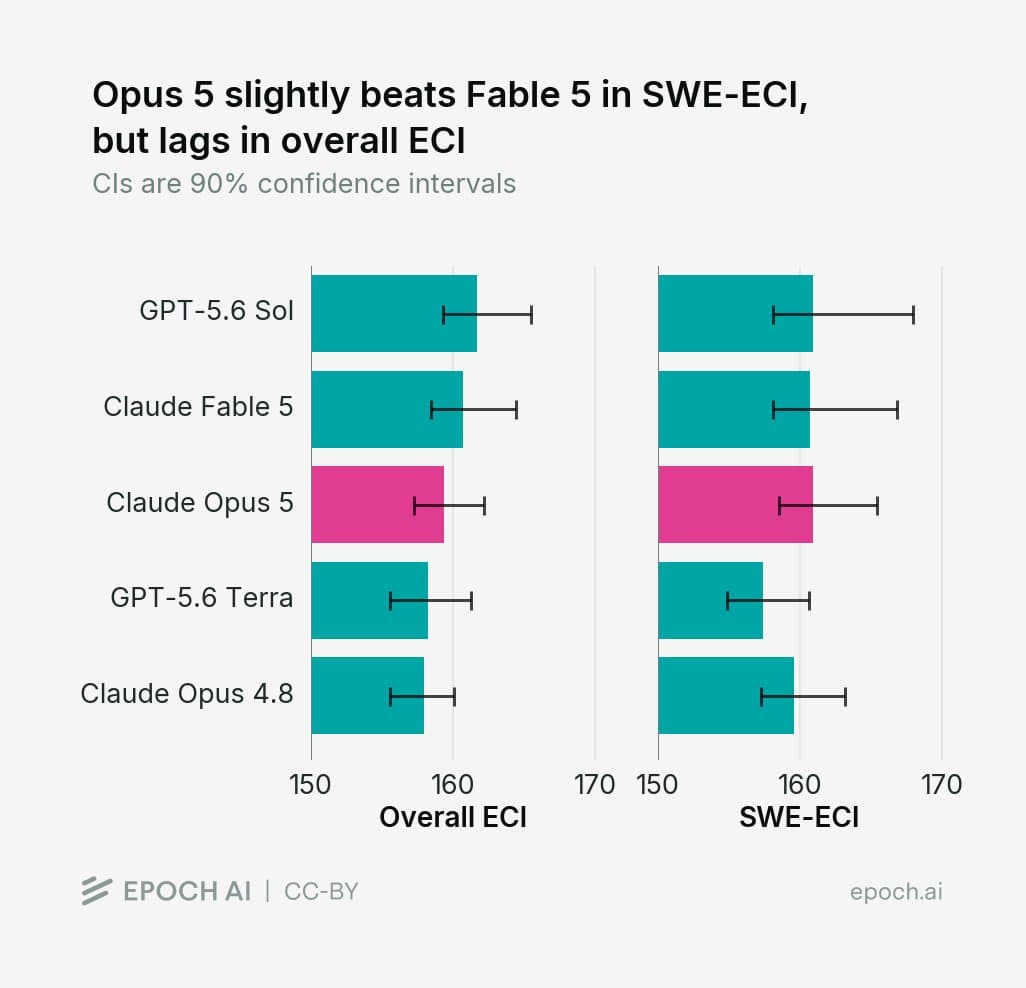
The tight clustering of scores confirms what many suspected: no single frontier model can claim a decisive advantage. GPT-5.6 Sol, Fable 5, and Opus 5 trade leads depending on the task. This lends weight to the argument that AI models will eventually become commoditized, with competition shifting to price, latency, and specialized capabilities.
Opus 5 pricing: $5 per million input tokens
Token pricing stays at $5 per million input tokens and $25 per million output tokens. Cache writes cost $6.25 per million tokens with a five-minute lifetime. Cache hits run $0.50 per million tokens, making prompt caching economically attractive for repetitive queries.
| Model | Intelligence Index | Cost per Task | Coding Index | Hallucination Rate |
|---|---|---|---|---|
| Claude Opus 5 | 61 | $2.03 | 67 (with Claude Code) | 50% |
| Claude Fable 5 | 60 | $2.75 | — | Lower than Opus 5 |
| GPT-5.6 Sol | 59 | — | 67 (with Codex) | — |
| Claude Opus 4.8 | 56 | $1.80 | Lower | 36% |
| Claude Sonnet 5 | — | $1.53 | Lower | — |
Knowledge work: Opus 5 pulls ahead
Opus 5 performs especially well on the AA-Briefcase benchmark, which measures how AI handles typical office tasks: writing research reports, building presentations, and analyzing spreadsheets based on thousands of input files. Performance is scored across correctness, analytical quality, and presentation quality, then rolled into an Elo rating.
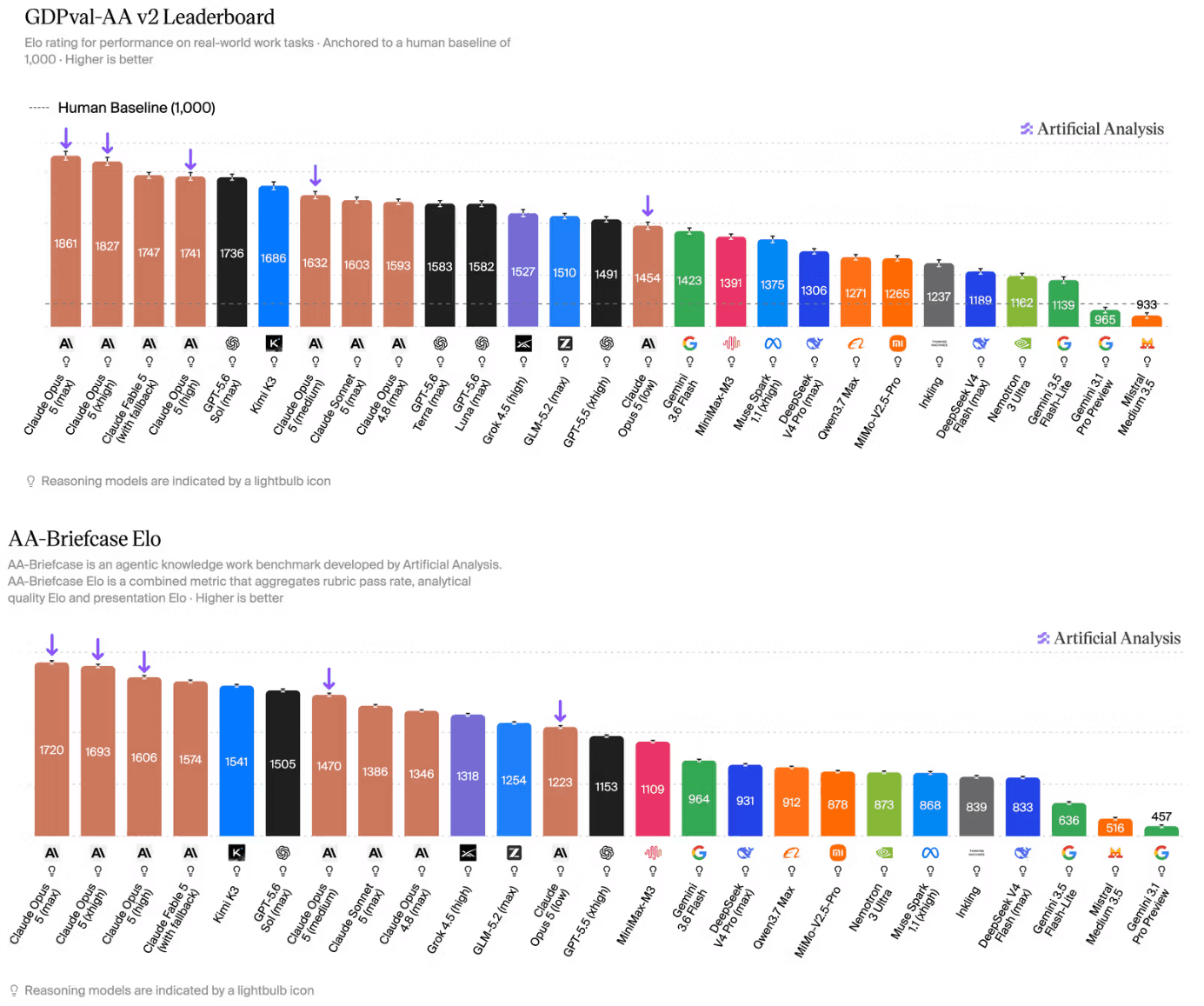
Artificial Analysis highlights Opus 5's particular strengths in analytical quality and knowledge-based tasks. For teams building AI-powered business applications, document analysis tools, or research assistants, Opus 5 looks like the strongest option.
Context on frontier model capabilities and risks
What tier should you use?
The data points to a clear recommendation: start with 'high'. It's the default for a reason. The 'high' tier delivers 89.8% on Vibe Code Bench, beats 'max' on Terminal-Bench, and costs substantially less than 'xhigh' or 'max'. Reserve the top tiers for problems where brute-force reasoning time actually helps.
For cost-sensitive applications, the lower tiers remain viable. The 'medium' tier hits 82% on coding tasks at a fraction of the cost. Teams running high-volume inference may find the tradeoff worthwhile.
Logicity's Take
The benchmark gap between frontier models has compressed to noise. Opus 5 leads by one point, Fable 5 trails by one, GPT-5.6 Sol sits two behind. The real differentiation now lives in pricing, latency, and the 50% hallucination rate that should give pause to anyone building agentic systems. For AI product teams, this commoditization means vendor lock-in carries less technical justification. Build abstractions that let you swap providers, because the leader changes quarterly. If you're automating workflows, tools like [Zapier](https://logicity.in/r/zapier), [Make](https://logicity.in/r/make), or [n8n](https://logicity.in/r/n8n) let you integrate multiple LLM backends and route queries based on task type or cost constraints.
Disclosure
Some links in this post are affiliate links — Logicity earns a commission if you sign up, at no extra cost to you. We only link products we have used or actively recommend.
Frequently Asked Questions
Is Claude Opus 5 better than GPT-5.6 Sol?
On the Artificial Analysis Intelligence Index, Opus 5 scores 61 versus 59 for GPT-5.6 Sol. However, Sol leads the Epoch Capability Index and ties on coding benchmarks. Neither model has a decisive advantage across all tasks.
Why does Claude Opus 5 have a 50% hallucination rate?
Opus 5 answers more frequently when uncertain, rather than declining to respond. This increases coverage but also increases the rate of fabricated information in responses.
What is the best reasoning tier for Claude Opus 5 coding tasks?
The 'high' tier delivers the best results at 89.8% on Vibe Code Bench, outperforming both 'xhigh' and 'max' tiers while costing less.
How much does Claude Opus 5 cost per token?
Input tokens cost $5 per million, output tokens cost $25 per million. Cache writes are $6.25 per million with a 5-minute TTL, and cache hits cost $0.50 per million.
Should I switch from Claude Opus 4.8 to Opus 5?
Opus 5 scores 5 points higher on the Intelligence Index and improves factual accuracy by 7 points. However, its hallucination rate is 14 points higher. For high-stakes applications requiring reliability, test carefully before switching.
Need Help Implementing This?
Building with Claude Opus 5 or evaluating frontier models for your product? Logicity's consulting team helps AI product teams benchmark, integrate, and optimize LLM deployments. Contact us at consulting@logicity.in.
Source: The Decoder / Matthias Bastian
Huma Shazia
Senior AI & Tech Writer
Produced with AI assistance and reviewed by the Logicity editorial team. Learn more in our Editorial Policy.