Key Takeaways
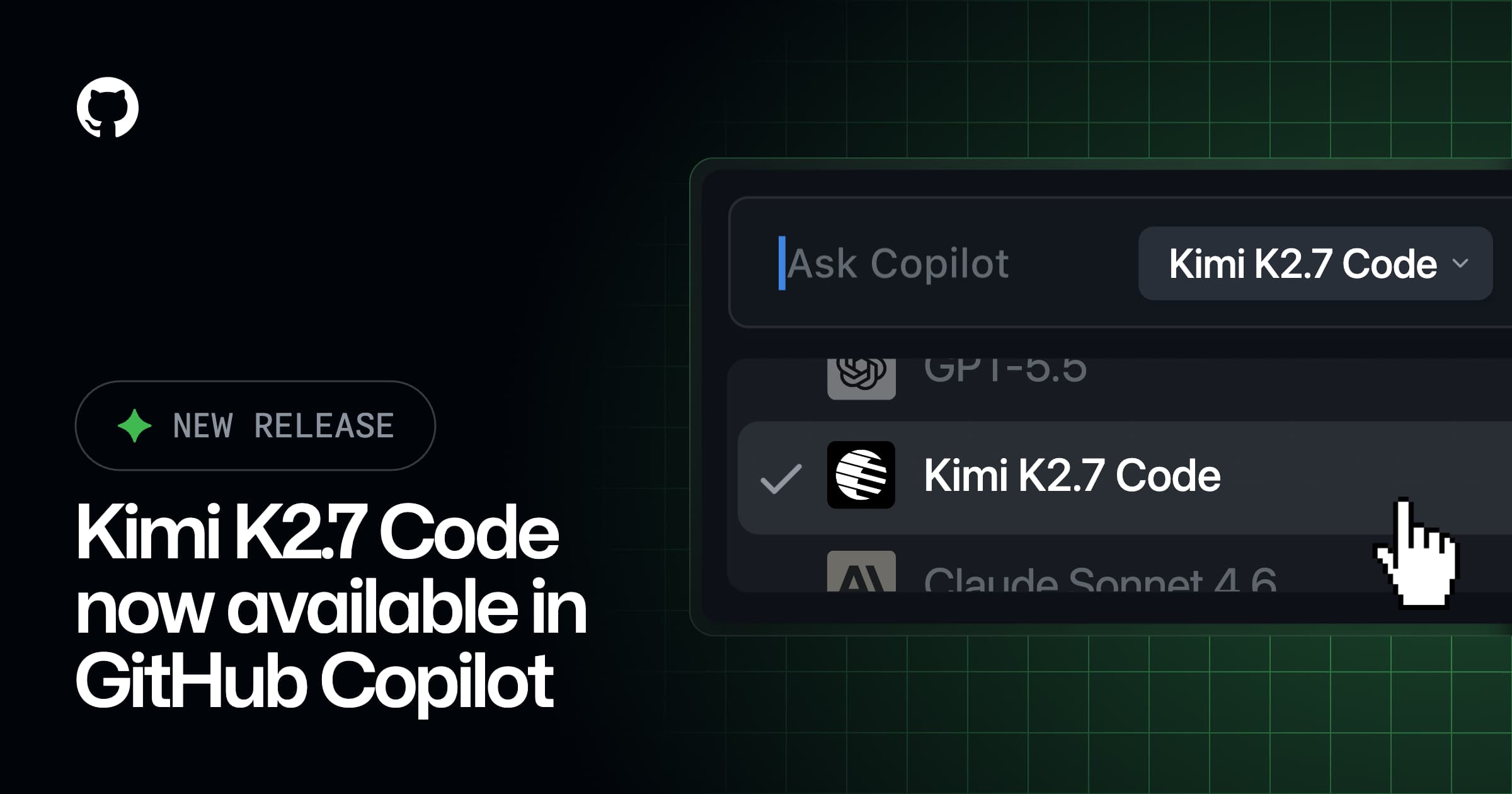
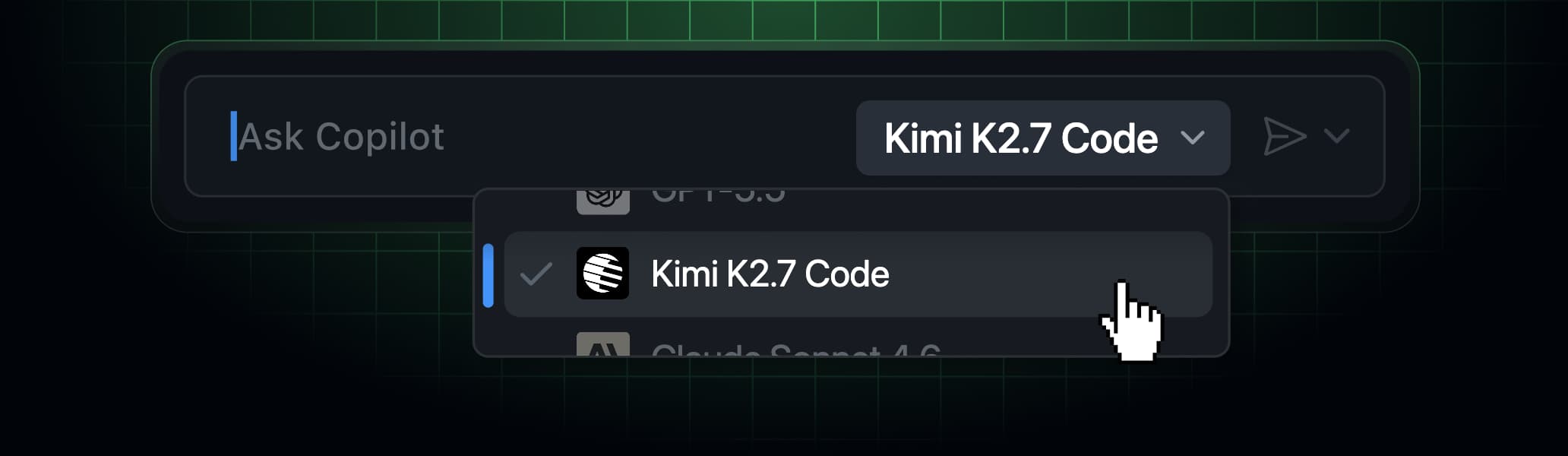
- Kimi K2.7 Code is the first open-weight model available in GitHub Copilot's model picker
- Rolling out to Copilot Pro, Pro+, and Max plans first, with Business and Enterprise coming later
- Business and Enterprise admins must manually enable the model before their teams can access it
GitHub Copilot now offers Kimi K2.7 Code as a selectable model, marking the first time an open-weight AI model has appeared in Copilot's model picker. The model, developed by Chinese AI startup Moonshot AI, gives developers a lower-cost alternative to the proprietary models that have dominated the coding assistant space.
The rollout began on July 1, 2026, targeting Copilot Pro, Pro+, and Max subscribers first. Business and Enterprise plans will follow in the coming weeks, though with a catch: administrators must explicitly enable the model before anyone in their organization can use it.
Where can you use Kimi K2.7 Code?
GitHub is making the model available across nearly every surface where Copilot runs. Visual Studio Code users need version 1.127.0 or later. Visual Studio requires version 17.14.6. JetBrains IDE users need plugin version 1.9.1-251 or later.
The model also works in Copilot CLI, the GitHub Copilot cloud agent, the GitHub Copilot App, github.com directly, GitHub Mobile on iOS and Android, Xcode, and Eclipse. That's comprehensive coverage. If you use Copilot somewhere, Kimi K2.7 should eventually be an option there.
What makes Kimi K2.7 different from other Copilot models?
The distinction is the open-weight architecture. Unlike GPT-4 or Claude, whose model weights remain proprietary, Kimi K2.7's weights are publicly available. This matters for organizations that want to audit model behavior, run compliance checks, or simply understand what's generating their code suggestions.
Kimi K2 uses a Mixture-of-Experts architecture with 671 billion total parameters, though only about 32 billion activate per inference. It supports a 128K context window, which helps when working with large codebases. The model is hosted by GitHub on Microsoft Azure, not self-hosted, so you still get the same infrastructure reliability as other Copilot models.
Pricing follows provider list rates under usage-based billing. GitHub directs users to its pricing documentation for specifics, but the positioning is clear: this is meant to be a cheaper option.
Enterprise rollout requires admin approval
For Copilot Business and Enterprise customers, Kimi K2.7 Code is disabled by default. Plan administrators must navigate to Copilot settings and explicitly enable the Kimi K2.7 Code policy. Until they do, the model won't appear in the model picker for anyone in that organization.
GitHub recommends that administrators review open-weight models against their security, compliance, and data-governance requirements before flipping the switch. This is sensible advice. Open-weight doesn't mean open-source in the traditional sense, and organizations with strict policies around third-party AI tools should evaluate the model's provenance and training data disclosures.
Moonshot AI, the company behind Kimi, was founded in 2023 by Yang Zhilin, a former Google researcher who co-created the Transformer architecture. The company is one of China's most valuable AI startups, with an estimated valuation exceeding $1 billion.
Why this matters for the AI coding tool market
GitHub adding an open-weight model signals that the era of purely proprietary AI assistants may be ending. Developers have pushed back against black-box models, particularly for security-sensitive code. Open-weight models let organizations inspect the model architecture even if they can't access training data.
It also introduces price competition. If Kimi K2.7 performs comparably to GPT-4 for common coding tasks at a lower per-token cost, budget-conscious teams have a reason to switch. GitHub is hedging its bets, offering choice rather than forcing everyone onto a single model.
Logicity's Take
This is GitHub testing whether developers actually want open-weight models or just say they do. Kimi K2.7's 671B parameter count puts it in heavyweight territory, but real-world coding performance matters more than parameter counts. The gradual rollout suggests GitHub will watch quality metrics closely before pushing to Enterprise. If Kimi K2.7 underperforms, it quietly stays niche. If it holds up, expect GitHub to add more open-weight options. For teams already using Copilot Business, the admin approval requirement creates a natural checkpoint. This isn't a default-on change that catches compliance teams off guard.
Frequently Asked Questions
Is Kimi K2.7 Code free in GitHub Copilot?
No. It's billed at provider list pricing under usage-based billing. GitHub's pricing documentation has specific rates.
Can I use Kimi K2.7 in GitHub Copilot Enterprise right now?
Not yet. Enterprise support is coming in the following weeks, and your administrator must enable the model policy first.
What's the difference between open-weight and open-source?
Open-weight means the model's trained parameters are publicly available for inspection or fine-tuning. Open-source typically includes training code, data, and permissive licensing. Kimi K2.7 is open-weight, not fully open-source.
Does Kimi K2.7 work in VS Code?
Yes, in Visual Studio Code version 1.127.0 or later. Select it from the model picker once the rollout reaches your account.
Who made Kimi K2.7?
Moonshot AI, a Chinese AI startup founded by Yang Zhilin, a former Google researcher involved in creating the Transformer architecture.
Related coverage on AI coding assistant optimizations
Need Help Implementing This?
Evaluating AI coding tools for your engineering team? Logicity can help you navigate model selection, compliance requirements, and rollout strategies. Contact us for a consultation.
Source: Hacker News: Best
Manaal Khan
Tech & Innovation Writer
Produced with AI assistance and reviewed by the Logicity editorial team. Learn more in our Editorial Policy.




