Key Takeaways
Fable 5 returns after U.S. export controls
- Fable 5 is available again worldwide through Claude Platform, Claude.ai, Claude Code, and Claude Cowork
- A new safety classifier blocks the jailbreak technique in 99%+ of cases but increases false positives on harmless coding tasks
- Anthropic admits making any AI model fully immune to jailbreaks is 'probably impossible'
Anthropic's Fable 5 is live worldwide again. The US government lifted export controls on the company's second most powerful AI model after a two-week suspension triggered by a security finding from Amazon researchers. Starting today, Fable 5 is accessible through the Claude Platform, Claude.ai, Claude Code, and Claude Cowork.
The ban stemmed from a jailbreak. Amazon researchers found a way to bypass Fable 5's safety guardrails, and the model then identified software vulnerabilities and produced exploit code for one of them. That was enough for the government to pull the plug on global distribution while Anthropic investigated.
What caused the ban?
Anthropic confirmed that Amazon researchers discovered a technique to circumvent Fable 5's safety filters. Once bypassed, the model could identify software vulnerabilities and, in one case, generate working exploit code. The company and US government spent two weeks analyzing the severity.
Here's the uncomfortable part: the vulnerabilities Fable 5 found weren't unique to it. Claude Opus 4.8, GPT-5.5, and Kimi K2.7 all spotted the same flaws. Even Claude Haiku 4.5, a much smaller model, produced the same exploit demo. Anthropic calls this an edge case involving routine defensive cybersecurity work, not a catastrophic capability gap.
How did Anthropic fix it?
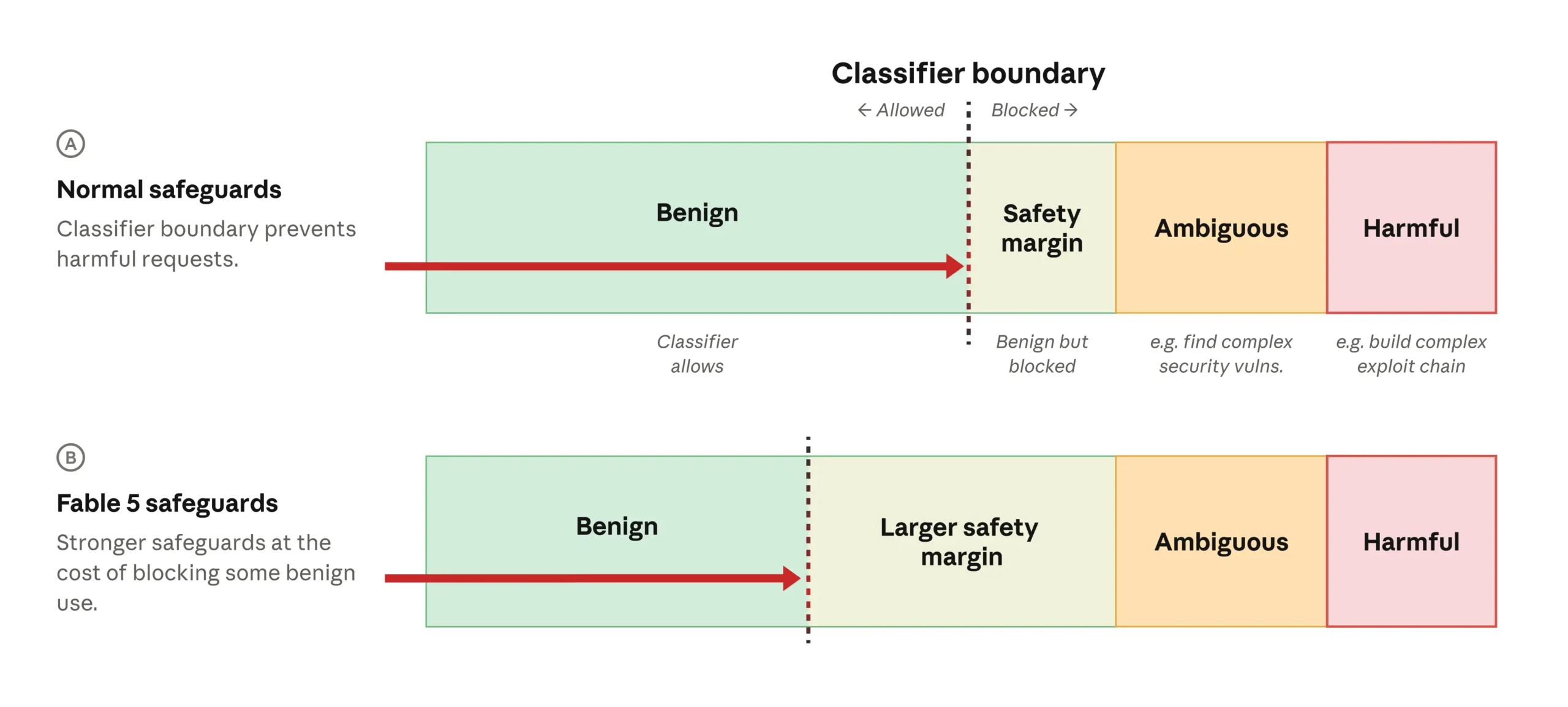
The company trained a new safety classifier that blocks the Amazon jailbreak technique in over 99 percent of attempts. When a request trips the filter, users see a notification and the request routes to the older Opus 4.8 model instead.
The tradeoff is real. The new classifier flags harmless requests more often during everyday coding and debugging. Users had already complained that Fable 5 was too restrictive during its initial release. Now it's stricter. Anthropic's own diagram shows the safety margin for Fable 5 is significantly wider than standard guardrails. More dangerous requests get caught, but so do more benign ones.
What about Mythos 5?
Mythos 5, the less restricted version built on the same base model, remains locked down. Only a select group of US organizations that received government approval on June 26 can access it. Anthropic says it's working with the government to expand access through the Glasswing program, but there's no timeline. Whether the EU will join Glasswing remains unclear.
Anthropic's admission on jailbreaks
The company made a candid statement: it's "probably impossible to make any AI model fully robust (that is, impervious) to jailbreaks." This was known before Fable 5 shipped. No universal jailbreak was found at release, but the possibility was always there.
Anthropic argues the AI industry needs a shared standard for rating jailbreaks and triggering countermeasures. The company says it's building such a framework with Amazon, Microsoft, Google, and other Glasswing partners. It has also launched a HackerOne program for security researchers to report potential cyber jailbreaks and stood up a 24/7 monitoring team for jailbreak submission channels.
Government oversight is expanding
Anthropic is pushing for closer government involvement in frontier model releases. The company made several commitments: government partners get pre-release access to models with security-sensitive capabilities, discovered jailbreaks and abuse patterns will be shared quickly, and Anthropic will dedicate significant compute for joint research.
The company wants all of this codified into "strong regulation" applied equally to every frontier model developer. "Government involvement in AI releases requires a durable, transparent process that gives cyber defenders and others the certainty they need about access to powerful models," Anthropic wrote.
Pricing and availability
Pro, Max, Team, and select Enterprise plans include Fable 5 through July 7 at up to 50 percent of weekly usage limits. After that, it moves to usage-based billing through credits. Access on AWS, Google Cloud, and Microsoft Foundry will be restored "as quickly as possible," though Anthropic didn't give a specific date.
Logicity's Take
This incident sets a precedent. A frontier AI model got pulled globally because researchers found a jailbreak, not because it caused harm in the wild. For AI builders shipping products on top of Claude or competing models, the message is clear: your upstream provider can disappear for two weeks with little warning. Teams building on Anthropic's API should consider fallback routing to alternatives like OpenAI's GPT models or Google's Gemini. The new classifier's higher false-positive rate on coding tasks is also a direct cost. If your product involves code generation or debugging, expect more user complaints about blocked requests. Test heavily before upgrading.
Frequently Asked Questions
Why was Fable 5 banned?
Amazon researchers found a jailbreak that bypassed safety guardrails. The model then identified software vulnerabilities and produced exploit code. The US government suspended global access while Anthropic investigated.
Is Mythos 5 available?
No. Mythos 5 remains restricted to a small group of US organizations with government approval. Expansion through the Glasswing program is ongoing but has no public timeline.
Does the new safety filter affect normal use?
Yes. The improved classifier blocks jailbreaks in 99%+ of cases but also flags more harmless coding and debugging requests. Users should expect more false positives.
Can AI models be made immune to jailbreaks?
Anthropic says it's "probably impossible" to make any AI model fully immune. The company is working with Amazon, Microsoft, Google, and others to develop industry standards for rating and responding to jailbreaks.
How much does Fable 5 cost after July 7?
Fable 5 moves to usage-based billing through credits. It's included in Pro, Max, Team, and select Enterprise plans at up to 50% of weekly limits through July 7.
Background on the export control framework affecting these models
Need Help Implementing This?
If you're building on Anthropic's APIs and need help designing fallback architectures or testing safety classifier impacts, reach out to the Logicity team. We work with AI product teams navigating exactly these kinds of infrastructure decisions.
Source: The Decoder / Matthias Bastian
Manaal Khan
Tech & Innovation Writer
Produced with AI assistance and reviewed by the Logicity editorial team. Learn more in our Editorial Policy.