Key Takeaways
- 222 European university spinouts raised €4.9 billion in H1 2026, with a handful of blockbuster deals driving most of the total
- UK universities captured €3.49B across 97 spinouts, dwarfing Germany's €72M and France's €18M combined
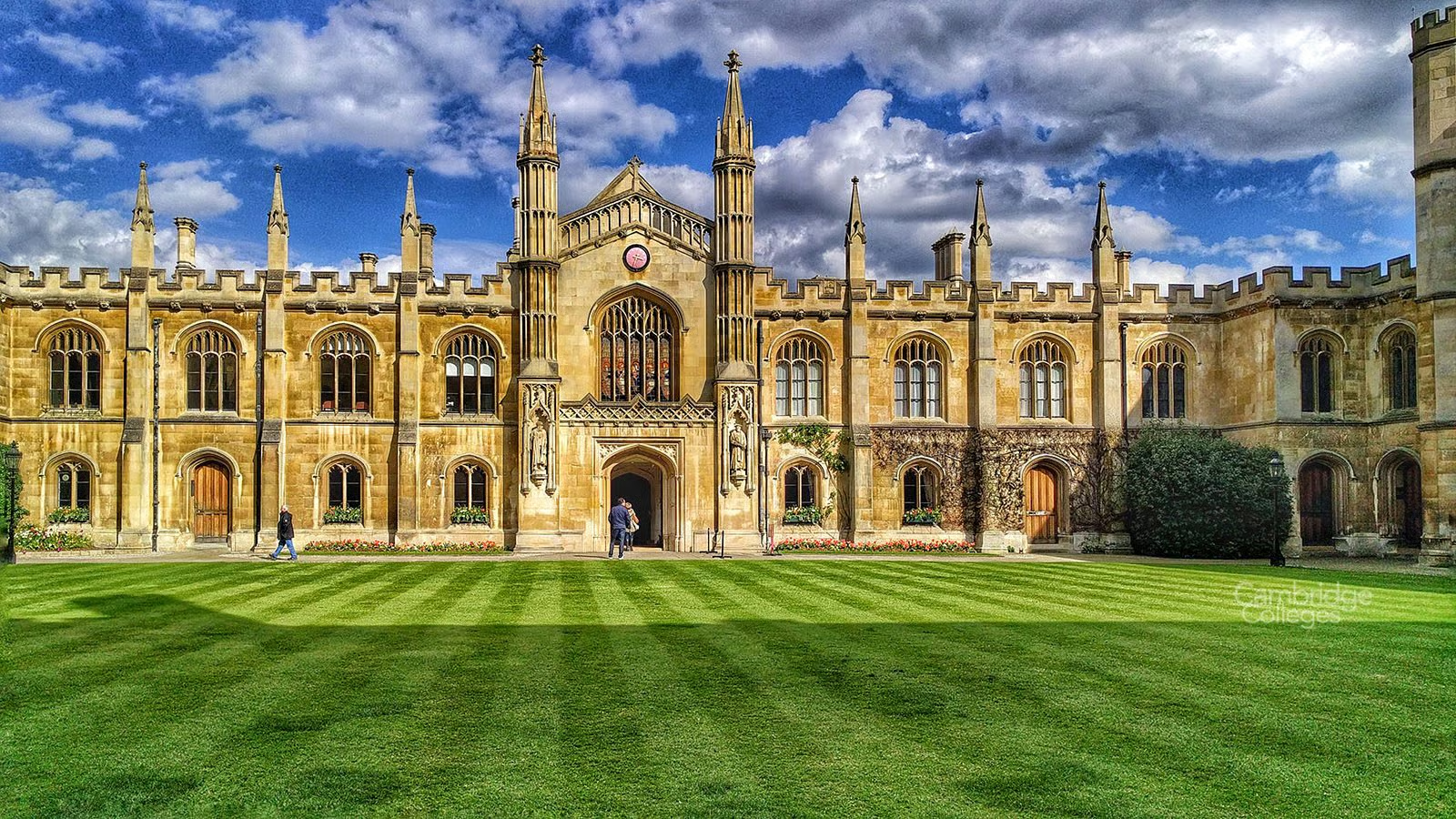
- Oxford leads Europe with €957M raised from 72 spinouts, followed by Cambridge at €490M from fewer deals
European university spinouts raised €4.9 billion in the first half of 2026 across 222 companies, according to new data from Sifted. The headline figure looks healthy, but dig into the numbers and a stark pattern emerges: a small cluster of British institutions, backed by a few enormous rounds, accounts for most of the capital. For founders weighing where to build their next deep tech company, the geographic concentration matters more than the aggregate.
The UK's overwhelming dominance
The UK pulled in €3.49 billion across 97 spinouts. That is 71% of Europe's entire university spinout haul, raised by fewer than half of the continent's total companies. Germany, often touted as Europe's industrial powerhouse, managed €72 million. France raised €18 million. British universities are not just ahead; they occupy a different tier.
This gap is not new, but it is widening. The UK's advantage stems from decades of deliberate policy: technology transfer offices with commercial mandates, university IP frameworks that favor founder-friendly terms, and a venture ecosystem in London and Cambridge that knows how to price scientific risk. German and French universities have traditionally been slower to commercialize research, and their venture markets remain smaller for hardware-intensive, capital-hungry spinouts.
Oxford and Cambridge: a two-horse race
Oxford topped the rankings with €957 million raised across 72 spinouts. The figure includes several major rounds in therapeutics and AI, sectors where Oxford's research clusters have produced globally competitive companies. Cambridge followed at €490.2 million from fewer spinouts, reflecting larger average deal sizes and a tighter concentration in deep tech and life sciences.
Together, these two universities represent more than half of European university spinout funding. The third-place finisher, ETH Zurich, raised €637.8 million, but from only seven deals. That suggests a different model: fewer spinouts, but each capturing substantial capital, likely driven by one or two standout companies.
Imperial College London rounded out the UK contingent at €309.3 million. The pattern across British universities shows both volume and scale: more spinouts per institution, and larger median rounds than continental peers.
Where the blockbuster rounds landed
A handful of companies drove disproportionate totals. Three spinouts alone accounted for a substantial share of all European university spinout funding. One Cambridge-linked company raised €940.9 million. Another from the same cluster secured €601 million. These are not seed rounds; they are growth-stage raises that reflect years of prior capital and operational scale.
The top 40 spinouts were described as exhibiting a power law pattern: a few at the top raising amounts that dwarf the long tail. For founders, this is both encouraging and sobering. The capital is there for spinouts that reach escape velocity. But most university-born companies will compete for much smaller pools.
Continental Europe's fragmented picture
Outside the UK and Switzerland, European university spinouts raised modest sums. German universities contributed 21 of the 222 spinouts tracked, representing 9.5% of the total, but captured just €47.8 million. That is less than a single mid-sized Series B in London.
France fared worse at €18 million. Even accounting for differences in how spinouts are counted or classified, the gap points to structural issues: fewer specialized deep tech investors, less liquid secondary markets for early shareholders, and university IP policies that can delay or complicate commercialization.
The Netherlands, Belgium, Denmark, Spain, and Portugal collectively showed activity, but none broke into the top ranks. Scandinavian universities have historically punched above their weight in software and biotech spinouts, but the H1 2026 data suggests their momentum has not kept pace with UK peers.
Why geography still matters for deep tech founders
Spinouts differ from typical startups. They often begin with years of academic research, patented IP, and grant funding. The transition from lab to company requires a specific infrastructure: experienced tech transfer teams, spinout-focused investors willing to wait a decade for returns, and proximity to talent pools that understand both science and business.
Oxford and Cambridge have spent decades building this infrastructure. Their alumni networks include partners at deep tech funds, executives at pharma companies hungry for licensing deals, and serial entrepreneurs who have done the spinout journey before. A first-time founder at a German technical university does not have the same density of models to learn from.
This does not mean a spinout cannot succeed elsewhere. ETH Zurich's strong showing proves that a well-resourced institution with clear IP policies can compete. But for founders making location decisions, the concentration of capital and support in the UK is hard to ignore.
Practical fundraising advice relevant to founders navigating high-stakes investor conversations
The policy implications no one is discussing
European policymakers have talked for years about closing the gap with American and Chinese innovation ecosystems. University spinouts are a natural lever: they convert public research funding into private companies that create jobs and IP. But the H1 2026 data shows that European policy is not failing uniformly. It is failing everywhere except the UK.
Germany's Fraunhofer institutes produce excellent applied research. France's CNRS is globally recognized. Yet neither translates research into funded spinouts at anything close to Oxbridge rates. The bottleneck is not science quality; it is the commercialization pipeline.
Some of this reflects cultural differences in academic incentives. In the UK, spinning out a company can be a legitimate career path. In Germany, academic tenure tracks still reward publications over patents. Changing this will take more than grant programs; it requires shifting what universities celebrate.
What this means for capital allocators
For VCs and institutional investors, the data reinforces a simple heuristic: if you want European deep tech exposure, you are mostly buying UK exposure. The diversification benefits of a pan-European spinout fund are limited when one country generates 71% of the deal flow.
This creates both risk and opportunity. Risk, because UK-specific regulatory or economic shocks would hit a disproportionate share of the portfolio. Opportunity, because the second-tier markets are underserved. A fund with the patience and local expertise to work with German or Dutch universities might find less competition for promising early-stage deals.
Logicity's Take
The €4.9 billion headline masks a deeply uneven reality: strip out the UK and Europe's university spinout ecosystem looks anemic. For founders, this means British institutions remain the obvious choice for deep tech ventures that need patient, scale-up capital. But the data also hints at an arbitrage opportunity. If you are building in Germany or France, you face fewer local competitors for university partnerships and potentially more favorable IP terms. The trade-off is a thinner investor bench and longer path to growth funding. Continental European governments talk about innovation sovereignty, but until their universities can commercialize research at Oxbridge rates, the UK will keep compounding its lead.
The sectors driving spinout capital
Life sciences and AI continue to dominate university spinout funding. The largest rounds in H1 2026 went to therapeutics companies with proprietary drug platforms and AI firms commercializing academic research in computer vision, NLP, and scientific computing. Hardware spinouts, while present, raised smaller rounds on average, reflecting the capital intensity and longer timelines that make them harder sells to generalist VCs.
Climate tech spinouts appeared across several universities, though none reached the top of the funding rankings. This may reflect timing: many climate-focused research projects are earlier in their commercialization journey. Expect this category to grow in coming years as grant-funded research matures.
Looking ahead to H2 2026
The first half sets a high bar. Maintaining €4.9 billion through year-end would require continued appetite for large deep tech rounds in an uncertain macro environment. Interest rate normalization has made growth capital more expensive, and some of the mega-rounds that defined H1 may not recur.
Still, the structural advantages of leading UK universities are unlikely to erode quickly. Oxford and Cambridge will continue producing high-quality spinouts. The question is whether continental peers can close the gap, or whether the divide will widen further.
Example of the scale of Series D rounds that well-positioned companies can achieve
Need Help Implementing This?
If you are a founder exploring spinout opportunities or considering university partnerships for your deep tech venture, reach out to Logicity. We can connect you with experts who specialize in technology transfer, IP structuring, and early-stage funding for research-driven companies.
Source: Sifted
Huma Shazia
Senior AI & Tech Writer
Produced with AI assistance and reviewed by the Logicity editorial team. Learn more in our Editorial Policy.