Key Takeaways
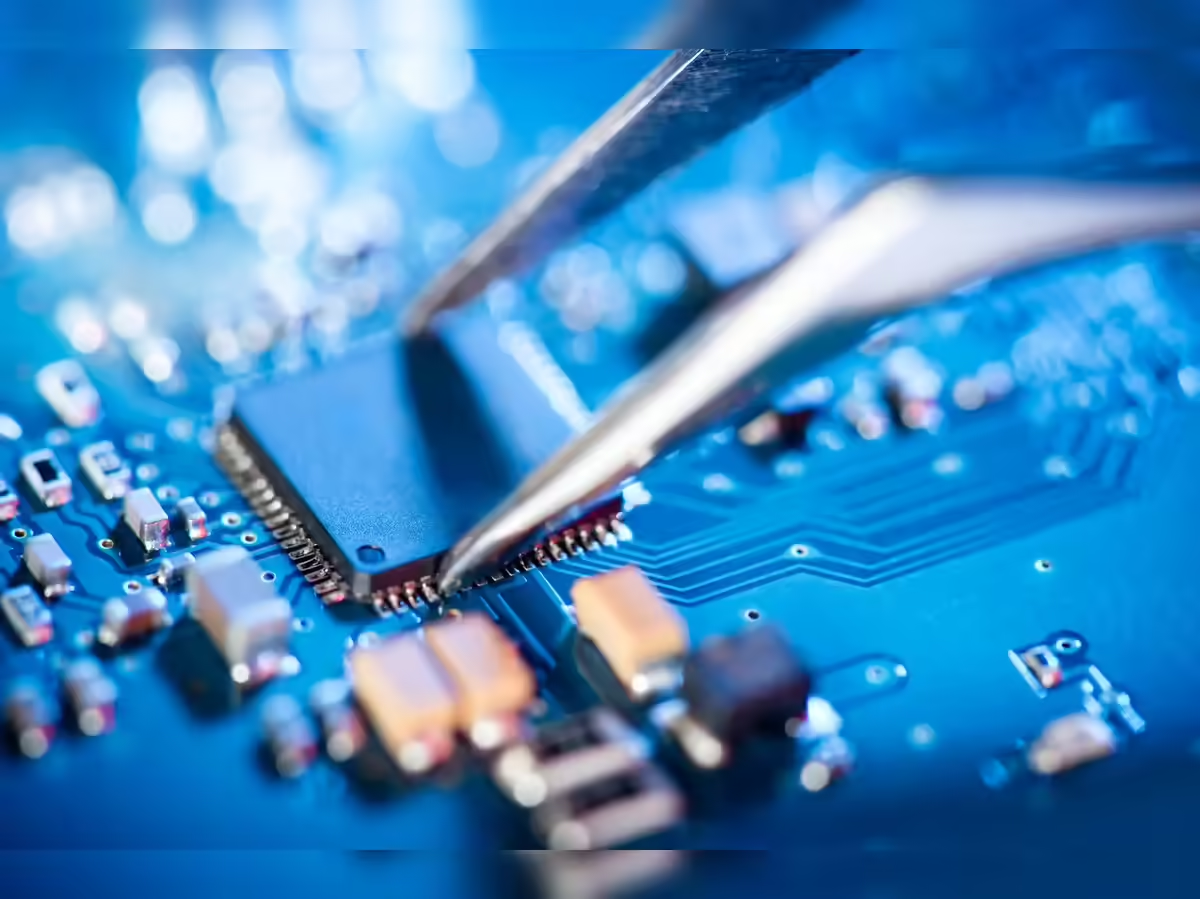
- Etched raised $300 million in Series C funding at a $10.3 billion valuation, the highest for any Sequoia-led Series C round
- The company focuses on AI inference chips, positioning itself as a challenger to Nvidia's dominance in the space
- Etched recently opened an 80,000 square foot facility near San Jose to scale production as customer demand outpaces supply
Etched, a San Jose-based AI chip startup, closed a $300 million Series C round that values the company at $10.3 billion. Sequoia led the round, calling it the highest valuation the firm has ever attached to a Series C investment. The funding signals serious investor appetite for alternatives to Nvidia's grip on AI silicon.
Andreessen Horowitz, Jane Street, Diffusion, and SK Hynix also participated. SK Hynix's involvement is notable: the South Korean memory giant supplies high-bandwidth memory for AI accelerators, and its investment suggests potential supply chain alignment with Etched down the road.
Why inference chips are the next battleground
Nvidia dominates AI hardware, but most of that dominance sits in training, the compute-heavy process of building models from raw data. Inference, running those trained models to generate answers, predictions, or images, is a different workload. It happens millions of times per day across production systems, and it favors different chip architectures.
Etched bets that purpose-built inference hardware can outperform Nvidia's general-purpose GPUs on cost and latency. The bet has traction: the company says customer demand for its inference systems now outpaces supply, with early evaluations converting into full deployments.
Related coverage on the high costs driving AI infrastructure decisions
Scaling production in San Jose
Etched recently opened an 80,000 square foot facility near its San Jose headquarters. The space handles both production and prototyping, a setup that lets the company iterate on hardware without shuttling designs between distant fabs and engineering teams.
The company now employs about 400 people and is hiring aggressively. That headcount has grown fast: Etched was a small team just two years ago, and the jump to 400 reflects both the capital intensity of chip development and the company's push to deliver product before rivals catch up.
How Etched stacks up against inference competitors
Etched is not alone in chasing inference. Groq, Cerebras, and SambaNova all pitch specialized silicon for running AI models. Each takes a different architectural approach. Here is how the major players compare on recent funding and focus:
| Company | Latest Funding | Valuation | Primary Focus |
|---|---|---|---|
| Etched | $300M Series C | $10.3B | Transformer inference ASICs |
| Groq | $640M Series D | $2.8B | LPU inference accelerators |
| Cerebras | $250M Series F | $4B (2021) | Wafer-scale training & inference |
| SambaNova | $676M Series D | $5.1B (2021) | DataScale systems for enterprise AI |
Etched's valuation stands out. At $10.3 billion, it exceeds peers that have raised more total capital. Investors are paying a premium for Etched's architecture bet and its customer traction.
Another AI funding round reshaping enterprise workflows
The Nvidia question
Nvidia's H100 and upcoming Blackwell chips handle both training and inference. That flexibility is a strength: buyers can run mixed workloads on the same hardware. But it is also a liability. General-purpose silicon leaves performance on the table for inference-only deployments.
Large cloud providers and AI labs are the obvious customers for specialized inference chips. They run models at scale, and even a 20% improvement in latency or cost per query compounds into serious savings. Whether Etched can convert that interest into contracts, and whether it can manufacture at scale, remains the open question.
Logicity's Take
Etched's valuation is a bet on one thing: Nvidia's inference moat is thinner than its training moat. If Etched can deliver chips that cut inference costs by 30% or more, hyperscalers will carve out rack space for them regardless of Nvidia relationships. The risk is execution. Chip startups have a long history of missing tape-out deadlines and yield targets. For CTOs evaluating inference infrastructure, Etched is worth watching, but not worth locking into until production hardware ships at volume. Keep Groq and Cerebras on the shortlist for comparison.
What this means for enterprise AI buyers
Most enterprises will not buy Etched chips directly. They will rent inference capacity from cloud providers who adopt specialized silicon. The practical question is whether AWS, Google Cloud, or Azure will offer Etched-powered instances alongside Nvidia options.
If they do, expect a pricing war. Inference costs have fallen steadily over the past two years, and purpose-built hardware accelerates that trend. Enterprises running large language model applications, from customer support bots to document analysis, stand to benefit.
Context on the scale of inference demand driving chip investments
Frequently Asked Questions
What does Etched's AI chip do?
Etched builds application-specific integrated circuits (ASICs) optimized for AI inference, the process of running trained models to generate outputs. The company claims its chips outperform general-purpose GPUs on inference workloads.
Who invested in Etched's Series C?
Sequoia led the round with participation from Andreessen Horowitz, Jane Street, Diffusion, and SK Hynix.
How does Etched compare to Nvidia?
Nvidia dominates AI hardware broadly, handling both training and inference. Etched focuses exclusively on inference with specialized chips, betting it can deliver better performance per dollar for that specific workload.
Where is Etched headquartered?
Etched is based in San Jose, California, and recently opened an 80,000 square foot production facility nearby.
Is Etched's $10.3 billion valuation justified?
That depends on whether the company can ship production hardware at scale and win contracts from hyperscalers. The valuation reflects investor confidence in the inference chip market, but execution risk remains high for any chip startup.
Need Help Implementing This?
Evaluating AI infrastructure options for your organization? Logicity can connect you with advisors who specialize in cloud and silicon strategy. Contact us to discuss your inference workload requirements.
Source: Tech-Economic Times / ET
Huma Shazia
Senior AI & Tech Writer
Produced with AI assistance and reviewed by the Logicity editorial team. Learn more in our Editorial Policy.