Key Takeaways
DeepSeek DSpark Explained: 85% Faster LLM Inference
- DSpark uses speculative decoding with a lightweight draft model to achieve 60-85% faster per-user response times
- The framework works with third-party models including Google's Gemma and Alibaba's Qwen, released under MIT license
- Efficiency gains reduce chip requirements per query, a strategic advantage given US export restrictions on advanced GPUs
DeepSeek has released DSpark, an inference optimization framework the company claims boosts per-user response speed by 60 to 85 percent. The technique, called speculative decoding, addresses a long-standing inefficiency in how large language models generate text. It also happens to arrive at a moment when US export controls have made every GPU in China more valuable.
How DSpark speeds up inference
Most LLMs generate text one token at a time. Each token requires a full forward pass through the model, leaving GPUs underutilized while the system waits. DSpark attacks this bottleneck with a two-model approach: a small, fast draft model proposes candidate tokens, and the larger target model verifies them in batches.
The draft model generates small word groups rather than single tokens, increasing throughput. A confidence-based system adjusts verification depth based on compute load, cutting wasted processing when token proposals get rejected. The result, according to DeepSeek's benchmarks, is a significant shift in the throughput-latency tradeoff.
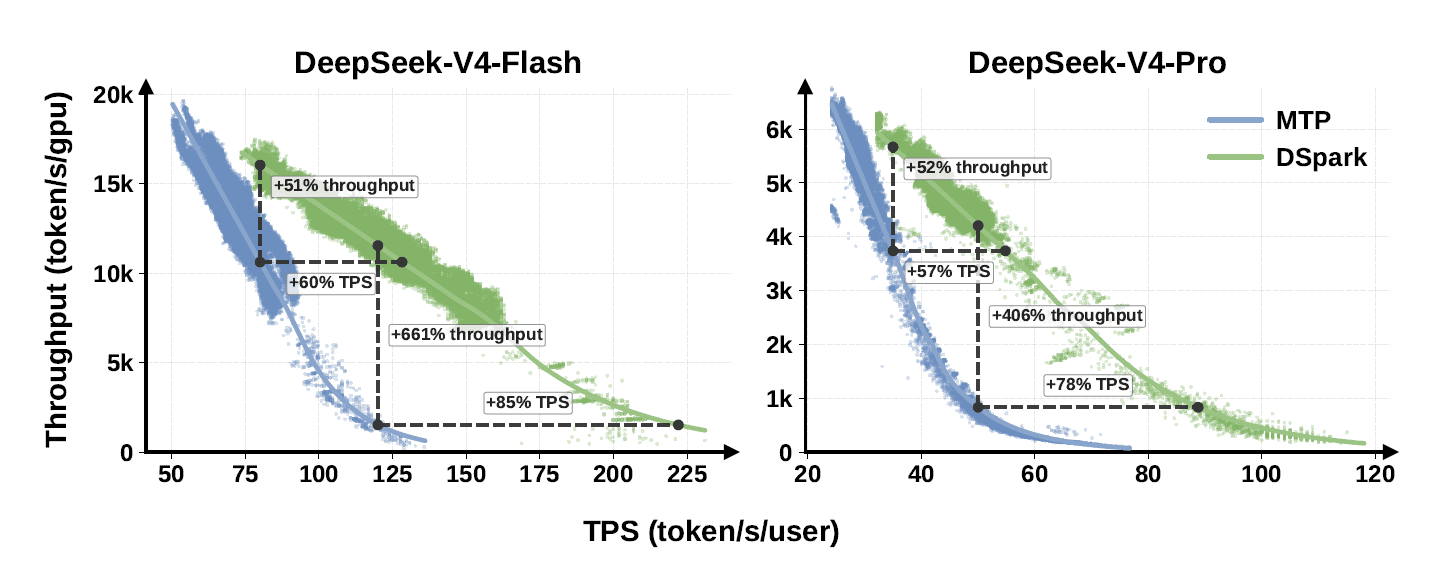
DeepSeek tested DSpark against its own V4-Flash and V4-Pro models under live traffic conditions. The green data points representing DSpark show gains up to 661 percent on throughput metrics compared to the MTP baseline. The company describes this as "shifting the Pareto frontier" of its serving infrastructure.
Works with Gemma and Qwen, not just DeepSeek
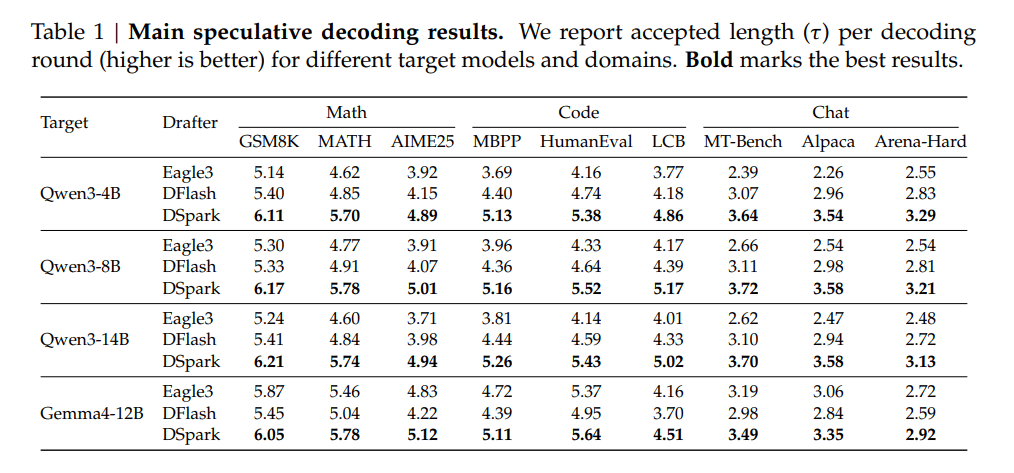
The framework is not locked to DeepSeek's own models. Testing on Google DeepMind's Gemma and Alibaba's Qwen showed consistent improvements across math, code, and chat benchmarks. The DSpark drafter achieved the highest accepted token length per decoding round, outperforming alternatives like Eagle3 and DFlash.
DeepSeek released the DSpark framework and the DeepSeek-V4-Pro model, developed with Peking University, on Hugging Face and GitHub under the MIT license. The permissive licensing means any team can integrate the technique into their own inference stack.
The chip calculus under export controls
Faster inference means fewer chips per query. That arithmetic matters differently depending on where you sit. For Chinese AI labs blocked from importing NVIDIA's H100 and H800 GPUs, efficiency gains translate directly into strategic capacity. The same applies to European organizations building out AI infrastructure with limited access to top-tier silicon.
But efficiency improvements rarely reduce total demand. The Jevons paradox suggests that freed compute gets absorbed by longer contexts, more requests, or new applications. DeepSeek's own framing hints at this: DSpark "enables performance tiers that were previously unattainable." That sounds less like using fewer chips and more like doing things that previously required more chips than you had.
In the short term, the efficiency gains let chip-constrained organizations squeeze more AI performance from existing hardware. That reduces the leverage US export restrictions can exert. In the longer term, it likely accelerates capability development rather than reducing resource consumption.
What this means for production deployments
For teams running inference at scale, an 85 percent speedup in per-user response time is significant. Faster responses improve user experience directly. Lower GPU utilization per request cuts serving costs. The combination makes previously marginal use cases economically viable.
The MIT license removes adoption friction. Teams can evaluate DSpark against their current serving stack without licensing negotiations. The cross-model compatibility means you are not locked into DeepSeek's models to benefit from the optimization.
Logicity's Take
DeepSeek's efficiency focus is not altruism. It is necessity. Blocked from buying the best GPUs, Chinese labs have become unusually good at squeezing performance from constrained hardware. DSpark is the latest example. For product teams evaluating open-weight models, the framework is worth testing against your current inference setup. The 60-85% improvement is a vendor claim, not an independent benchmark. But even half that improvement would meaningfully change serving economics for high-volume applications.
Frequently Asked Questions
What is speculative decoding in LLMs?
Speculative decoding uses a small draft model to propose multiple tokens at once, which a larger model then verifies in batches. This reduces the number of sequential operations needed, improving throughput without changing the output quality.
Does DSpark work with models other than DeepSeek?
Yes. DeepSeek tested DSpark with Google's Gemma and Alibaba's Qwen models, showing consistent improvements. The framework is released under MIT license for general use.
How does DSpark reduce GPU requirements?
By generating and verifying tokens in batches rather than one at a time, DSpark achieves higher GPU utilization per inference request. This means fewer GPU-seconds per response, reducing hardware costs at scale.
Why is inference efficiency strategically important for China?
US export controls restrict Chinese companies from importing advanced NVIDIA GPUs. Efficiency improvements let Chinese labs achieve competitive AI performance with fewer high-end chips, partially offsetting the hardware gap.
Another approach to reducing AI inference costs through model optimization
Need Help Implementing This?
Evaluating speculative decoding for your inference stack? Logicity's consulting team helps product teams benchmark and deploy open-weight model optimizations. Contact us for a technical assessment.
Source: The Decoder / Matthias Bastian
Manaal Khan
Tech & Innovation Writer
Produced with AI assistance and reviewed by the Logicity editorial team. Learn more in our Editorial Policy.