Commonwealth Fusion Systems raised $1 billion in fresh capital, extending its position as the world's best-funded fusion startup. The company has now raised $4 billion total as it races to prove that commercial fusion power can work.
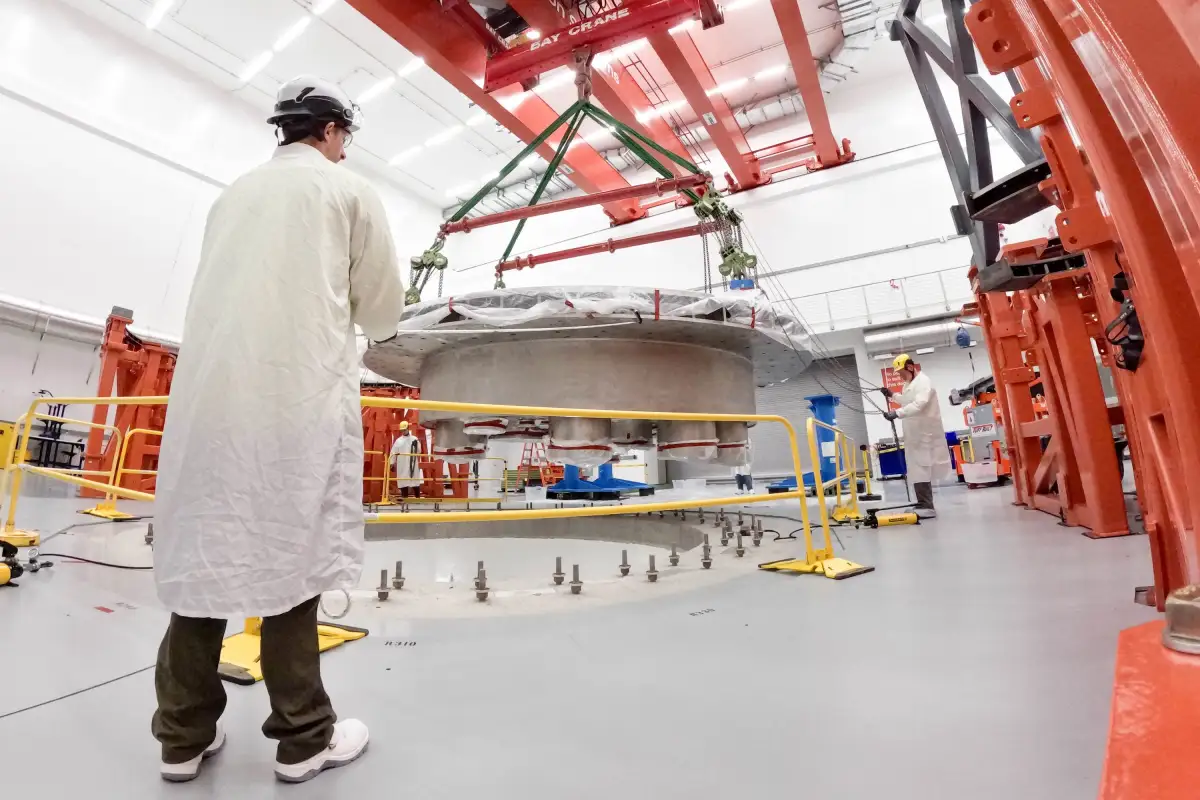
The round, announced July 30, drew from pension funds, sovereign wealth funds, and unnamed industrial partners. CFS declined to identify specific investors. The money arrives as the company's burn rate accelerates: it is building Sparc, its demonstration reactor, while finalizing the design for Arc, its first commercial plant.
What CFS is building
CFS pursues magnetic confinement fusion, using powerful magnets to trap plasma hot and dense enough to fuse atomic nuclei. The energy released heats water, spins a turbine, generates electricity. The physics is proven. The engineering at commercial scale is not.
Sparc is the proof-of-concept reactor. CFS expects it to hit scientific breakeven in 2027, the point where fusion reactions release more energy than the reactor consumes to ignite them. Only one device has ever crossed that line: the National Ignition Facility at Lawrence Livermore, using a different approach (laser-driven inertial confinement). If Sparc succeeds, it validates CFS's magnet technology and reactor design.
Arc is the commercial plant planned for Virginia. Former governor Glenn Youngkin described it as a multi-billion-dollar project in 2024. CFS has not disclosed exact costs for either Sparc or Arc.
Who's buying the power
Two major offtake deals anchor Arc's business case. Italian energy company Eni committed to buying more than $1 billion worth of electricity. Google signed for 200 megawatts, half of Arc's planned 400-megawatt output.
These agreements matter because they shift risk. A power plant with no customers is a stranded asset. Pre-signed contracts give CFS leverage with lenders and future investors, and they signal that sophisticated energy buyers believe the reactor will actually work.
The funding trajectory
This is CFS's largest raise since the $1.8 billion round in 2021 that put it on the map. Last August, the company added $863 million from a group that included Nvidia, Google, Khosla Ventures, and Breakthrough Energy Ventures.
CEO Bob Mumgaard has signaled that more capital raises are coming. Building two reactors, one experimental and one commercial, will require sustained spending for years. The $1 billion announced this week buys runway, but Arc alone could cost several billion dollars.
Logicity's Take
CFS's fundraising pace tells us two things. First, institutional money is now comfortable with fusion timelines that stretch past 2030. Pension funds and sovereign wealth are not speculative venture capital. Second, the offtake deals with Eni and Google are doing real work: they convert a science project into an infrastructure play with contracted revenue. The risk now is execution. Sparc hitting breakeven in 2027 is not guaranteed, and any slip will make the next round harder.
What scientific breakeven actually means
Breakeven is a technical milestone, not a commercial one. It proves the physics work. It does not prove the economics. A reactor at breakeven still loses energy when you count the power needed to run the magnets, cooling systems, and control infrastructure. Net electricity gain, the threshold for a real power plant, comes later.
CFS is betting that its high-temperature superconducting magnets, developed with MIT, give it a faster path to that net gain than competitors using older magnet designs. If Sparc performs as modeled, Arc's economics look plausible. If Sparc underperforms, the company will need to explain why Arc will do better.
Another infrastructure-focused funding round in the current market
Need Help Implementing This?
If your organization is tracking the energy transition or evaluating long-term power procurement, Logicity can connect you with analysts and consultants who specialize in next-generation energy infrastructure.
Source: TechCrunch / Tim De Chant
Manaal Khan
Tech & Innovation Writer
Produced with AI assistance and reviewed by the Logicity editorial team. Learn more in our Editorial Policy.