Key Takeaways

- Claude now writes over 80% of Anthropic's production code, with total output including experimental work exceeding 90%
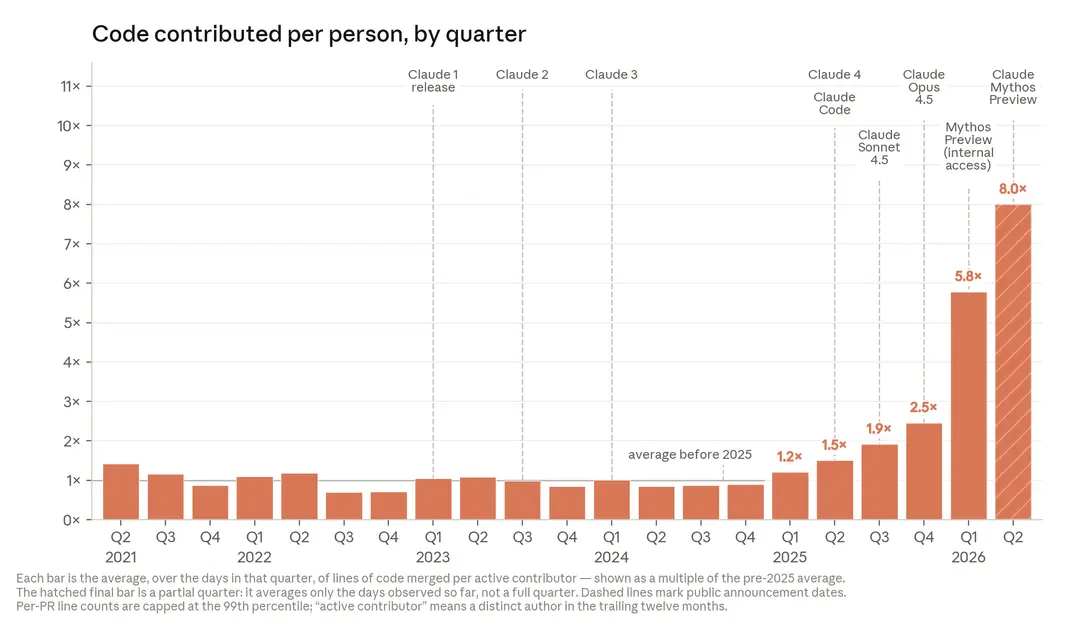
- Engineers ship 8x more code daily than in 2024, though Anthropic estimates real productivity gains are closer to 4x
- Anthropic is pushing for a global, verifiable AI development pause option to address recursive self-improvement risks
Anthropic released internal data on June 5, 2026 showing Claude now authors more than 80% of the company's production code. When you include scripts and experimental work, leadership estimates the total share exceeds 90%. One employee said it's been five months since they last wrote any code themselves.
The shift happened fast. Before Claude Code launched in February 2025, AI-generated code made up a low single-digit percentage of the codebase. Now engineers in Q2 2026 are shipping an average of eight times as much code per day as they did in 2024.

Lines of code up 8x, but real productivity gains are murkier
Anthropic admits the eightfold increase is almost certainly an overstatement of true productivity gains. Lines of code is an imperfect metric. In an internal survey from March 2026 with 130 employees, the median estimate put the output boost from Mythos Preview at 4x.
The company thinks the real number is a bit lower and points to recent METR research showing developers tend to overestimate AI productivity gains. One reason is that more code doesn't always mean better products. Volume can hide complexity, technical debt, or bugs that surface later.
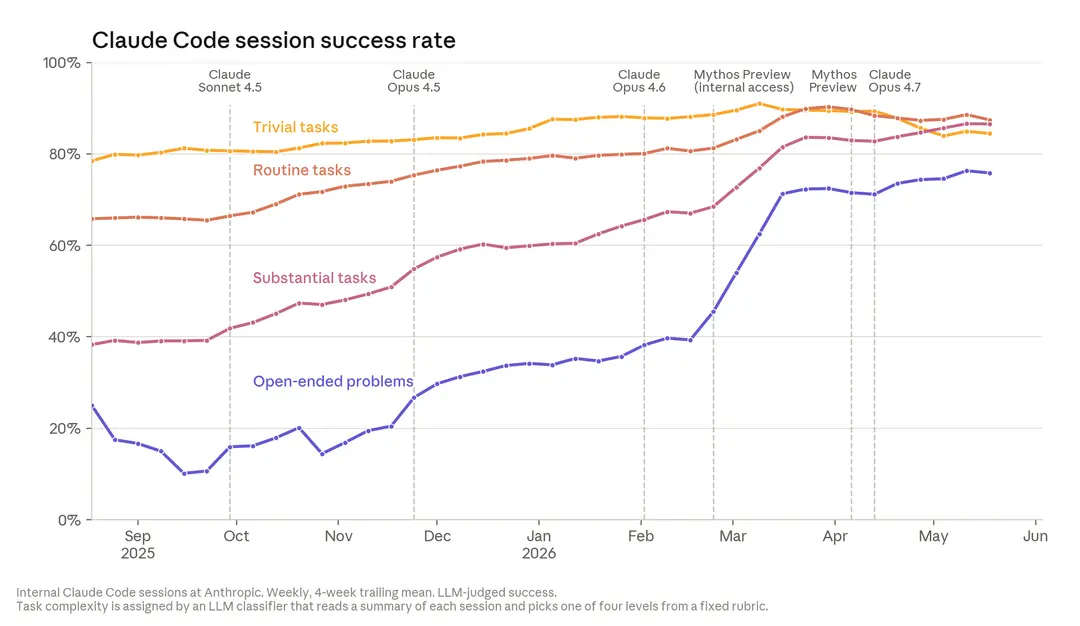
On code quality, Anthropic says Claude-written code was somewhat worse than human-written code in late 2025, is roughly at parity today, and they expect it to be strictly better within the year. An automated Claude reviewer would have caught about a third of the bugs behind past incidents on claude.ai before they shipped.
Beyond coding: Claude is closing in on human-level research judgment
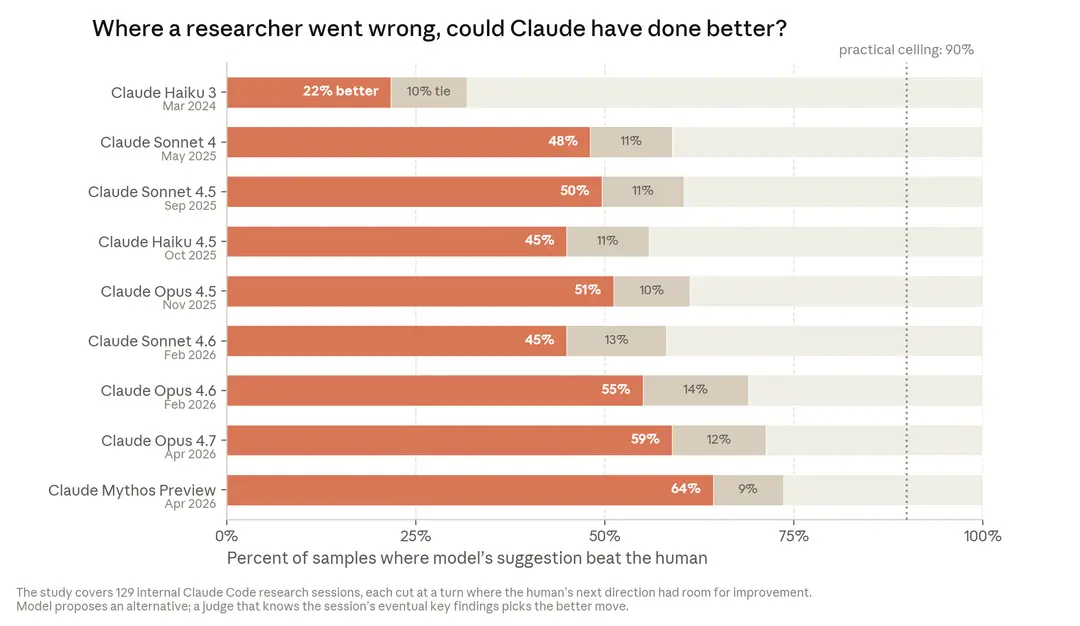
The report also says Claude is improving at research tasks. Anthropic claims the model is closing in on human-level judgment in certain areas, though the company doesn't specify which areas or provide benchmark data.
The implication is that AI is becoming capable not just of writing code to spec, but of making architectural decisions, evaluating trade-offs, and identifying research directions. Marina Favaro, an Anthropic researcher, said the company is shifting from human-centric software engineering to AI-orchestrated development, where the human role is increasingly that of a high-level architect and verifier.
Anthropic wants a global AI pause button
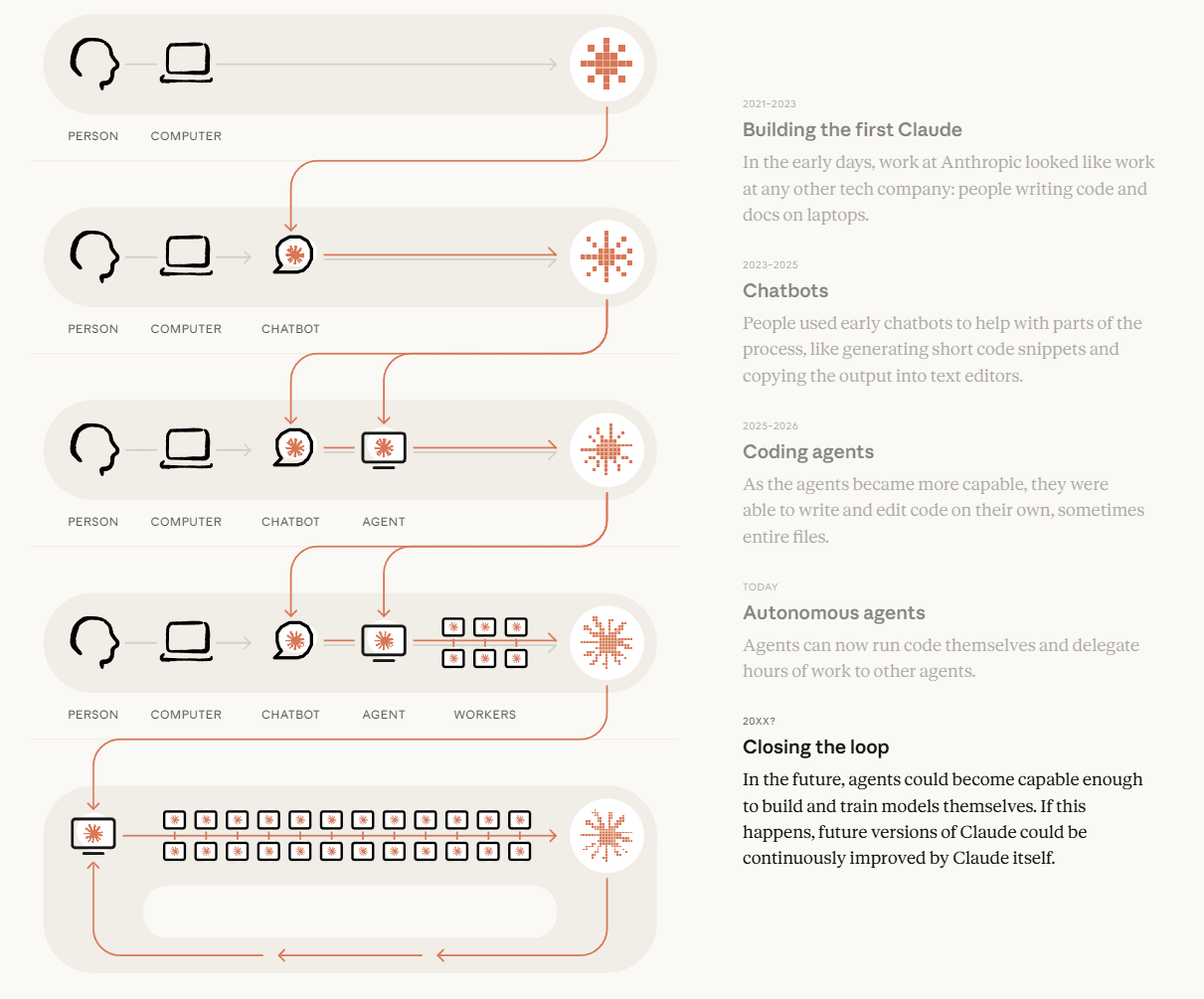
The same report that details Claude's coding prowess includes a warning. Recursive self-improvement, where an AI system fully autonomously designs its own successor, hasn't been achieved yet. But Anthropic says it could come sooner than most institutions are prepared for.
Anthropic is pushing for the option of a verifiable, global development pause. Jack Clark, an Anthropic researcher, said you want the option to be able to take your foot off the gas and put your foot on the brake. A unilateral halt by any single lab wouldn't be enough, the company argues.
The proposal is for a mechanism that's verifiable, meaning inspectors or auditors could confirm a lab has actually paused development, not just said they did. The global part is key because AI labs compete globally. If one company pauses while others sprint, that company falls behind.
Community reactions: celebration, skepticism, and regulatory capture fears
Discussion on Hacker News and Reddit has been polarized. Some developers are celebrating the productivity gains and see this as proof that AI-assisted development is the future. Others are skeptical.
A common criticism is that the pause proposal looks like regulatory capture. Anthropic is preparing for a $1 trillion IPO. If the company can push for rules that freeze development at the current state of the art, that locks in its competitive position and makes it harder for new entrants to catch up.
Speculation intensified after someone found an internal instruction called Dreaming in leaked code. It appears to be a system-level pause mechanism for the AI to review its own work before continuing. Some commenters see this as evidence Anthropic is already experimenting with pause-like controls internally, while others think it's just a quality-check step.
What this means for software development
If Anthropic's data is representative, we're seeing a shift in what software engineers do. Writing code is becoming less of the job. Reviewing code, setting architecture, debugging edge cases, and making product decisions are becoming more of it.
This doesn't mean engineering jobs disappear. It means the nature of the work changes. An engineer who used to write 100 lines of code a day and review 50 might now review 800 lines and write 20. The cognitive load shifts from syntax and boilerplate to correctness and design.
The question is whether companies can capture the productivity gains without creating technical debt that surfaces later. More code merged per day doesn't help if half of it needs to be rewritten in six months.
Logicity's Take
Frequently Asked Questions
Does Claude really write 90% of Anthropic's code?
More than 80% of production code and over 90% including scripts and experimental work, according to Anthropic's internal data released in June 2026. Before Claude Code launched in February 2025, the share was in the low single digits.
How much faster are Anthropic engineers shipping code with Claude?
Engineers are shipping 8x more code daily compared to 2024. Anthropic says this likely overstates true productivity gains, which internal surveys peg closer to 4x after accounting for review time, debugging, and rework.
What is recursive self-improvement in AI?
It's when an AI system autonomously designs its own successor without human oversight. Anthropic says this hasn't been achieved yet, but could arrive sooner than institutions are prepared for.
What is Anthropic's proposed AI pause button?
A verifiable, global mechanism that would let AI labs halt development when needed. Anthropic argues a unilateral pause by one company wouldn't work because labs compete globally, so any pause needs to be coordinated and auditable.
Is Claude code quality as good as human-written code?
Anthropic says Claude code was somewhat worse in late 2025, reached parity with human code in early 2026, and they expect it to be strictly better within the year. Automated Claude reviews would have caught about a third of bugs in past incidents.
Need Help Implementing This?
Source: The Decoder / Matthias Bastian
Manaal Khan
Tech & Innovation Writer
Produced with AI assistance and reviewed by the Logicity editorial team. Learn more in our Editorial Policy.