Key Takeaways
Claude Voice Mode Just Got Serious: Opus, Sonnet and Tools Explained

- Claude voice mode now supports Opus and Sonnet models, not just Haiku
- Users can switch models mid-conversation on mobile, desktop, and web
- Tool integrations let users compose and send emails via voice commands
Anthropic has upgraded Claude's voice mode to run on its more powerful Opus and Sonnet models, expanding beyond the lightweight Haiku model. The update rolls out across mobile, desktop, and web apps, letting users switch between models mid-conversation based on task complexity.
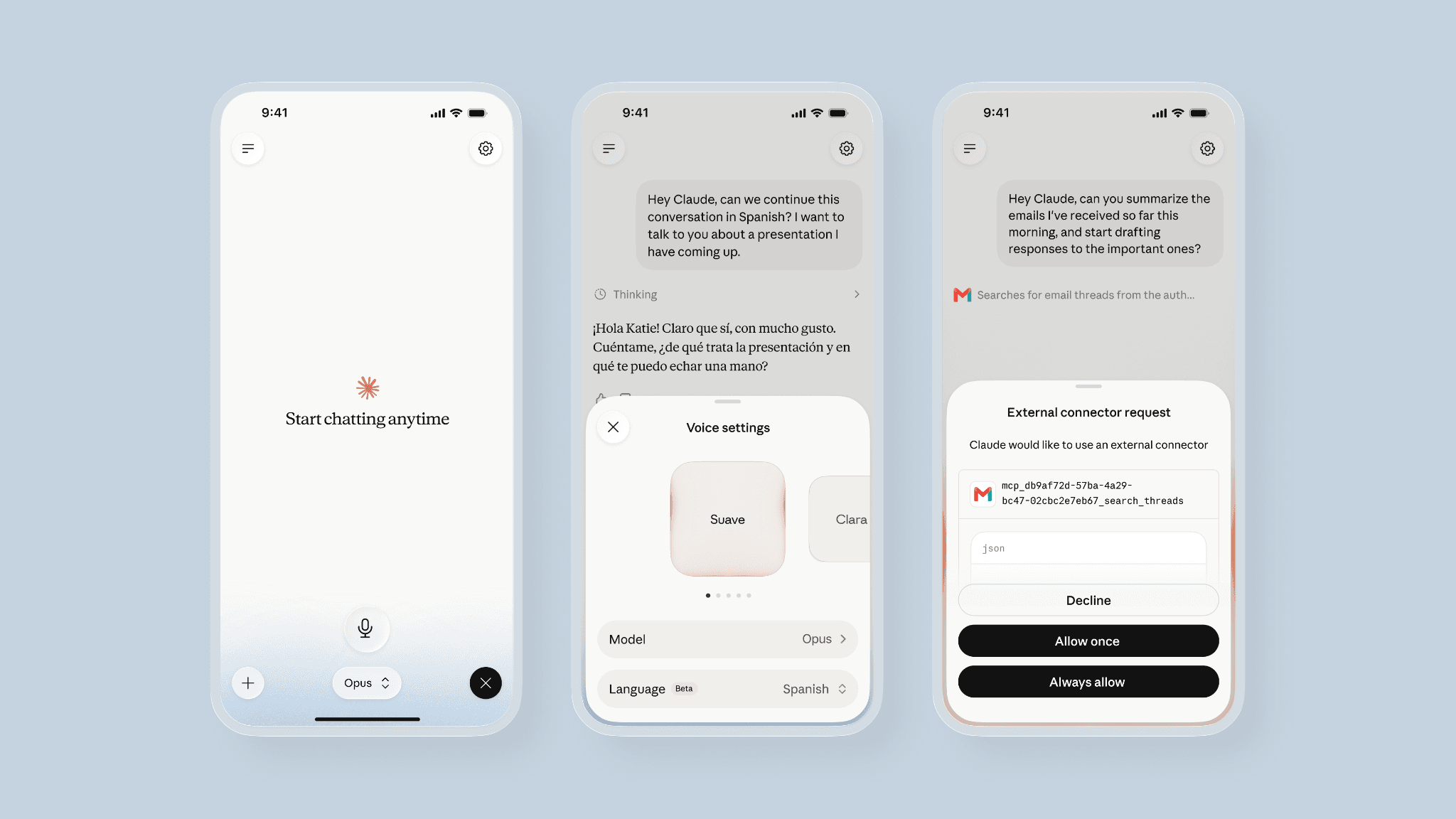
The practical upside: voice interactions now tap into Claude's full reasoning capabilities. A quick calendar check can stay on Haiku, but complex research or analysis can jump to Opus without starting over. This flexibility didn't exist before.
What tool integrations does Claude voice mode support?
Claude's voice mode connects to Gmail, Google Calendar, and Slack. Users can compose, edit, and send emails entirely by voice. The same applies to scheduling. Ask Claude to check your calendar for conflicts, then add a meeting without touching the keyboard.
Disclosure
Some links in this post are affiliate links — Logicity earns a commission if you sign up, at no extra cost to you. We only link products we have used or actively recommend.
Anthropic claims this tool integration is its main differentiator. Neither OpenAI's GPT-Live nor Google's Gemini Live currently let users compose and save emails from audio mode. Both competitors handle voice queries well, but stop short of executing actions in third-party apps.
How does Claude voice compare to GPT-Live and Gemini Live?
The three leading voice assistants take different technical approaches. OpenAI's GPT-Live uses full-duplex audio, meaning it speaks and listens simultaneously. This creates more natural conversations with fewer awkward pauses. Google's Gemini Live uses a similar real-time approach but runs only on smartphones.
Claude uses a turn-based system. It waits for you to finish speaking before responding. In practice, this feels slightly less fluid than OpenAI and Google's implementations. But Claude compensates with deeper tool integration and cross-platform availability.
| Feature | Claude Voice | GPT-Live | Gemini Live |
|---|---|---|---|
| Audio processing | Turn-based | Full-duplex | Full-duplex |
| Platforms | Mobile, desktop, web | Mobile, desktop, web | Mobile only |
| Email composition | Yes (Gmail) | No | No |
| Calendar integration | Yes (Google Calendar) | Limited | Yes |
| Languages supported | 11 | 50+ | 40+ |
| Model switching mid-conversation | Yes | No | No |
Claude supports 11 languages in voice mode. That's a smaller list than GPT-Live's 50+ or Gemini Live's 40+, but covers major languages including English, Spanish, French, German, Japanese, and Mandarin.
Why model switching matters for complex tasks
The ability to switch models mid-conversation solves a common problem. Lightweight models like Haiku respond faster and cost less, but struggle with nuanced reasoning. Opus handles complexity but adds latency and token costs. Letting users toggle between them means voice mode can scale with task difficulty.
Consider a support workflow. A user starts in Haiku to draft a quick reply. The conversation shifts to troubleshooting a technical issue. They switch to Opus for deeper analysis, then back to Sonnet for the final summary. One continuous conversation, three different capability levels.
Understanding infrastructure costs behind AI model deployment
What this means for product teams building with voice AI
Anthropic's approach signals a shift in how voice assistants compete. The race isn't just about conversational fluidity anymore. It's about what users can do without leaving the voice interface. Composing emails, scheduling meetings, and executing tasks directly creates stickier products.
Product teams integrating voice should watch the tool ecosystem closely. Anthropic's current integrations hit common productivity apps. But the pattern suggests more connectors are coming. If your product relies on Zapier or Make for automations, voice-triggered workflows could become a meaningful interface.
Logicity's Take
Anthropic is betting that action beats conversation quality. GPT-Live sounds more natural, but Claude can actually send your email. For AI builders targeting enterprise workflows, this distinction matters. The tool integration pattern also positions Anthropic for agent-based architectures where voice is just one input mode. Teams building voice products should prototype with all three major providers. OpenAI charges $20/month for GPT-Live access via ChatGPT Plus; Claude Pro runs $20/month with full voice mode; Gemini Advanced costs $20/month but limits voice to mobile. The pricing is uniform, so capability becomes the differentiator.
Comparing AI model capabilities across different benchmarks
Frequently asked questions
Frequently Asked Questions
Can I use Claude voice mode on desktop?
Yes. Claude voice mode now works across mobile apps, desktop apps, and web chat. Users can switch between models on any platform.
What languages does Claude voice mode support?
Claude voice mode supports 11 languages including English, Spanish, French, German, Japanese, and Mandarin Chinese.
Can Claude send emails using voice commands?
Yes. With Gmail integration enabled, users can compose, edit, and send emails entirely through voice. This currently works only with Gmail, not other email providers.
Is Claude voice mode available on free accounts?
Voice mode is available to Claude Pro subscribers. The free tier has limited or no access to voice features depending on region.
How does Claude voice mode differ from GPT-Live?
Claude uses turn-based audio while GPT-Live uses full-duplex, meaning GPT-Live can listen and speak simultaneously. However, Claude offers deeper tool integrations like email composition that GPT-Live lacks.
Need Help Implementing This?
Building voice interfaces into your product? Our team covers AI integration patterns and can connect you with implementation partners. Reach out at business@logicity.in.
Source: The Decoder / Gregor Kobsik
Huma Shazia
Senior AI & Tech Writer
Produced with AI assistance and reviewed by the Logicity editorial team. Learn more in our Editorial Policy.