Key Takeaways
Best AI Tools for Sales Prospecting in 2026

- 37% of sales reps now use AI tools for prospecting, making it the highest-adopted category in sales stacks
- Consolidation around fewer, more connected tools is outperforming fragmented multi-tool setups
- CRM integration and AI-powered lead scoring are now table-stakes features, not differentiators
B2B sales prospecting software is consolidating fast. Revenue teams that ran four or five tools to fill the top of funnel are now replacing them with platforms that handle contact data, sequencing, intent signals, and CRM enrichment in one place. According to HubSpot's 2025 State of Sales Report, 37% of sales reps now use AI tools for prospecting, more than any other software category. Another 31% rate AI as the highest-ROI tool in their stack.
Disclosure
Some links in this post are affiliate links — Logicity earns a commission if you sign up, at no extra cost to you. We only link products we have used or actively recommend.
The shift matters for SaaS founders running lean sales teams. Fewer tools means lower costs, cleaner data, and less time lost to context-switching. This guide breaks down the five leading B2B prospecting platforms in 2026, the features that separate useful from noise, and how each fits different team sizes.
What does B2B sales prospecting software actually do?
B2B sales prospecting software automates lead research and outreach before a formal sales cycle begins. These platforms pull from contact databases, company firmographic data, and behavioral signals to surface leads matching your ideal customer profile. SDRs, account executives, and RevOps teams use them to cut manual research time, maintain cleaner pipeline data, and prioritize outreach based on fit and intent.
The category has fragmented badly over the past five years. One tool for verified emails, another for phone numbers, a third for sequencing, something else for LinkedIn automation. The overlap compounds costs and fractures your data across systems that rarely talk to each other. The best 2026 platforms collapse this stack.
Which features matter in 2026?
Six capabilities separate the useful tools from the also-rans: contact data accuracy, CRM integration, AI-powered lead scoring, multi-channel outreach automation, intent data, and reporting analytics.
- Contact and company data accuracy: Verified business emails, direct dials, job titles, headcount, and tech stack. Outdated data means bounced emails and wasted dials.
- CRM integration: Bidirectional sync with platforms like HubSpot, Salesforce, or Pipedrive. Without it, prospecting data sits in a silo.
- AI-powered lead scoring: Automated ranking based on firmographic fit, behavioral signals, and historical deal data. Replaces gut feel with pattern recognition.
- Multi-channel sequencing: Coordinated outreach across email, phone, and LinkedIn from one interface. Cuts tab-switching and manual follow-up.
- Intent data: Signals showing which accounts are actively researching solutions like yours.
- Reporting and analytics: Pipeline attribution, rep activity, and conversion rates at each stage.
For sales leaders evaluating options, the feature set matters more than the brand name. A tool with excellent data but no CRM sync creates as many problems as it solves.
How do the top 5 B2B prospecting tools compare?
The five platforms dominating enterprise and mid-market prospecting in 2026 are HubSpot Sales Hub, LinkedIn Sales Navigator, Outreach, Salesloft, and Apollo.io. Each excels in different contexts.
| Tool | Best For | Key Strength | Starting Price | CRM Integration |
|---|---|---|---|---|
| HubSpot Sales Hub | SMB to mid-market | Native CRM + AI prospecting agent | Free tier, paid from $15/user/mo | Native |
| LinkedIn Sales Navigator | Account-based selling | Real-time LinkedIn data and InMail | $99/user/mo | Salesforce, HubSpot, MS Dynamics |
| Outreach | High-volume SDR teams | Sequence automation and analytics | $100+/user/mo (annual) | Salesforce, HubSpot |
| Salesloft | Enterprise cadence management | Conversation intelligence | $125+/user/mo (annual) | Salesforce, HubSpot |
| Apollo.io | Startups and lean teams | Large contact database + free tier | Free tier, paid from $49/user/mo | HubSpot, Salesforce, Pipedrive |
HubSpot Sales Hub: Native CRM with AI prospecting built in
HubSpot's prospecting workspace now includes an AI agent that automates lead research, suggests next actions, and runs sequences without leaving the CRM. The advantage is obvious: no data sync issues, no separate subscription, no learning a second interface. For teams already on HubSpot's free CRM, upgrading to Sales Hub keeps the stack tight.
The platform handles contact enrichment, email sequencing, call tracking, and meeting scheduling. Reporting ties prospecting activity directly to closed revenue. The downside: if you're locked into Salesforce or another CRM, the native integration advantage disappears.
LinkedIn Sales Navigator: Best for account-based selling
Sales Navigator remains the gold standard for finding decision-makers at named accounts. Real-time LinkedIn data, advanced search filters, and InMail access make it indispensable for AEs running strategic outreach. The platform's lead recommendations surface contacts you'd miss with manual research.
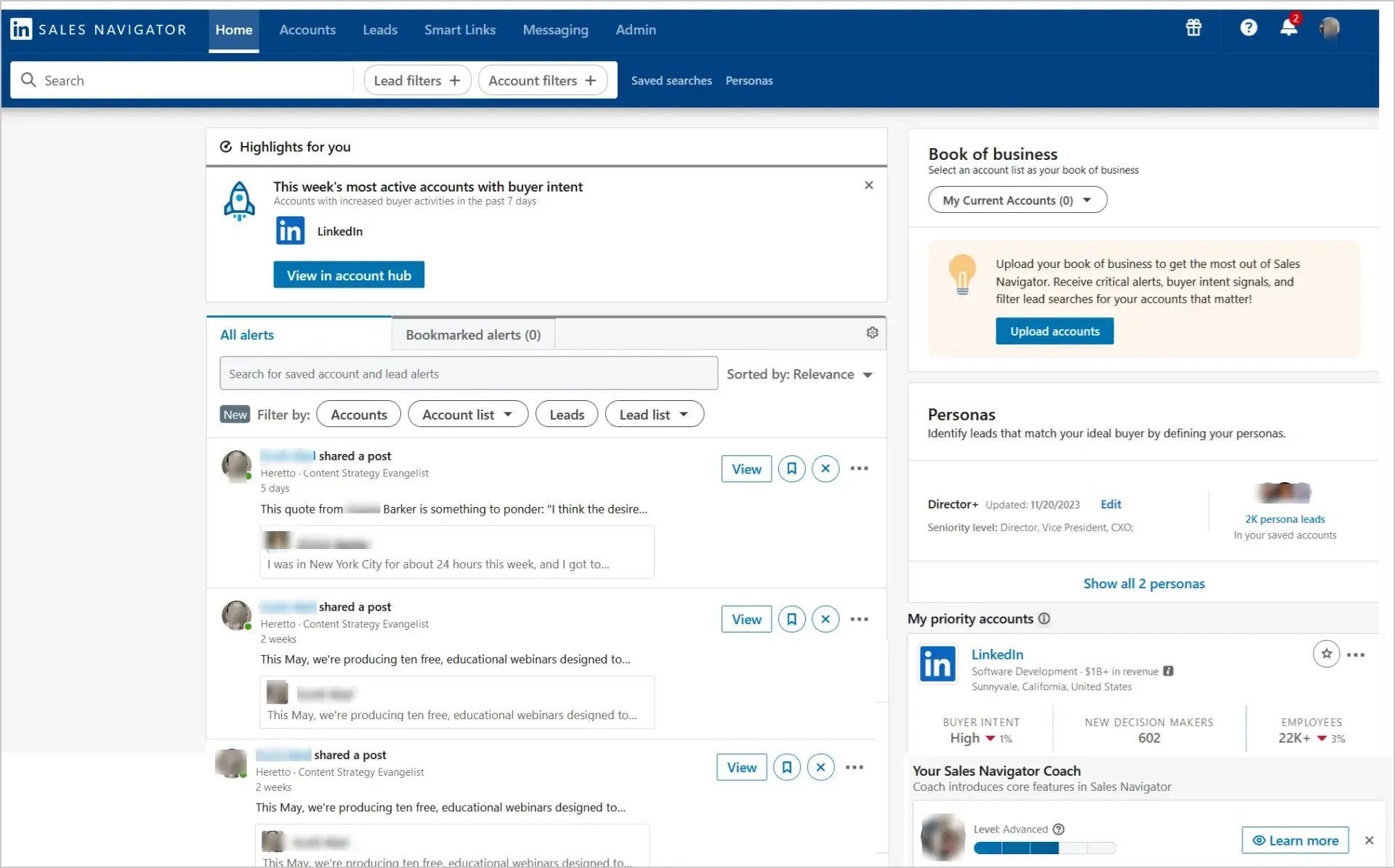
The limitation: Sales Navigator is not a sequencing tool. You'll need to export leads into a separate platform for email automation. Teams often pair it with Outreach or Apollo for multi-channel cadences. At $99/user/month, it's expensive as a standalone but cost-effective when used for high-value accounts.
Outreach: Built for high-volume SDR teams
Outreach dominates in sales orgs running large SDR teams with aggressive outbound targets. The platform's sequencing engine handles thousands of prospects across email, phone, and social touchpoints. Analytics show which sequences convert and where reps drop the ball.
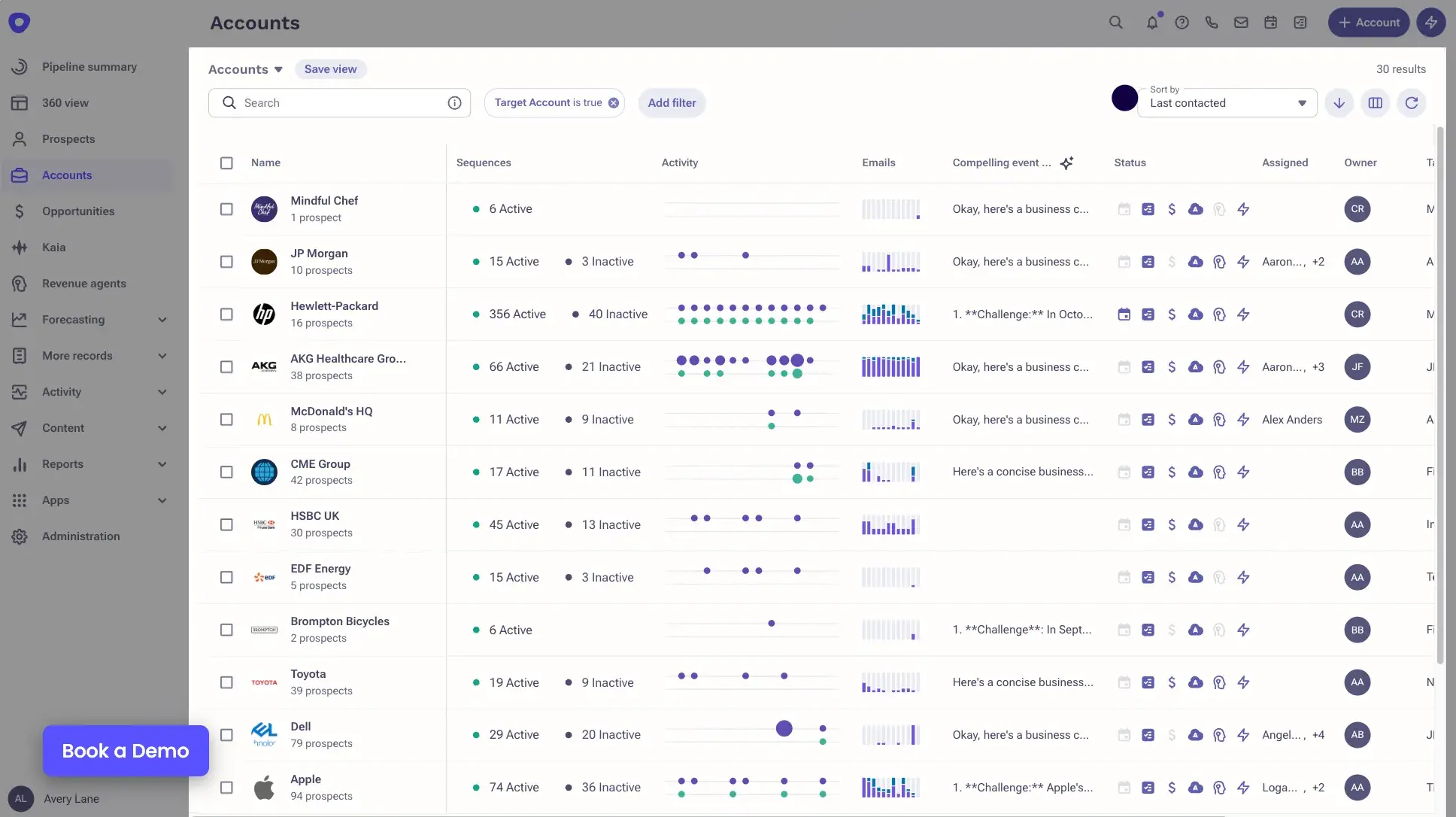
Outreach's complexity is both a strength and a weakness. Setup takes time. The learning curve is steep. Pricing starts north of $100/user/month on annual contracts, putting it out of reach for early-stage startups. But for mid-market and enterprise teams, the productivity gains justify the cost.
Salesloft: Enterprise cadence and conversation intelligence
Salesloft competes directly with Outreach and wins on conversation intelligence. The platform records, transcribes, and analyzes sales calls to surface coaching opportunities. Cadence management is equally strong, with branching logic and A/B testing baked in.
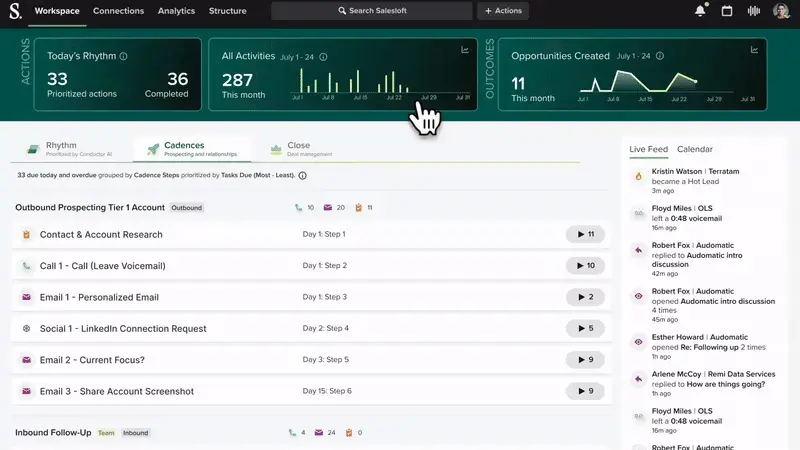
Pricing is enterprise-grade, typically $125+/user/month on annual contracts. The platform integrates deeply with Salesforce and HubSpot but requires serious onboarding. Best for orgs with dedicated RevOps support.
Apollo.io: Best value for startups and lean teams
Apollo combines a massive contact database with sequencing, dialer, and CRM sync in one platform. The free tier is genuinely useful, offering 10,000 email credits per month and basic sequences. Paid plans start at $49/user/month, making it the most accessible option for bootstrapped startups.
Data quality is the trade-off. Apollo's database is large but not always accurate. Bounce rates run higher than dedicated data vendors like ZoomInfo. For teams that can tolerate some data cleanup, the all-in-one approach and low price point outweigh the friction.
Understanding infrastructure costs helps SaaS founders budget for scaling their sales stack
How should prospecting software integrate with your CRM?
Bidirectional sync is non-negotiable. Your prospecting tool should push contact records, activity data, and engagement signals into your CRM automatically. It should also pull existing contact data back so reps never duplicate outreach to current customers.
The tightest integrations are native. HubSpot's prospecting tools live inside the CRM. Outreach and Salesloft offer deep Salesforce integrations that approach native behavior. Apollo syncs well with most CRMs but requires more configuration.
Without clean integration, prospecting data sits in a separate silo. Sales operations can't track which prospecting activities convert to qualified opportunities. Attribution breaks. Data hygiene decays.
Logicity's Take
For SaaS founders running teams under 20 reps, Apollo.io or HubSpot Sales Hub offers the best value. Apollo's free tier lets you validate outbound before committing budget. HubSpot's native CRM eliminates integration headaches. Outreach and Salesloft make sense once you have dedicated RevOps and are scaling past 50 outbound calls per day per rep. LinkedIn Sales Navigator is worth the premium only if you're running named-account ABM plays where InMail access moves deals.
AI automation trends in sales prospecting mirror what's happening in customer support
Frequently asked questions about B2B prospecting tools
Frequently Asked Questions
What is the difference between prospecting software and a CRM?
CRMs manage existing relationships and deal pipelines. Prospecting software finds and engages potential customers before they enter the pipeline. Some platforms like HubSpot combine both functions.
Is AI prospecting actually useful or just hype?
Useful when implemented well. AI lead scoring surfaces high-intent accounts that reps would otherwise miss. AI-written email drafts save time on first-touch personalization. The ROI depends on data quality feeding the models.
Which prospecting tool has the best data accuracy?
LinkedIn Sales Navigator has the most reliable contact data because it's sourced directly from user profiles. ZoomInfo leads among dedicated data vendors. Apollo and HubSpot have broader databases but higher bounce rates.
How much should a startup budget for prospecting software?
Early-stage teams can start free with Apollo or HubSpot's free CRM. Budget $50-100/user/month once you're ready to scale outbound. Enterprise platforms like Outreach and Salesloft run $100-150+/user/month.
Can I run prospecting without integrating with my CRM?
You can, but you shouldn't. Without CRM integration, prospect data stays siloed, attribution breaks, and reps risk contacting existing customers. Bidirectional sync is essential for clean operations.
Need Help Implementing This?
Choosing the right prospecting stack depends on your team size, CRM, and outbound volume. If you're evaluating tools and want a second opinion on fit, reach out to the Logicity team for a free 15-minute stack review.
Source: Sales
Huma Shazia
Senior AI & Tech Writer
Produced with AI assistance and reviewed by the Logicity editorial team. Learn more in our Editorial Policy.