Key Takeaways
Claude Opus vs Sonnet vs Haiku - Which One for Sales? (I Tested All 3)
- Claude voice mode now supports all three model tiers: Opus, Sonnet, and Haiku
- Users can connect voice mode to Gmail, Google Calendar, Slack, Canva, and Notion
- Free users are limited to Haiku with one connected app
Anthropic announced Thursday that Claude voice mode now supports all three of the company's model tiers, letting users choose between Opus, Sonnet, and Haiku depending on the complexity of their task. The update also adds integrations with Gmail, Google Calendar, Slack, Canva, and Notion, a capability OpenAI's voice mode still lacks.
What changed in Claude voice mode?
When Anthropic launched Claude voice mode last year, it ran exclusively on Haiku, the company's fastest but least capable model. That made sense for quick back-and-forth, but it limited the kind of work users could actually accomplish through voice.
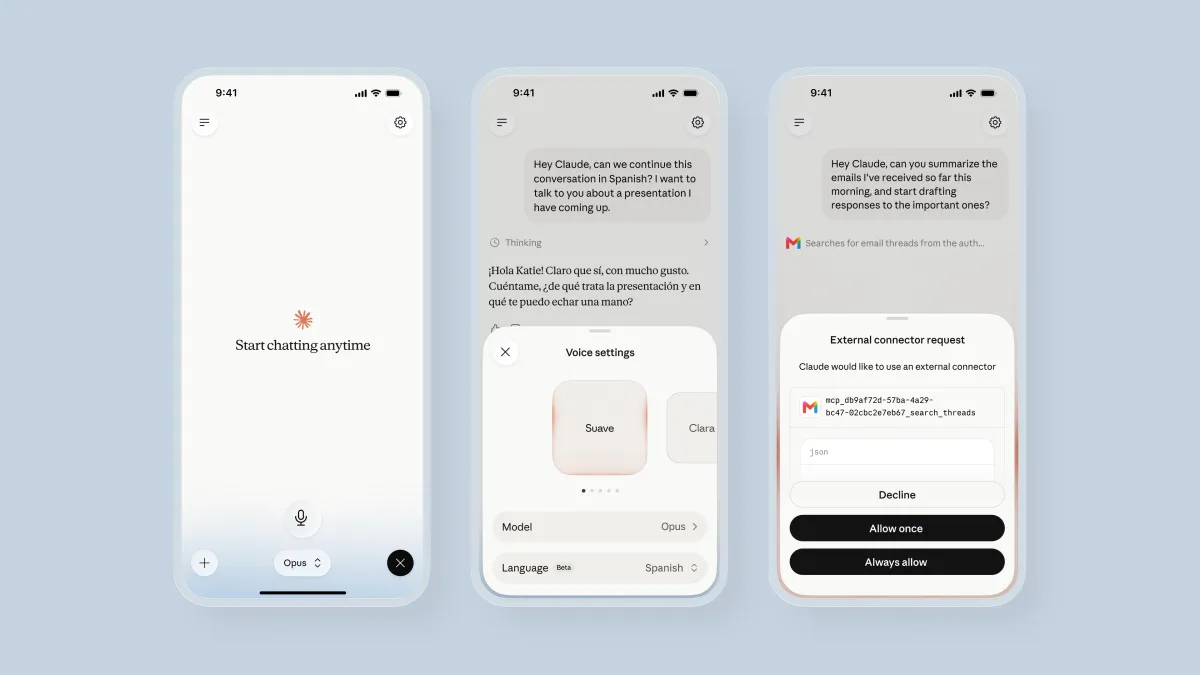
The new update changes the default behavior. Voice mode now picks the last model a user selected in text chat and uses its fastest version automatically. So if you've been working with Sonnet in the browser, voice mode will default to Sonnet too.
Anthropic says the upgrade makes voice mode viable for longer conversations. The company specifically mentions three use cases: getting feedback on communication style, practicing a client pitch, and brainstorming product market research. All of these require the model to hold context across an extended dialogue, something Haiku struggled with.
Tool integrations set Claude apart from ChatGPT
The bigger news is the tool integration. Claude voice mode can now connect to Gmail, Google Calendar, Slack, Canva, and Notion. Users can ask Claude to update a meeting slot, draft an email, or create a document without leaving the voice interface.
Disclosure
Some links in this post are affiliate links — Logicity earns a commission if you sign up, at no extra cost to you. We only link products we have used or actively recommend.
This is a meaningful gap between Claude and ChatGPT. OpenAI recently updated ChatGPT's voice mode with improved conversational style and better interruption handling, but it still can't trigger actions in external apps. You can talk to ChatGPT, but you can't tell it to reschedule your 2 PM call.
For teams already using productivity tools like Asana, ClickUp, or Monday.com, the question becomes whether Anthropic will expand integrations beyond the current five. The list is narrow right now, but it establishes a template for voice-to-action workflows.
OpenAI's parallel push into specialized voice applications
Multilingual support and free tier limits
Anthropic added multilingual support to voice mode in beta earlier this year. Users can now speak in English, French, German, Hindi, Indonesian, Italian, Japanese, Korean, Brazilian Portuguese, and Spanish (both Latin American and Spain variants). One catch: you have to manually specify the language. There's no auto-detection yet.
Free users get access to the beta, but with restrictions. They're limited to the Haiku model and can only connect one app. Paid subscribers get full access to Opus and Sonnet, plus multiple app integrations.
| Feature | Free Tier | Paid Tier |
|---|---|---|
| Model access | Haiku only | Opus, Sonnet, Haiku |
| Connected apps | 1 app | Multiple apps |
| Multilingual support | Yes (manual selection) | Yes (manual selection) |
| Voice mode availability | Beta | Beta |
No changes to the voice model itself
Anthropic didn't update the underlying voice model with this release. The company hasn't disclosed what voice stack Claude uses. That matters because OpenAI's recent update focused specifically on conversational improvements: better interruption handling, more natural turn-taking, reduced latency.
Claude's update prioritizes capability over conversational polish. You can do more with it, but the voice interaction itself may feel the same as before. For some users, that tradeoff makes sense. If you want an AI that can actually modify your calendar, you might tolerate less fluid conversation.
More on Anthropic's strategic moves as the company scales
Logicity's Take
This update signals Anthropic's bet that voice AI needs to do things, not just talk about doing things. OpenAI has better voice UX, but Claude can now trigger real actions in Slack, Gmail, and Notion. For teams already deep in the Anthropic ecosystem, this makes voice mode useful instead of novelty. The free tier restriction to Haiku plus one app is aggressive, though. Anthropic clearly wants conversion to paid.
The competitive picture
OpenAI and Anthropic are taking different paths with voice. OpenAI has invested heavily in making conversation feel natural. Anthropic is investing in making conversation productive. Both approaches have merit, but they serve different users.
Meanwhile, Google's Gemini remains a wildcard. The company has been quiet on voice mode capabilities while focusing on model scale. Whether Google prioritizes conversational quality or tool integration when it moves will shape the competitive landscape.
Google's competing AI strategy and roadmap
Frequently Asked Questions
Which Claude models work with voice mode now?
Claude voice mode now supports Opus, Sonnet, and Haiku. Free users are restricted to Haiku only.
Can Claude voice mode connect to other apps?
Yes. The update adds integrations with Gmail, Google Calendar, Slack, Canva, and Notion. Free users can connect one app; paid users can connect multiple.
What languages does Claude voice mode support?
English, French, German, Hindi, Indonesian, Italian, Japanese, Korean, Brazilian Portuguese, and Spanish. Users must manually specify the language.
Did Anthropic improve Claude's voice quality?
No. The underlying voice model remains unchanged. This update focused on model selection and tool integrations rather than conversational improvements.
Is Claude voice mode available to free users?
Yes, but with limits. Free users can only use the Haiku model and connect one app.
Need Help Implementing This?
If you're evaluating AI voice assistants for your team or building voice-enabled workflows, Logicity can help you assess whether Claude, ChatGPT, or another solution fits your stack. Contact us for a consultation.
Source: TechCrunch / Ivan Mehta
Manaal Khan
Tech & Innovation Writer
Produced with AI assistance and reviewed by the Logicity editorial team. Learn more in our Editorial Policy.