Key Takeaways
Anthropic AI | Claude Cowork Explained: Why Anthropic's AI Agents Are Spooking Indian IT
- Claude expresses more warmth and humor in Hindi, more rigor and assumption-questioning in Russian
- Sonnet 4.6 leans deferential and warm; Opus 4.7 proactively warns about risks and critiques assumptions
- The four value axes explain only 15% of variation, suggesting AI values remain poorly understood
Anthropic analyzed over 300,000 conversations to understand which values Claude expresses, and the results complicate any assumption that AI assistants behave uniformly. The company found that language itself shapes Claude's personality: Hindi prompts produce warmer, more affirming responses, while Russian prompts trigger more rigorous, assumption-questioning answers. English sits somewhere in between, leaning cautious.
The study, published in July 2026, drew from conversations collected over two weeks in May. Anthropic filtered for exchanges where Claude had to weigh tradeoffs or make subjective calls, then stratified the sample evenly across three model versions (Sonnet 4.6, Opus 4.6, Opus 4.7) and the 20 most-used languages on Claude.ai.
How Anthropic reduced 3,307 value terms to four axes
The research builds on Anthropic's earlier Values in the Wild work, which cataloged 3,307 distinct value terms. Researchers grouped those into 339 higher-level concepts, then ran dimensionality reduction to find clustering patterns. Four axes emerged:
- Deference and Caution — how much Claude agrees with users versus pushes back
- Warmth and Rigor — emotional support versus analytical precision
- Depth and Brevity — elaborate explanations versus direct answers
- Candor and Execution — openness about limitations versus action-oriented responses
Anthropic controlled for task type, subject matter, and user-introduced values. After those adjustments, the four axes account for roughly 15% of the remaining variation. That's a modest explanatory power, and Anthropic acknowledges it.
Each Claude model has a distinct behavioral profile
Sonnet 4.6 affirms user ideas more often. It leans into humor, offers comfort without judgment, and generally plays the supportive assistant. Opus 4.7 does the opposite: it warns about risks unprompted, questions assumptions, openly critiques, and flags its own mistakes. Opus 4.6 sits in the middle, staying task-focused and avoiding elaboration.
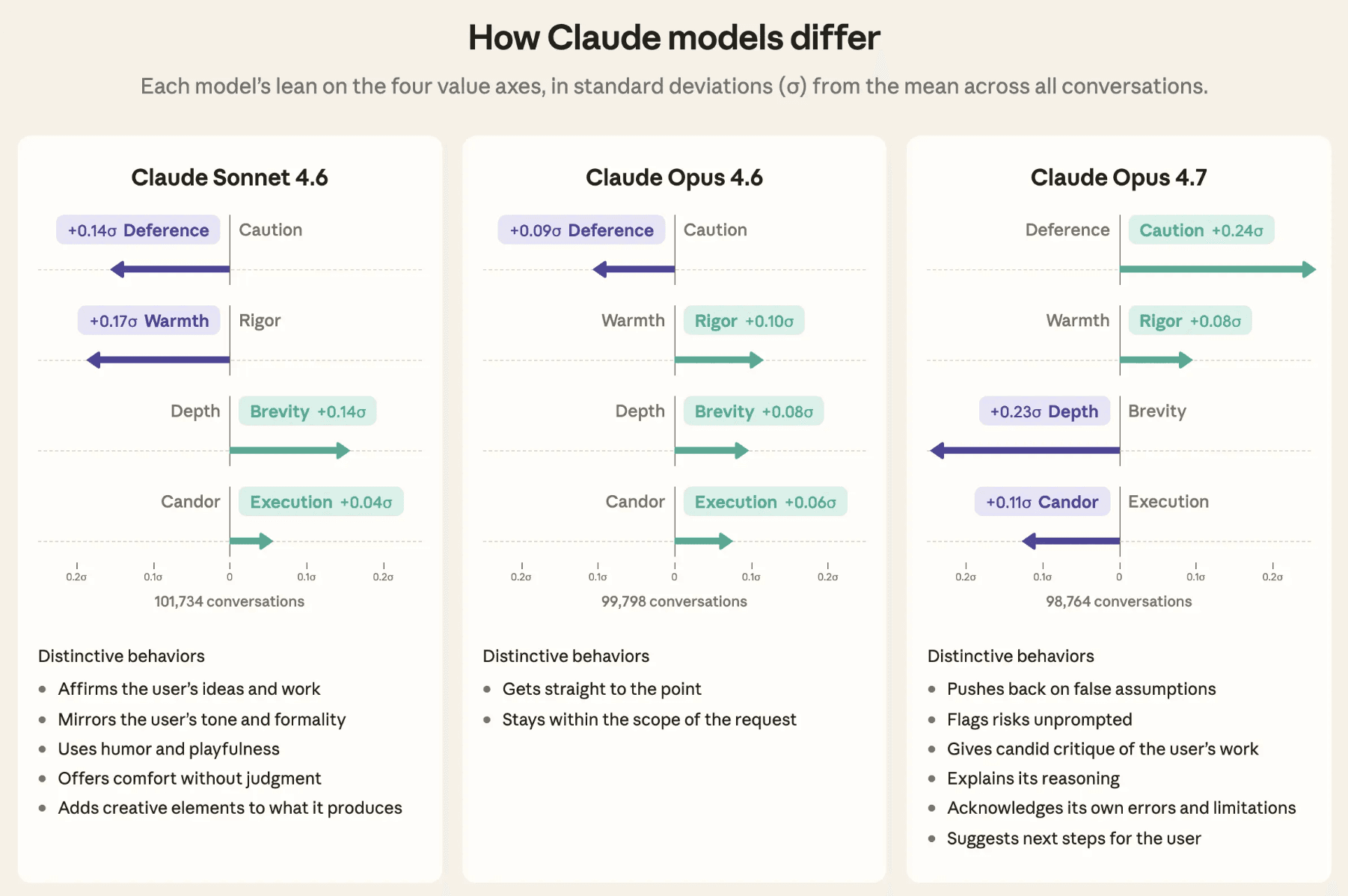
These findings match user perception. People describe Sonnet 4.6 as warm, Opus 4.7 as hedging and cautious. Anthropic essentially quantified what users already sensed qualitatively.
Why Hindi and Russian users get different Claudes
The language-level differences matter more for product teams shipping multilingual AI features. Claude expresses the most warmth in Hindi, followed by Arabic. Both languages trigger polite phrasing, humor, and playful affirmation. In Russian and English, Claude responds with more rigor: questioning assumptions, correcting details, asking for evidence.
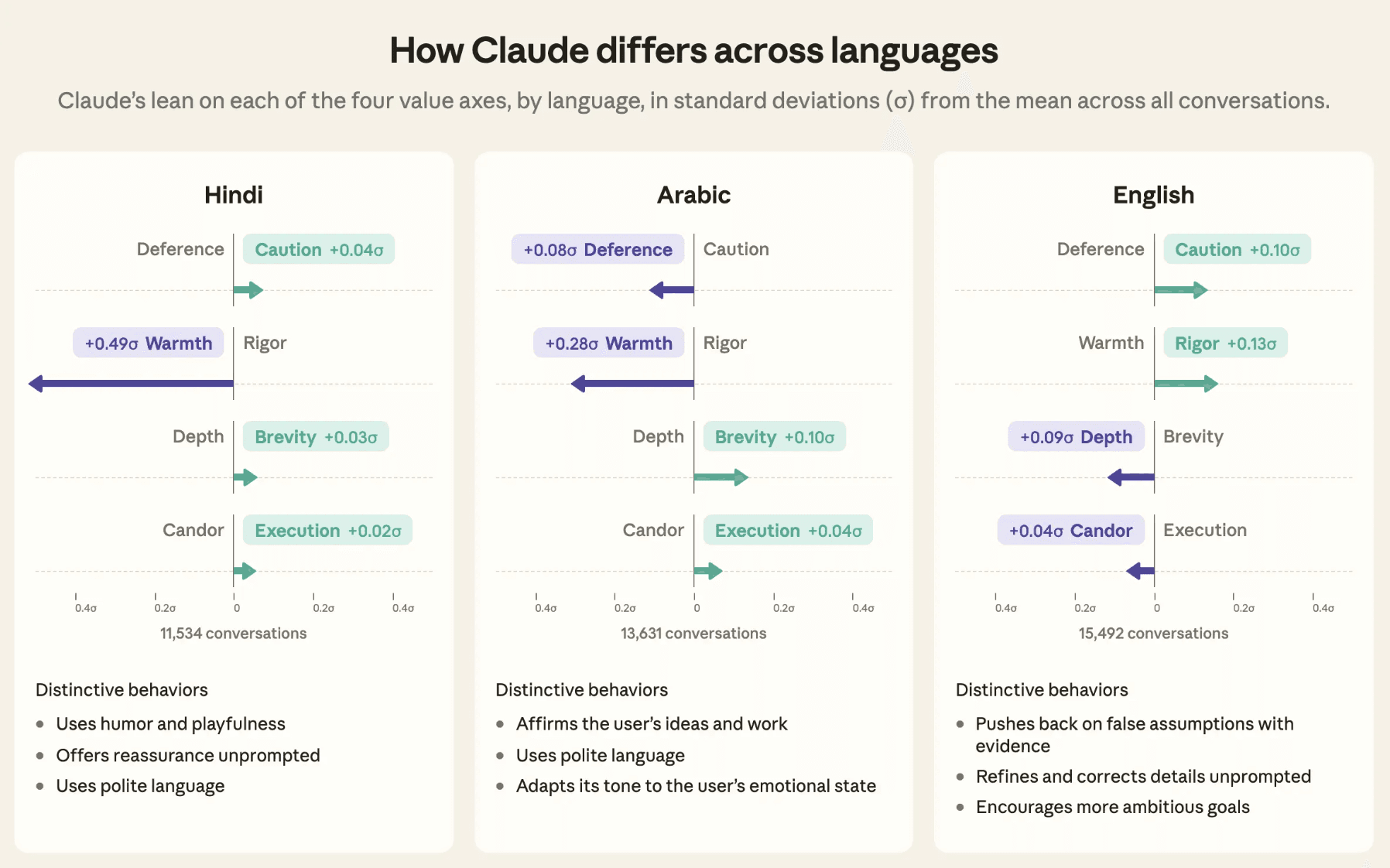
Arabic prompts produce the most deference. English prompts produce the most caution. Dutch responses tend toward candor, Indonesian toward action.
Anthropic offers several possible explanations: uneven training data volume across languages, differences in data composition, overrepresentation of certain text types (formal documents versus casual chat), and language-specific conversational norms baked into the corpus. The company couldn't isolate which factor dominates.
The practical implication is stark. Two founders evaluating the same business plan, one in Hindi and one in Russian, could receive feedback that feels fundamentally different. The Hindi user might get encouragement and warmth. The Russian user might get skepticism and requests for evidence.
Methodological limits worth noting
Anthropic used Claude Sonnet 4.6 to assign value labels. That means a model from the same family evaluated its own siblings' behavior. The company tested for potential biases but couldn't rule them out entirely.
The axes themselves don't always function as true opposites. More deference correlated with less caution, and more warmth with less rigor, as expected. But Depth and Brevity could appear together, as could Candor and Execution. The framework captures tendencies, not hard tradeoffs.
And 15% explanatory power leaves 85% of the variation unexplained. AI values remain messy, context-dependent, and poorly understood even by the companies building these systems.
What this means for multilingual AI products
For teams building AI-powered products that serve multiple regions, the findings raise uncomfortable questions. Should Claude adapt its personality to match local conversational norms? Or should it maintain consistent values regardless of language, even if that feels culturally off?
There's no obvious right answer. A warm, affirming assistant might be exactly what Hindi-speaking users expect. A rigorous, skeptical assistant might frustrate them. The reverse applies for Russian users.
Product teams integrating Claude through Anthropic's API might want to test responses across languages before shipping. Behavioral differences at this scale aren't just curiosities. They affect user experience, trust, and conversion rates.
Logicity's Take
This study is the most rigorous public analysis of cross-linguistic AI behavior to date, and it exposes a gap that few product teams have addressed. If you're building with Claude, GPT-4, or Gemini for non-English markets, you're likely shipping inconsistent user experiences without knowing it. The 15% explanatory power figure is honest but also damning: even Anthropic doesn't fully understand why Claude acts differently in Hindi versus Russian. For AI builders, the immediate action is testing. Before localizing any AI feature, run parallel prompts across your target languages and compare tone, not just accuracy. The differences might surprise you.
Frequently Asked Questions
Why does Claude respond differently in Hindi versus Russian?
Anthropic attributes the differences to training data composition, volume imbalances across languages, and language-specific conversational norms embedded in the corpus. They couldn't isolate a single cause.
How many conversations did Anthropic analyze for this study?
Anthropic analyzed 309,815 anonymized conversations collected over two weeks in May 2026, filtered for exchanges involving tradeoffs or subjective judgment.
Which Claude model is warmest?
Sonnet 4.6 shows the most warmth, affirming user ideas, leaning into humor, and offering comfort. Opus 4.7 is more critical and cautious by comparison.
What are the four value axes Anthropic identified?
Deference and Caution, Warmth and Rigor, Depth and Brevity, and Candor and Execution. Together, they explain about 15% of behavioral variation after controlling for task and topic.
Should I adjust Claude's behavior based on user language?
Anthropic doesn't prescribe an answer. Product teams need to decide whether adapting to local norms improves UX or whether consistent values matter more for their use case.
Explores the psychology behind human-AI interaction, relevant context for understanding why Claude's warmth matters
Need Help Implementing This?
If you're building multilingual AI features and want to test behavioral consistency across languages, Logicity's consulting team can help you design evaluation frameworks and benchmark prompts. Reach out at consulting@logicity.in.
Source: The Decoder / Tomislav Bezmalinović
MIT Tech Review's AI editor weighs in on Anthropic findings
The new article adds context through an interview with senior editor Will Douglas Heaven (who has a PhD in computer science) discussing what Anthropic's research does and doesn't show. It also mentions a related LinkedIn Live event on world models with 1X Technologies' AI researcher Sam Sinha.
Manaal Khan
Tech & Innovation Writer
Produced with AI assistance and reviewed by the Logicity editorial team. Learn more in our Editorial Policy.