Key Takeaways
Claude Code Can Make Screen Recordings Now?

- Claude Cowork's new 'Record a skill' feature captures screen activity, clicks, typing, and voice narration to create reusable automated workflows
- The feature is available now for Claude Pro, Max, and Team plan subscribers through the desktop app
- OpenAI's Codex offers a similar workflow recording feature, signaling a new front in the AI assistant competition
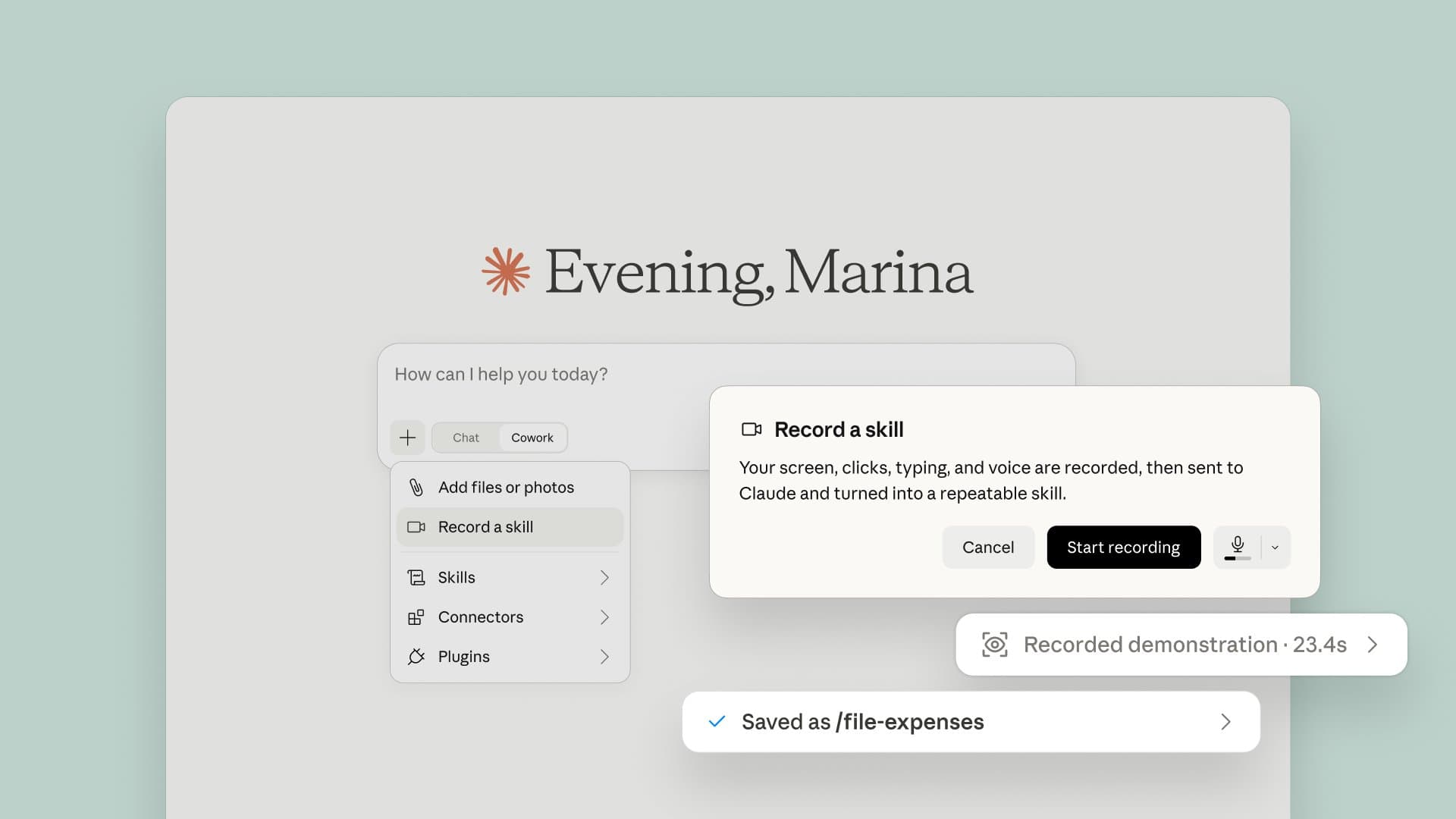
Anthropic launched a 'Record a skill' feature for Claude Cowork that lets users teach the AI assistant new tasks by recording their screen and narrating the steps. The desktop app captures clicks, typing, and voice explanation, then converts the recording into a reusable skill that Claude can replay whenever the same task comes up.
The feature is available now through the '+' menu in Cowork, the workspace section of the Claude desktop app. Users on Pro, Max, and Team plans can access it immediately.
How the skill recording works
The process mirrors how you might train a new colleague. Start a recording, walk through the task on your screen, and explain what you're doing out loud. Claude watches the screen activity, registers where you click, what you type, and listens to your voice-over. When the recording ends, the system compiles everything into a saved skill.
Next time you need that task done, you call up the skill instead of clicking through it yourself. Think expense report formatting, CRM data entry, or repetitive file organization. The voice component matters here. Claude uses your narration to understand intent, not just mimic clicks. If you explain why you're skipping a field or checking a box, the model has context to handle edge cases.
Where this fits in the AI assistant race
OpenAI already offers something similar in Codex, its developer-focused coding agent. Codex can record workflows and replay them as reusable skills, though it leans heavily toward software development tasks. Claude Cowork's version appears aimed at a broader audience: knowledge workers automating admin tasks, not just engineers scripting deployments.
The difference matters for product teams evaluating these tools. Codex excels when the workflow is code-centric. Cowork's pitch is that any screen-based task can become a skill, regardless of whether it involves a terminal.
Traditional robotic process automation (RPA) tools from UiPath, Automation Anywhere, and Microsoft Power Automate have offered macro-style recording for years. But those systems typically require explicit programming of exception handling. The bet Anthropic is making: an LLM that understands your spoken explanation can adapt to variations without brittle if-then rules.
What this means for automation workflows
For teams already using tools like Zapier, Make, or n8n for cross-app automation, Claude Cowork's skill recording fills a different gap. Those platforms connect APIs. Cowork operates at the UI layer, automating tasks inside applications that don't expose APIs or that require human-style navigation.
Disclosure
Some links in this post are affiliate links — Logicity earns a commission if you sign up, at no extra cost to you. We only link products we have used or actively recommend.
The two approaches are complementary. Zapier handles the 'when X happens in Slack, create a row in Airtable' scenario. Cowork handles 'log into this legacy web portal, navigate three menus, download a report, and rename the file.'
There's risk here too. Screen-based automation breaks when UIs change. A button moves, a modal appears, a page redesign ships. Whether Claude Cowork can recover gracefully from those shifts, or just fail like a traditional macro, remains to be seen in production use.
Who should try this first
Operations teams drowning in repetitive admin tasks are the obvious candidates. So are solo founders who spend hours weekly on tasks that don't scale but can't justify hiring an assistant. The voice narration requirement means you need a quiet enough environment to record, and you need to articulate your reasoning clearly. That's a feature, not a bug. Explaining a task out loud often surfaces edge cases you'd otherwise forget.
Enterprise buyers will ask about security. Screen recordings contain sensitive data. Where does Anthropic store them? Who can access saved skills? The company hasn't detailed its data handling for this feature yet.
Logicity's Take
This feature signals where Anthropic sees Claude's competitive edge: not just answering questions, but becoming a genuine productivity layer on your desktop. For AI product teams, the takeaway is clear. Screen-level understanding plus voice context creates a training interface that feels almost natural. The open question is reliability. OpenAI Codex and traditional RPA tools have struggled with UI fragility. If Anthropic has solved that, or even meaningfully improved it, Claude Cowork becomes compelling for any team running repetitive screen-based workflows. Worth testing on low-stakes tasks before handing it your expense reports.
Frequently Asked Questions
Which Claude plans include the Record a Skill feature?
Record a Skill is available to users on Claude Pro, Max, and Team plans. Free tier users don't have access.
Does Claude Cowork work on Mac and Windows?
The Claude desktop app runs on both Mac and Windows. The skill recording feature is available in the Cowork workspace section of the app.
How does Claude Cowork differ from OpenAI Codex workflow recording?
Codex focuses on developer workflows and code-centric tasks. Cowork targets broader knowledge worker automation, capturing any screen-based task with voice narration for context.
Can Claude Cowork replace tools like Zapier or Make?
Not exactly. Zapier and Make connect apps via APIs. Cowork automates at the UI layer, handling tasks inside applications that don't have API integrations. The tools are complementary.
Is the screen recording data stored securely?
Anthropic hasn't published detailed data handling documentation for this feature yet. Enterprise buyers should request specifics on storage, access controls, and retention before using it with sensitive workflows.
Context on the broader AI model race between Anthropic, Google, and OpenAI
Need Help Implementing This?
If you're evaluating Claude Cowork for your team's automation needs, or comparing it against RPA tools and API-based platforms, reach out to the Logicity team. We can help you map workflows and identify where AI-driven automation fits.
Source: The Decoder / Matthias Bastian
Manaal Khan
Tech & Innovation Writer
Produced with AI assistance and reviewed by the Logicity editorial team. Learn more in our Editorial Policy.