Key Takeaways
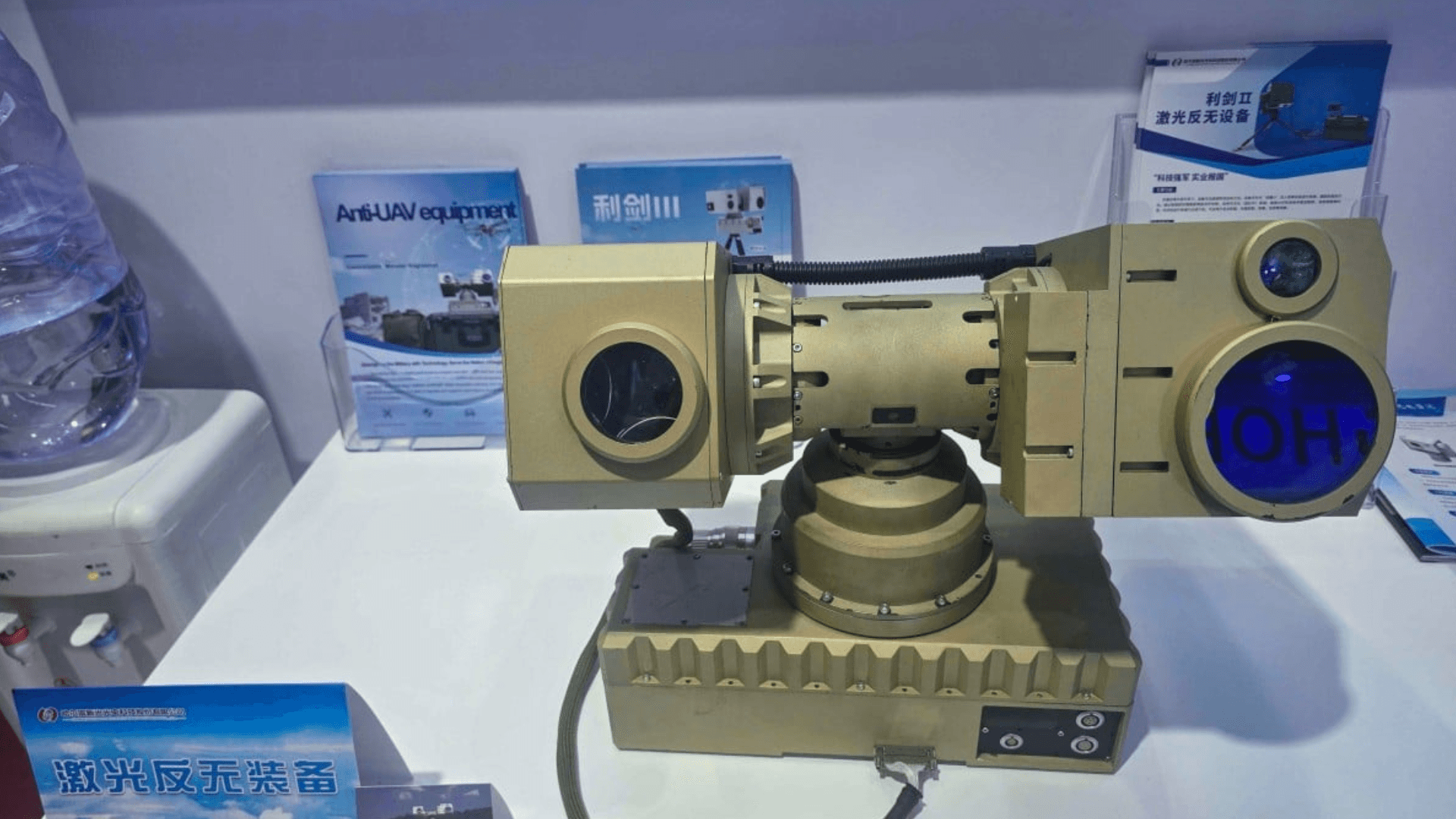
- China's Lijian III anti-drone laser weighs 55 pounds, costs $295,000, and claims to destroy drones at 500 meters in 4 seconds
- The 2kW portable systems use AI for target identification and can be carried by a single soldier
- Manufacturer claims the lasers are already deployed at Chinese military airfields, though specs remain untested by third parties
Chinese defense firm Harbin Xinguang Optic-Electronics Technology showed off two man-portable anti-drone lasers at a Beijing arms expo this week. The Lijian II and Lijian III weigh 66 and 55 pounds respectively, draw about 2 kilowatts, and the company claims they can burn through a drone at 500 meters in four seconds. Each unit costs roughly $295,000.
The unveiling at the Defence Information Equipment & Technology Exhibition 2026, which opened Tuesday, puts backpack-scale directed-energy hardware alongside the vehicle-mounted platforms that have dominated counter-drone development. If the manufacturer's claims hold up, these systems would give individual soldiers a reusable option against small drones without burning through expensive missiles.
What can the Lijian systems actually do?
Each portable unit splits into three components: a laser emitter weighing about 33 pounds, an air cooler at roughly 22 pounds, and a handheld control terminal. One or two soldiers can carry the full kit. Both models pitch above 90 degrees and reach an effective range of 500 meters, or about 1,640 feet.
The Lijian III, the lighter model, claims a four-second engagement time to destroy a drone and needs under five seconds to cool before the next shot. That cycle time matters in a swarm scenario. The company says the systems use AI for target identification, cued by external sensors like radar, and can engage drones that enter their range.
Harbin Xinguang also displayed a fixed-position model, the Lijian-10G, which draws around 10 kilowatts and reaches 1,200 meters. That one trades portability for range, requiring a large liquid-cooled box rather than a backpack setup.
How does 2 kilowatts compare to other counter-drone lasers?
The portable Lijian models sit below China's own 3kW-class NI-L3K counter-drone lasers shown at DSA 2026 in Malaysia. They are far below the heavier systems being fielded elsewhere. The U.S. Army is testing a vehicle-mounted 20kW LOCUST system on the Oshkosh JLTV platform. Israel's 100kW Iron Beam became the first high-power laser to enter active service late last year.
The tradeoff is obvious: portability versus power. A 2kW laser suits small, low, and slow targets at close range. It will not engage a cruise missile or a fixed-wing drone at altitude. What it offers is a much more favorable cost-per-shot calculation. Burning down a quadcopter or FPV drone with a laser consumes electricity rather than shoulder-fired munitions that can run tens of thousands of dollars per round.
| System | Power Output | Range | Form Factor |
|---|---|---|---|
| Lijian III (China) | 2 kW | 500m | Man-portable |
| NI-L3K (China) | 3 kW | Not disclosed | Vehicle-mounted |
| LOCUST (U.S.) | 20 kW | Not disclosed | Vehicle-mounted |
| Iron Beam (Israel) | 100 kW | Not disclosed | Fixed/mobile platform |
Why is China pushing portable anti-drone weapons now?
A company representative named Zhao told the South China Morning Post that the core technology reached maturity in 2023. That timing aligns with lessons from Ukraine, where cheap commercial drones have reshaped ground warfare. Small FPV drones dropping grenades or flying kamikaze strikes into armored vehicles have proven devastatingly effective against both sides.
The systems are "easier to operate and can be quickly deployed and recovered," a product promoter said. Harbin Xinguang claims the lasers are already deployed at some Chinese facilities, including military airfields. The company is seeking additional orders through the exhibition.
At $295,000 per unit, the Lijian series could appeal to export markets that cannot afford Western alternatives or lack the logistics to support heavier directed-energy platforms. Whether the manufacturer's specifications hold up under real-world conditions remains unknown. All figures come from exhibition materials and company representatives; no independent testing has been published.
What are the concerns about AI-targeted weapons?
The AI targeting component raises questions. The system identifies targets and engages drones that enter its range, cued by external sensors. How it distinguishes between a hostile drone, a friendly drone, a bird, or a false positive is not detailed in the manufacturer's materials. Autonomous target engagement, even against drones, moves into contested ethical and legal territory that militaries worldwide are still working through.
Whether a human operator must authorize each shot or the system can fire autonomously within defined parameters is not clear from the reporting. For export customers, that distinction could matter for compliance with emerging norms around lethal autonomous weapons.
Logicity's Take
The real story is not the laser itself but China's speed-to-market. While the U.S. and Israel build higher-powered systems for integrated air defense, China is shipping a good-enough solution at a price point accessible to smaller militaries and security services. If the Lijian systems perform even at 70% of claimed specs, they could become the AK-47 of counter-drone warfare: cheap, portable, and everywhere. That proliferation would reshape how commercial drone operators, humanitarian organizations, and insurgent groups all calculate risk.
Frequently Asked Questions
How much does China's portable anti-drone laser cost?
The Lijian II and Lijian III cost approximately 2 million yuan each, or about $295,000 USD according to the manufacturer.
Can one soldier carry the anti-drone laser?
Yes, the Lijian III weighs 55 pounds total and splits into components that one or two soldiers can carry, including a 33-pound emitter and 22-pound cooling system.
What is the effective range of the Lijian anti-drone laser?
The manufacturer claims an effective range of 500 meters, or about 1,640 feet, for the portable models.
Has the Lijian anti-drone laser been independently tested?
No. All specifications come from the manufacturer's exhibition materials and company representatives. No independent testing has been published.
How does laser anti-drone defense compare to missiles?
Lasers offer a much lower cost-per-shot since they consume electricity rather than munitions that can cost tens of thousands of dollars per round. The tradeoff is shorter range and lower power.
Need Help Implementing This?
Logicity tracks defense technology developments and their implications for enterprise security. For analysis of emerging threats to drone operations, airspace security, or critical infrastructure protection, reach out to our team.
Source: Latest from Tom's Hardware
Manaal Khan
Tech & Innovation Writer
Produced with AI assistance and reviewed by the Logicity editorial team. Learn more in our Editorial Policy.