Key Takeaways

- Cerebras priced its IPO at $185 per share, 58% above its initial range, raising $5.5 billion
- The company swung from a $500 million loss to $237.8 million in net income in 2025
- OpenAI, AWS, and G42 are now Cerebras customers as the company targets the AI inference market
The Numbers Behind the Hype
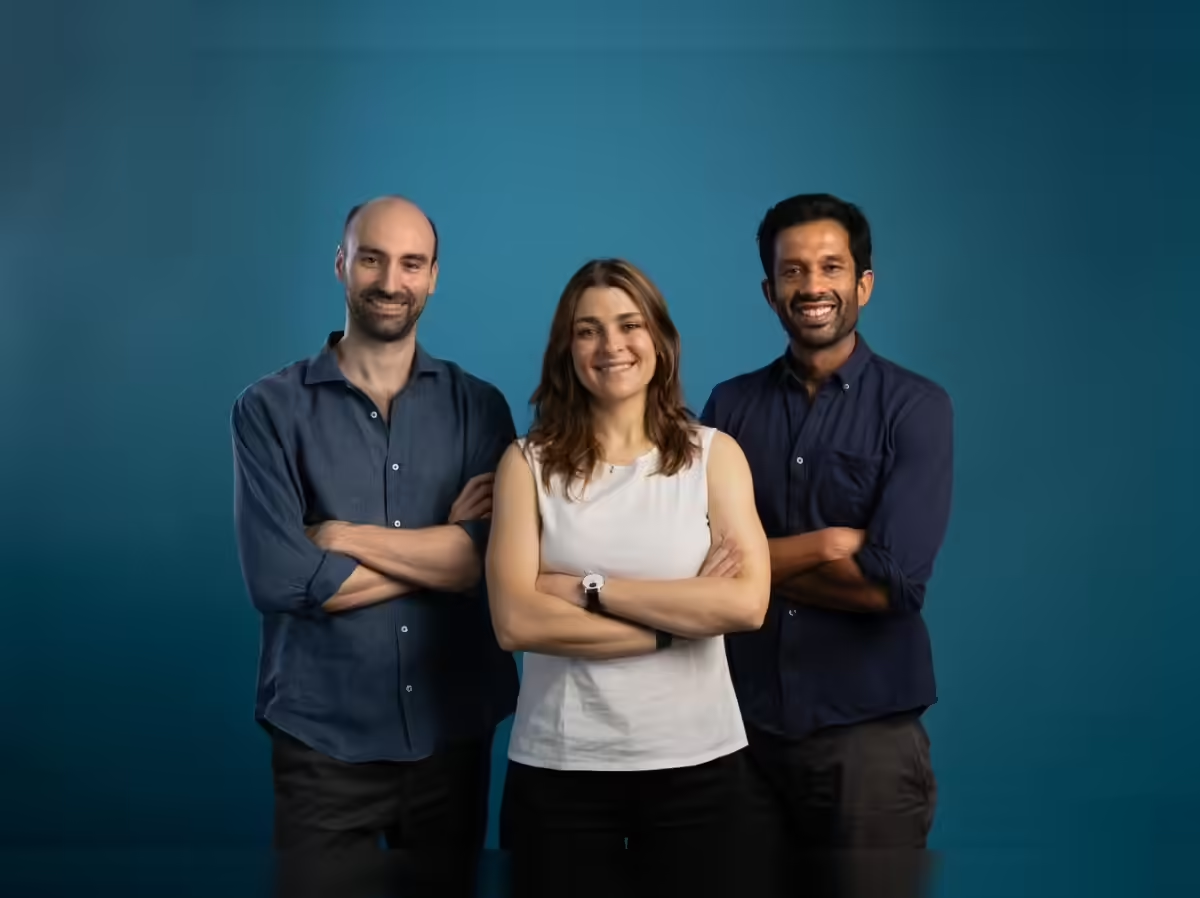
Cerebras Systems raised $5.5 billion in its initial public offering on Thursday, pricing shares at $185. That price landed 58% above the company's initial $115 to $125 range, which had already been raised once to $150 to $160. The company also increased the offering size to 30 million shares.
At the $185 price, co-founder and CEO Andrew Feldman's stake is worth nearly $1.9 billion. Co-founder and CTO Sean Lie's stake comes in at about $1 billion. Pre-market trading suggested shares would open even higher as retail investors bid up prices.
A Year of Setbacks Before the Win
This outcome seemed unlikely just a year ago. Cerebras first filed to go public in 2024, but the listing stalled. A large investment from Abu Dhabi-based Group 42 triggered an extended review by the Committee on Foreign Investment in the United States (CFIUS). Investors were also skeptical because G42 accounted for almost all of the company's revenue at the time.
The company shelved those IPO plans. It wasn't until April 2026 that ambitions reappeared, backed by much stronger financials.
The Financial Turnaround
Cerebras reported $510 million in revenue for 2025, up 76% year over year. More important, the company swung from losing nearly half a billion dollars to posting $237.8 million in net income. That profit figure changed the investor calculus entirely.
The customer base also diversified beyond G42. Cerebras now counts OpenAI (through what TechCrunch describes as a "complicated circular-deal relationship"), Saudi Arabia's Mohamed bin Zayed University of Artificial Intelligence, and Amazon Web Services among its customers.
“In the 70 years of the compute industry, Cerebras was the only company to succeed at building a big chip. Since we did it, others have tried and also failed. So we're really confident that the technical moat is wide and deep.”
— Andrew Feldman, CEO of Cerebras Systems
Positioning for the Inference Era
Cerebras has positioned itself as a major contender in inference, the ongoing compute processing required for AI models to answer prompts. This is distinct from training, where Nvidia dominates. Every time you ask ChatGPT a question or generate an image, that's inference. As AI models move from labs to production, inference workloads are growing faster than training.
The company's approach is unusual. While most chip makers design processors that fit on standard silicon wafers, Cerebras builds its Wafer-Scale Engine as a single massive chip. The WSE-3, its current generation, is roughly the size of a dinner plate. This design eliminates the communication bottlenecks that slow down systems built from many smaller chips.
What This Means for the AI Chip Market
Cerebras's successful IPO sends a signal that investors believe there's room for Nvidia alternatives. Nvidia's market cap exceeds $2 trillion, and the company controls roughly 80% of the AI accelerator market. But customers want options. Supply constraints, pricing power, and single-vendor risk all push large buyers to qualify second sources.
The $56.4 billion valuation prices Cerebras at roughly 110 times its 2025 revenue. That multiple assumes the company can continue growing rapidly and capture meaningful market share. The backlog numbers will be worth watching. Research suggests Cerebras entered 2026 with $24.6 billion in remaining performance obligations, though that figure was not confirmed in the IPO filing.
OpenAI is now a Cerebras customer, making this security incident relevant to the chip maker's enterprise sales
Founder Stakes and Market Reaction
Andrew Feldman founded Cerebras in 2016 after selling his previous company, SeaMicro, to AMD for $334 million. His nearly $1.9 billion stake at IPO represents one of the largest founder outcomes in the AI hardware space. Sean Lie, who leads the technical architecture, holds about $1 billion worth of shares.
Pre-market trading indicated strong demand beyond the IPO price. Retail investors were bidding shares higher before the opening bell. The final first-day trading numbers will determine whether Cerebras joins the list of IPOs that "pop" significantly above their offering price.
Logicity's Take
Frequently Asked Questions
What does Cerebras do?
Cerebras designs AI chips using a wafer-scale approach, building processors roughly the size of a dinner plate. The company focuses on inference workloads, the compute required for AI models to respond to user queries.
How much did Cerebras raise in its IPO?
Cerebras raised $5.5 billion by selling 30 million shares at $185 each, valuing the company at $56.4 billion on a fully diluted basis.
Who are Cerebras's customers?
Cerebras counts OpenAI, Amazon Web Services, G42 (Abu Dhabi), and Saudi Arabia's Mohamed bin Zayed University of Artificial Intelligence among its customers.
Is Cerebras profitable?
Yes. The company reported $237.8 million in net income for 2025, a major turnaround from losing nearly half a billion dollars the previous year.
Why was Cerebras's IPO delayed?
A large investment from Abu Dhabi-based G42 triggered a lengthy review by the Committee on Foreign Investment in the United States (CFIUS), pushing the original 2024 IPO plans back by more than a year.
Need Help Implementing This?
Source: TechCrunch / Julie Bort
Huma Shazia
Senior AI & Tech Writer
Produced with AI assistance and reviewed by the Logicity editorial team. Learn more in our Editorial Policy.