Key Takeaways
- CarDekho parent Girnar Software targets Rs 13,000 crore valuation, up from Rs 9,000 crore in its last private round
- Indian tech sector may cut 25,000-35,000 jobs this year, driven by AI productivity gains rather than weak demand
- PayU projects 25% growth across payments and lending, turning profitable after exiting low-margin businesses
CarDekho's parent company Girnar Software plans to file draft papers for an IPO this quarter, targeting up to Rs 3,000 crore at a Rs 13,000 crore valuation. The Jaipur-based auto-tech company is returning to public markets after shelving earlier listing plans, and its timing coincides with a broader reckoning in Indian tech: silent layoffs that could eliminate up to 35,000 jobs this year.

What's in the CarDekho IPO?
The IPO will be largely an offer for sale by existing investors, with a fresh issue of about Rs 300 crore. Peak XV Partners, Hillhouse Investment, and Google's CapitalG are among those expected to sell shares. The Rs 13,000 crore valuation marks a 44% jump from CarDekho's last private round of Rs 9,000 crore.
The listing bundles CarDekho's core classifieds marketplace, its financing arm Rupyy, and the mobility business under one umbrella. InsuranceDekho, currently merging with RenewBuy, will sit on the books as an associate investment and is preparing for a separate listing.
CarDekho is pitching profitability and cash generation to investors. In FY25, group operating revenue rose 24% to Rs 2,795 crore while losses narrowed to Rs 266 crore. The standalone business stayed profitable for the second straight year, crossing Rs 1,000 crore in revenue. As of March 2025, the group held net cash reserves of Rs 1,177 crore.
Founded in 2008 by brothers Amit and Anurag Jain, CarDekho has grown from a car research portal into a full-stack automotive platform covering new cars, used cars through its Gaadi brand, insurance, and auto financing. The company claims over 98 million monthly unique visitors and a network of more than 15,000 car dealers across India.
How many tech jobs are at risk?

India's tech and software services sector could shed up to 35,000 jobs this year as companies pursue higher productivity. Through May, 10,000 to 15,000 tech workers lost jobs via what TeamLease calls "silent" layoffs. The firm expects total cuts to reach 25,000 to 35,000 roles by year-end.
CIEL HR Services puts 2026 layoffs so far at about 12,000 and forecasts 18,000 to 21,000 for the full year. Combined, tech job losses across 2025-26 could reach as many as 43,000 positions.
The story here differs from past downturns. TeamLease says 2025 was about unwinding pandemic-era over-hiring. This year is about redesigning the workforce itself. The latest cuts stem from AI-driven productivity gains, skill mismatches, and organizational simplification rather than weak demand.
“The AI era is breaking the old workforce equation in IT and consulting. This does not mean people are irrelevant; it means that the basis of workforce value is being redefined.”
— Satish Vishwanathan, former managing director at Accenture
Future reductions will be more surgical, experts predict. Companies are targeting redundant roles, overlapping functions, and bloated management layers rather than sweeping headcount cuts. The new workforce strategy is shifting toward what Vishwanathan calls "cognitive leverage" over "labor scale."
PayU targets 25% growth after profitability pivot

Digital payments firm PayU is aiming for 25% growth in both total payment value and lending assets under management over the next 12 to 18 months. CEO Anirban Mukherjee told ET the company is targeting net profitability across its fintech operations.
In FY25-26, PayU reported total revenue of Rs 6,700 crore and Ebitda of Rs 249 crore, a sharp turnaround from negative Ebitda the previous year. The company processed about $90 billion in total payment value. Gross margins improved by roughly 700 basis points after PayU exited low-margin payment lines and cut open-market sourcing for its lending arm, PayU Finance. Lending AUM stands at about Rs 6,000 crore.
"We are focusing on building both merchant and consumer credit through embedded finance models, or ecosystem credit as it is called in industry parlance, by offering such products through the digital ecommerce ecosystem only," Mukherjee said. Parent company Prosus recently confirmed that PayU's India business had turned profitable.
Zostel challenges Oyo IPO disclosures
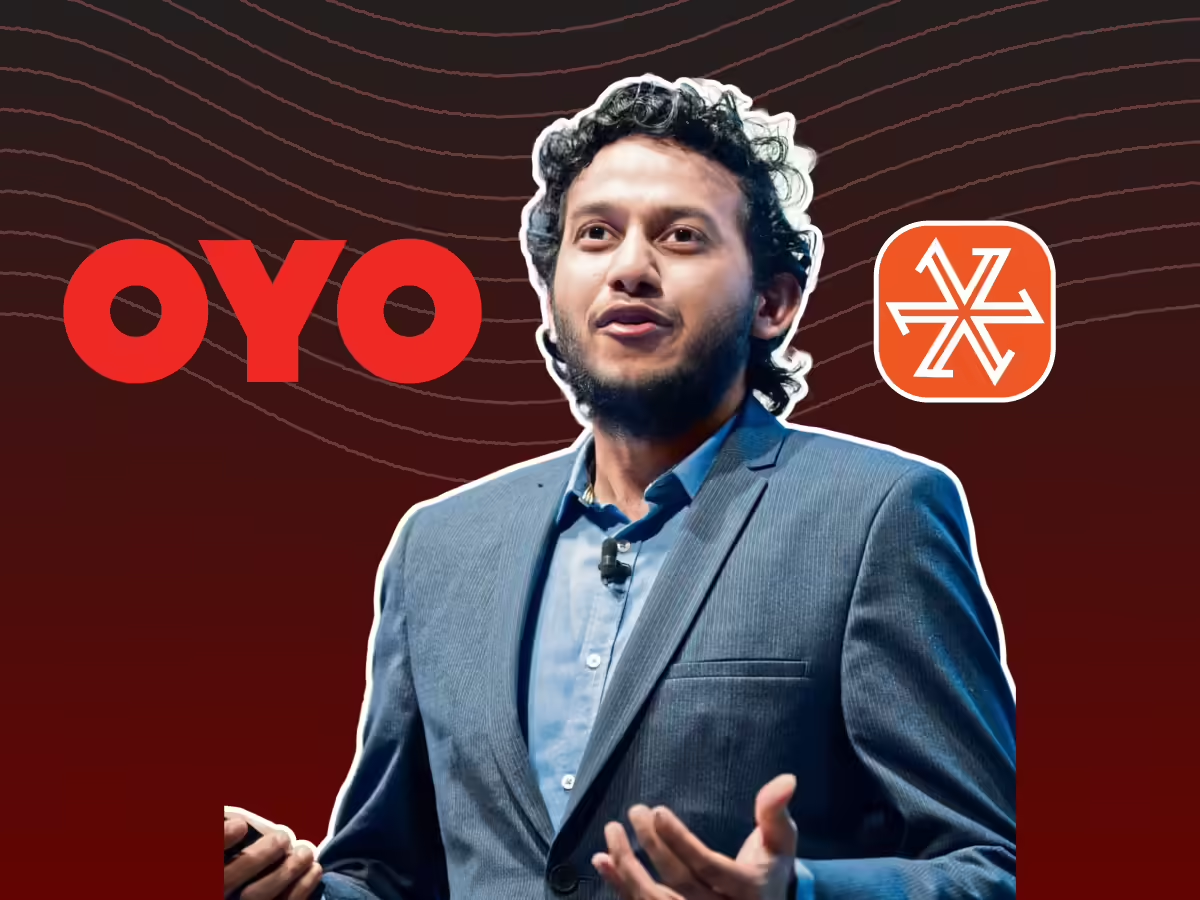
In other IPO news, Zostel has urged SEBI to examine Oyo's IPO disclosures. The long-running dispute between the two hospitality companies continues to cast a shadow over Oyo's public market ambitions. The nature of Zostel's specific concerns was not detailed in the source material.
Is Swiggy now Indian-owned?

Questions are also circulating about Swiggy's ownership structure. The food delivery giant's investor composition and whether it qualifies as Indian-owned under various regulatory definitions remains a point of discussion among market watchers. The distinction matters for certain government contracts and regulatory treatment.
Logicity's Take
CarDekho's IPO timing is deliberate. The company is filing when Indian tech IPOs have regained credibility after Zomato and Nykaa, but before market sentiment shifts again. The real signal is what's bundled and what's not: keeping InsuranceDekho separate suggests the company believes vertical fintech plays command higher standalone valuations. For CTOs watching the job market, the 35,000-cut forecast isn't a recession story. It's a structural shift where AI handles tasks that previously required junior engineers. Companies that invested early in automation tools like [Zapier](https://logicity.in/r/zapier), [Make](https://logicity.in/r/make), or [n8n](https://logicity.in/r/n8n) for workflow automation are now realizing productivity gains that make certain roles redundant. The question isn't whether to automate, but which functions to automate next.
Disclosure
Some links in this post are affiliate links — Logicity earns a commission if you sign up, at no extra cost to you. We only link products we have used or actively recommend.
Frequently Asked Questions
When will CarDekho file its IPO?
CarDekho's parent Girnar Software plans to file draft papers in the July-September quarter of 2025, aiming to raise up to Rs 3,000 crore.
What valuation is CarDekho seeking?
CarDekho is targeting a valuation of around Rs 13,000 crore, up from its last private valuation of Rs 9,000 crore.
How many tech jobs will be cut in India in 2025?
Estimates range from 25,000 to 35,000 tech jobs this year, with combined losses across 2025-26 potentially reaching 43,000 positions.
Why are tech companies laying off workers despite no recession?
Unlike past downturns, current cuts are driven by AI productivity gains, skill mismatches, and organizational simplification rather than weak demand.
Is PayU profitable?
Yes, PayU's India business has turned profitable after exiting low-margin payment lines, reporting Rs 249 crore Ebitda in FY25-26.
Another tech company pursuing aggressive valuation growth
Need Help Implementing This?
Logicity advises engineering leaders and investors on tech market dynamics, IPO readiness, and workforce automation strategies. Get in touch at logicity.in/contact.
Source: Tech-Economic Times
Huma Shazia
Senior AI & Tech Writer
Produced with AI assistance and reviewed by the Logicity editorial team. Learn more in our Editorial Policy.