Key Takeaways
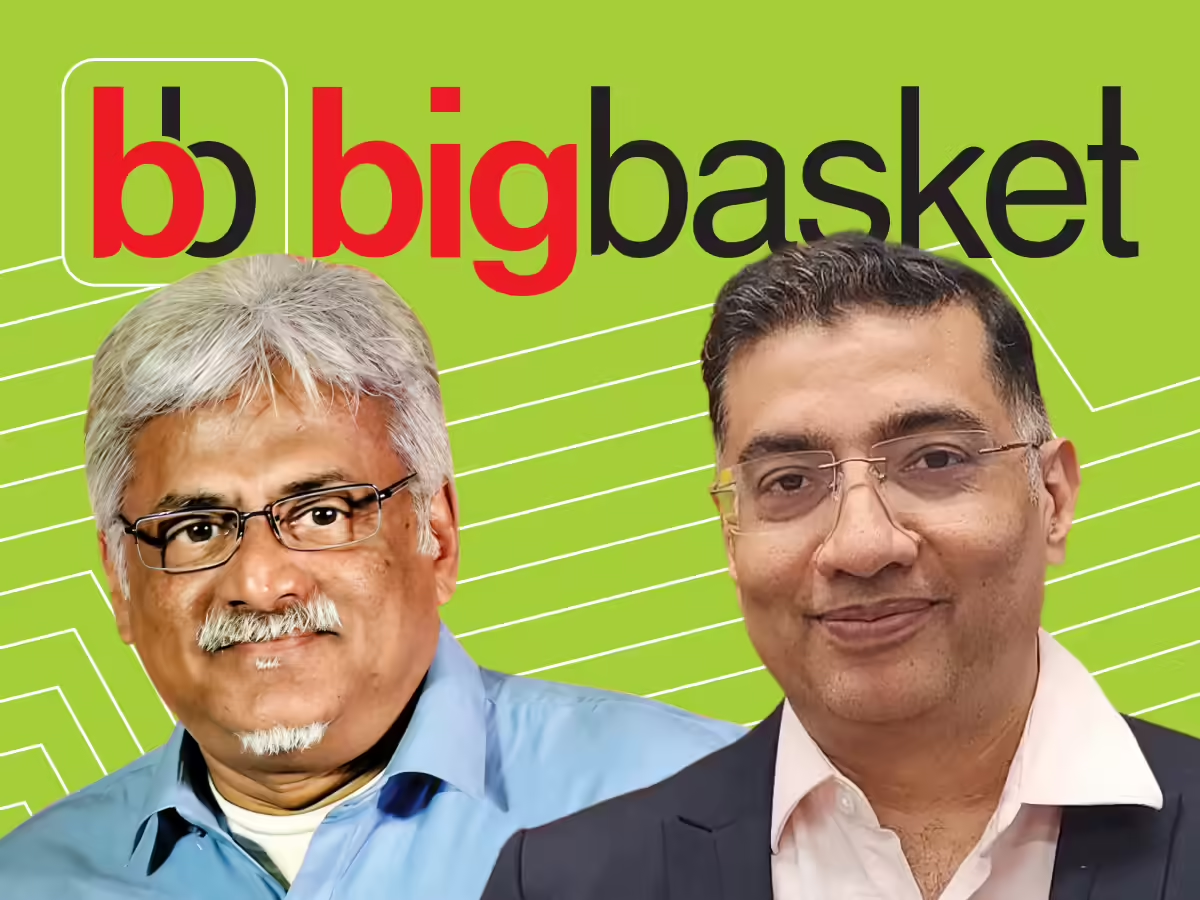
- Hari Menon is stepping down as BigBasket CEO after 15 years, handing over to former Amazon executive Amit Nanda
- BigBasket fully pivoted to quick commerce in August 2024 after losing market share to Blinkit, Zepto, and Swiggy Instamart
- The company now operates over 900 dark stores across 60+ cities, a complete transformation from its scheduled delivery origins
Hari Menon, the founder who built BigBasket into India's largest online grocer, is stepping down as CEO. In a LinkedIn post marking the end of his 15-year run, Menon made a striking admission: he was 'in denial' about quick commerce, the very model that forced his company to reinvent itself.
The timing matters. BigBasket's leadership change arrives as the company fights to reclaim ground lost to Blinkit, Zepto, and Swiggy Instamart. These upstarts rewrote consumer expectations with 10-minute grocery delivery, a pace BigBasket initially dismissed as economically unsustainable.
Why Menon underestimated quick commerce
BigBasket launched in 2011 with a scheduled delivery model. Customers ordered groceries and received them within a predictable time window, usually the same day or next day. The economics made sense: route optimization, larger basket sizes, lower delivery costs per order.
Quick commerce upended that logic. Menon believed consumers would reject the tradeoffs. Smaller selections. Higher prices. The need for dense networks of 'dark stores' within 2-3 kilometers of every customer.
“If you had asked 100 people back then whether they wanted groceries in 10 mins… most would've said no. But the moment we gave it to our customers, they lapped it up.”
— Hari Menon, BigBasket founder
That last sentence captures the competitive dynamic. Customer surveys measure stated preferences. Actual behavior reveals revealed preferences. Urban Indians said they didn't need instant groceries. Then they switched to apps that offered it.
The market share collapse
Quick commerce players captured over 45% of metro grocery delivery. BigBasket, once dominant, watched its position erode. The company reported declining turnover in FY25 as Zepto raised billions and Blinkit expanded aggressively under Zomato's ownership.
In August 2024, BigBasket made the pivot Menon once resisted. The company went all-in on quick commerce, building out dark store infrastructure. Today it operates more than 900 dark stores across 60-plus cities.
Menon describes the current company as 'unrecognisable' compared to its early years. That's not nostalgia. It's an acknowledgment that survival required abandoning the model he'd spent a decade building.
What the new CEO inherits
Amit Nanda, formerly of Amazon, takes over as chief executive. Menon praised his 'sharp instincts' and 'deep consumer understanding.' Menon will remain on the board.
The succession had been telegraphed for months. Following Tata Digital's acquisition of BigBasket in 2021 for roughly $1.3 billion, succession planning accelerated. Tata wanted professional management. Menon's departure formalizes that transition.
Nanda inherits a company fighting on two fronts. Quick commerce competitors have speed advantages and fresher brand associations. Meanwhile, BigBasket must justify its premium positioning to Tata Group leadership expecting returns on their billion-dollar bet.
The quality and private label bet
BigBasket's strategy centers on differentiation through quality rather than competing purely on delivery time or pricing. The company's private labels, Fresho and BB Royal, are central to this approach.
Tata Digital CEO Sajith Sivanandan, who also chairs BigBasket, said the company is seeing early recovery signs. BigBasket now accounts for one in five new grocery app downloads. Whether that translates to sustained market share gains remains unclear.
The quality argument has limits. Quick commerce platforms also sell fresh produce. Zepto has invested heavily in fruits and vegetables. Blinkit benefits from Zomato's logistics expertise. Private labels help margins, but they don't solve the speed perception gap.
What BigBasket got right early
Menon's farewell post outlined the four metrics BigBasket prioritized from day one: order fill rate, on-time delivery, 95% SKU availability, and customer satisfaction. These operational fundamentals built the company's reputation.
The irony is that quick commerce players optimized for the same metrics at faster speeds. A 10-minute delivery with 80% fill rate beats a next-day delivery with 95% fill rate for many urban consumers. Convenience compressed the definition of 'on-time.'
BigBasket's original playbook was right for 2011. It became wrong somewhere around 2021. Recognizing that shift, even belatedly, is what allowed the company to pivot rather than collapse.
The broader lesson for Indian e-commerce
BigBasket's story illustrates how quickly category leadership can evaporate. The company had first-mover advantage, strong brand recognition, and eventually Tata's capital. None of it protected against a business model shift.
Quick commerce succeeded because it changed the buying occasion. Instead of weekly stock-up orders, consumers make impulsive small purchases. A missing ingredient for tonight's dinner. Snacks during a cricket match. The use case was new, not just faster.
Menon's candor about being 'in denial' is unusual for an exiting founder. Most frame their departures as victories or natural progressions. Admitting he misjudged the market suggests he's genuinely reflecting on what happened, not just managing his legacy.
Frequently Asked Questions
Why is Hari Menon leaving BigBasket?
Menon is stepping down after 15 years as CEO following Tata Digital's 2021 acquisition. Succession planning accelerated under Tata ownership, with former Amazon executive Amit Nanda taking over leadership.
When did BigBasket pivot to quick commerce?
BigBasket fully pivoted to quick commerce in August 2024, after initially resisting the model. The company now operates over 900 dark stores across more than 60 cities.
How much did Tata pay for BigBasket?
Tata Digital acquired a majority stake in BigBasket in 2021 for approximately $1.3 billion, integrating it into the Tata Neu super-app ecosystem.
Who are BigBasket's main competitors?
BigBasket competes primarily with Blinkit (owned by Zomato), Zepto, and Swiggy Instamart. These quick commerce players have captured over 45% of metro grocery delivery market share.
What is BigBasket's strategy under new leadership?
BigBasket is differentiating through quality and private labels like Fresho and BB Royal rather than competing solely on speed or pricing. The company reports early signs of market share recovery.
Logicity's Take
BigBasket's pivot reveals a painful truth for tech leaders: being right about unit economics doesn't matter if consumers don't care. Quick commerce burns cash, but Zepto raised $1.4 billion and Blinkit has Zomato's balance sheet. BigBasket's quality differentiation strategy might work, but private labels like Fresho compete against Zepto Café and Blinkit's own store brands. The real question is whether Tata's patience outlasts the competition's funding. For CTOs evaluating last-mile logistics, this is a case study in how infrastructure built for one delivery paradigm (scheduled) doesn't transfer cleanly to another (instant).
Another founder perspective on technology transformation
Need Help Implementing This?
Building quick commerce infrastructure or evaluating last-mile delivery technology? Contact Logicity's advisory team for vendor comparisons and implementation guidance tailored to your market.
Source: Tech-Economic Times / ET
Huma Shazia
Senior AI & Tech Writer
Produced with AI assistance and reviewed by the Logicity editorial team. Learn more in our Editorial Policy.




