Key Takeaways

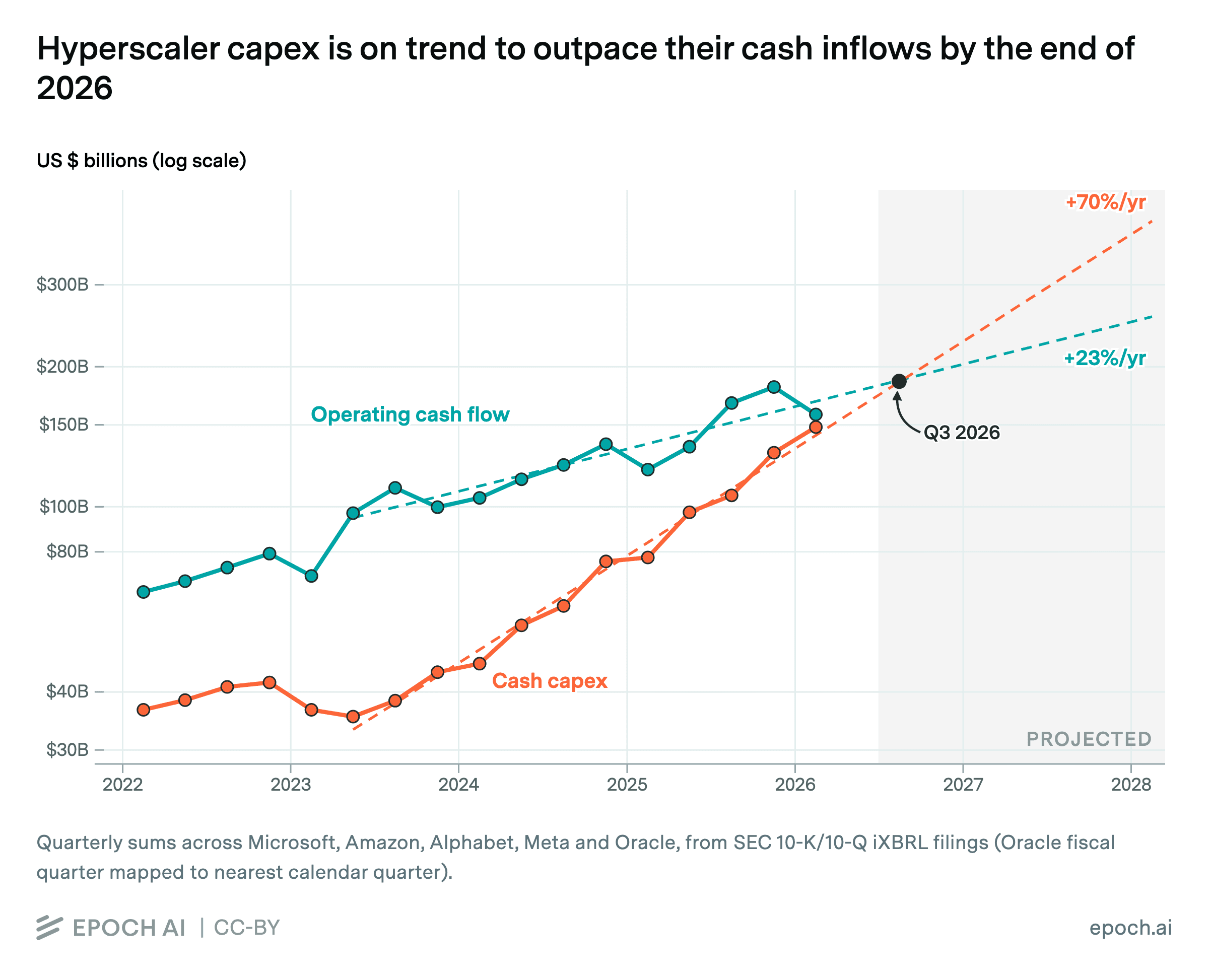
- AI infrastructure spending by the Big Five hyperscalers is growing at 70% annually, triple the rate of cash flow growth at 23%
- Spending is projected to overtake operating cash flow around Q3 2026, forcing reliance on external financing
- Alphabet raised $85 billion in equity while Amazon and Nvidia have sold bonds, signaling the shift is already underway
The five largest hyperscalers, Microsoft, Amazon, Alphabet, Meta, and Oracle, are burning through cash on AI infrastructure faster than their core businesses can replenish it. Epoch AI analysis of SEC filings shows infrastructure spending growing at 70% annually while operating cash flow rises at just 23%. If those trajectories hold, spending overtakes cash flow around Q3 2026.
This marks a fundamental shift. For decades, Big Tech funded expansion from profits generated by search ads, cloud subscriptions, and social media. The generative AI buildout has broken that model.
Why AI spending is outpacing revenue
The numbers tell a stark story. Projected total CapEx for the five hyperscalers in 2026 falls between $700 billion and $900 billion. Meanwhile, Sequoia Capital partner David Cahn has estimated the annual revenue gap between infrastructure investment and current AI monetization at roughly $600 billion.
The companies aren't waiting for the crossover to act. Alphabet recently raised $85 billion in equity. Amazon and Nvidia have sold bonds. All five remain profitable and hold substantial cash reserves, with Oracle the exception. But free cash flow, the money remaining after capital spending is subtracted from operating revenue, could hit zero or turn negative if current trends persist.
What changes when hyperscalers borrow
The shift to external financing changes the risk profile of these companies. When Microsoft or Amazon funded data centers from Azure or AWS profits, they controlled their own destiny. Debt and equity financing introduces new stakeholders, interest obligations, and market timing concerns.
Epoch AI's research lead described it plainly: "We are witnessing the end of the 'self-funding' era for Big Tech. For the first time in decades, core business profits are no longer sufficient to sustain the capital intensity of their growth strategies."
The analyst community on HackerNews has drawn comparisons to the 1990s fiber-optic bubble, when telecoms overbuilt capacity that sat unused for years. Some argue AI will unlock productivity gains that justify the spend by 2027. Others worry these companies are creating stranded assets in the form of underutilized GPUs and specialized facilities.
The key question Epoch AI didn't answer
Epoch AI is explicit about what their analysis omits: whether AI investments will eventually generate enough revenue to close the gap. The projections are "simple extrapolations" that assume current growth rates continue unchanged. They don't model a scenario where enterprise AI adoption accelerates, or where efficiency improvements reduce infrastructure costs.
That's the trillion-dollar bet. If AI becomes as foundational as cloud computing, the infrastructure will pay for itself many times over. If adoption stalls or competitors commoditize the technology, today's CapEx becomes tomorrow's write-down.
The hyperscalers are betting on the first scenario. Their shareholders are betting along with them. By Q3 2026, we'll have early signals about which bet was right.
Logicity's Take
The real risk isn't that hyperscalers run out of cash. They won't. The risk is that external financing disciplines their AI ambitions in ways self-funding never did. Bond covenants and equity dilution create accountability that internal capital allocation doesn't. If AI revenue disappoints in 2027, these companies will face pressure to cut CapEx, and the one that blinks first hands competitors a structural advantage. Expect executives to double down rather than retreat, which means the cash burn could accelerate before it slows.
Frequently Asked Questions
Which hyperscalers are affected by the AI cash flow gap?
Microsoft, Amazon, Alphabet, Meta, and Oracle are the five companies in Epoch AI's analysis. All except Oracle hold large cash reserves, but all face the same spending trajectory.
When will AI infrastructure spending exceed hyperscaler cash flow?
Epoch AI projects the crossover around Q3 2026, assuming current growth rates of 70% for spending and 23% for cash flow continue.
How are hyperscalers funding AI infrastructure if not from cash flow?
Alphabet raised $85 billion in equity. Amazon and Nvidia have issued bonds. Debt and equity financing are replacing self-funded expansion.
Is this similar to the dot-com bubble?
Some analysts draw parallels to the 1990s fiber-optic overbuild. The key difference is that today's hyperscalers are profitable, diversified companies rather than single-product startups. But the risk of stranded infrastructure assets exists.
What would close the AI revenue gap?
Widespread enterprise AI adoption that generates revenue exceeding infrastructure costs. Epoch AI's analysis does not model this scenario, noting it is the key unknown.
Need Help Implementing This?
If your organization is evaluating cloud AI infrastructure decisions in light of hyperscaler pricing and capacity shifts, Logicity can connect you with analysts tracking these market dynamics. Reach out through our consulting network.
Source: The Decoder / Matthias Bastian
Huma Shazia
Senior AI & Tech Writer
Produced with AI assistance and reviewed by the Logicity editorial team. Learn more in our Editorial Policy.