Key Takeaways

- 70% of credit union members lack awareness of stablecoin mechanics and risks
- Community banks have an education advantage through existing relationship-based customer interactions
- Customer confusion between insured deposits and stablecoins creates fraud, compliance, and reputational risks
Banks and credit unions may win the crypto race not by building the biggest product menu, but by explaining what customers are actually buying. A PYMNTS report published July 21 argues that the institutions best positioned to drive digital asset adoption are those clarifying ownership, backing, and redemption rights, not simply adding wallets or stablecoins to their offerings.
The timing matters. Crypto's vocabulary has expanded faster than customer comprehension. Bitcoin, stablecoins, tokenized bank deposits, tokenized securities, and central bank digital currencies all fall under "digital assets," yet they represent different claims, risks, and use cases. Some are speculative. Some are payment instruments. Some are conventional products on new infrastructure. Others remain government research projects.
That confusion was tolerable when crypto lived outside mainstream banking. It becomes dangerous as regulated institutions gain latitude to provide custody, stablecoin, and blockchain services.
Why do smaller banks have a crypto education edge?
Large banks and fintechs can build broader digital asset product lines. Community banks, regional banks, and credit unions may be better positioned to make those products intelligible.
Small institutions have spent decades teaching customers distinctions the financial industry takes for granted: checking versus savings, debit versus credit, fixed versus variable rates, insured deposits versus investments. They operate through relationship managers and branch staff who know why a customer moves money, not just where it goes.
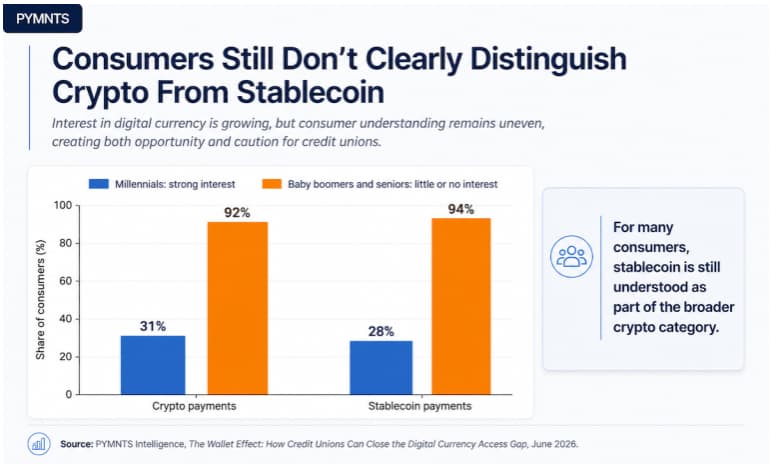
A customer who mistakes a stablecoin for an insured deposit takes risks the institution never intended to encourage. A small business assuming a tokenized payment is irreversible, anonymous, or legally equivalent to cash may make faulty decisions about fraud and refunds. A consumer believing every blockchain transaction carries card-payment protections discovers otherwise only after money disappears.
The "stable" in stablecoin creates false confidence
Even the label misleads. Stablecoins are designed to maintain a reference value, but their resilience depends on reserve quality, redemption arrangements, liquidity, and governance. Those distinctions determine nearly everything that matters: who owes the money, what backs it, whether its value can move, what protections apply, where it can be used, and what happens if the provider fails.
A retiree considering a tokenized Treasury fund needs a different explanation from a manufacturer using stablecoins to pay an overseas supplier. A customer asking how to purchase bitcoin is making a different decision from one asking whether a digital dollar payment can settle over a weekend. The institution's job is not to persuade all three to adopt the technology. It is to help each understand the financial claim, operational process, and risk involved.
Recent crypto custody breach shows why clear explanations of asset protections matter
What risks does customer confusion create for banks?
Three categories stand out: fraud, compliance, and reputation.
- Fraud risk: Customers who do not understand irreversibility or custody may be easier targets for scams and social engineering.
- Compliance risk: A customer who believes a stablecoin carries FDIC insurance may file complaints or regulatory actions when losses occur.
- Reputational risk: Institutions that sell products customers do not understand face backlash when those products behave unexpectedly.
The Federal Reserve has warned that stablecoin adoption could alter bank deposits, funding structures, and credit distribution. Banks entering this market face infrastructure developing faster than its shared vocabulary.
How should financial institutions approach crypto education?
The PYMNTS report suggests banks become translators rather than product distributors. Practically, this means:
- Train relationship managers on the differences between crypto assets, stablecoins, tokenized deposits, and CBDCs.
- Create plain-language disclosures that explain backing, redemption rights, and what protections do and do not apply.
- Match explanations to customer context: a business treasury manager needs different information than a retail customer buying bitcoin.
The institutions that win may not be those offering the most digital assets. They may be those who explain ownership, backing, and risk most clearly.
| Digital Asset Type | What It Is | Backed By | FDIC Insured? | Primary Use |
|---|---|---|---|---|
| Cryptocurrency (e.g., Bitcoin) | Speculative asset | Network consensus, no reserves | No | Investment, store of value |
| Stablecoin | Payment instrument pegged to fiat | Reserves (varies by issuer) | No | Payments, trading |
| Tokenized Bank Deposit | Deposit recorded on blockchain | Bank's balance sheet | Yes (if qualifying) | Payments, settlement |
| Tokenized Securities | Securities on blockchain rails | Underlying asset | No (SEC-regulated) | Investment, trading |
| CBDC | Government digital currency | Central bank | N/A (government liability) | Payments (pilot programs) |
Logicity's Take
For fintech and finance teams building crypto products, this report highlights a distribution bottleneck: customer education. The institutions with embedded trust, branch networks, and relationship managers may control the last mile, even if they lack technical sophistication. Fintechs pursuing B2B2C models should consider white-label education tools alongside product APIs. Credit unions using member communication platforms could integrate compliance-aware explainers from vendors like MX or Narmi. The competitive moat here is not custody technology; it is the ability to make a 62-year-old retiree understand why a stablecoin is not the same as a CD.
Security incidents compound trust issues in digital financial services
Frequently Asked Questions
What is the difference between a stablecoin and a bank deposit?
A stablecoin is a private payment instrument pegged to a fiat currency, backed by reserves held by the issuer. A bank deposit is a liability of the bank, typically insured by the FDIC up to $250,000. Stablecoins carry reserve and liquidity risk that insured deposits do not.
Are tokenized deposits FDIC insured?
Tokenized deposits issued by FDIC-insured banks that meet qualifying criteria may retain FDIC insurance, since they represent a deposit liability recorded on blockchain infrastructure rather than a new asset class.
Why are credit unions better positioned for crypto education?
Credit unions operate through relationship managers and member-focused service models. They have experience teaching customers distinctions between complex financial products, giving them a natural role as translators.
What risks do banks face from customer crypto confusion?
Fraud risk from customers who do not understand irreversibility, compliance risk from customers who believe products carry protections they lack, and reputational risk when products behave unexpectedly.
What did the Federal Reserve say about stablecoins?
The Fed warned that stablecoin adoption could alter bank deposits, funding structures, and credit distribution, making these instruments strategically significant for regulated institutions.
Need Help Implementing This?
Logicity helps fintech teams and financial institutions build digital asset education strategies. Contact us to discuss compliance-aware content frameworks, customer communication tools, and product positioning for crypto services.
Source: PYMNTS | / PYMNTS
Manaal Khan
Tech & Innovation Writer
Produced with AI assistance and reviewed by the Logicity editorial team. Learn more in our Editorial Policy.