Key Takeaways
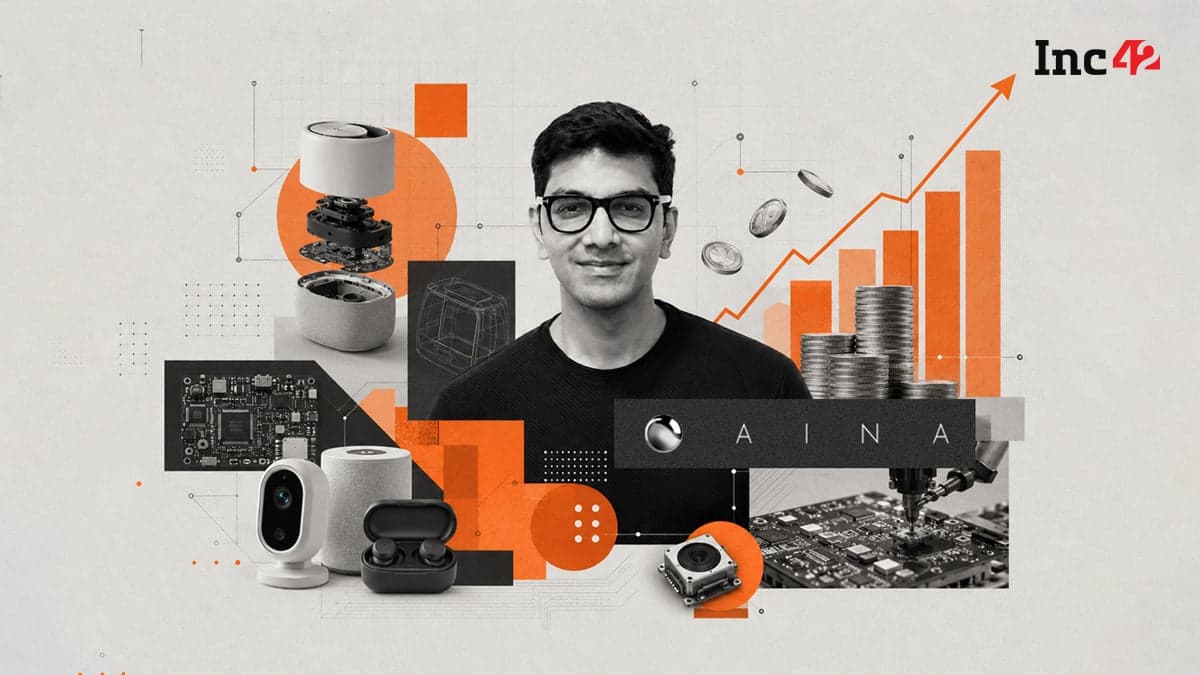
- Aina raised $5.5M seed funding led by Redstart Labs (Info Edge) and 360 ONE Asset to build AI-native hardware interfaces
- Founder Apoorv Shankar previously built hardware at Ultrahuman, which acquired his AI wearable startup LazyCo in 2022
- India's AI hardware market is projected to hit $46.5B by 2033, growing at 28.1% CAGR
Aina, an AI hardware startup founded by former Ultrahuman VP Apoorv Shankar, has emerged from stealth with $5.5 million in seed funding. The round was co-led by Redstart Labs (Info Edge Ventures' venture arm) and 360 ONE Asset, with participation from MIXI Global Investments, Antler, and Blume Founders Fund. The startup is building context-aware hardware interfaces designed for AI agents, a bet that the next computing shift will move beyond smartphones and touchscreens.
The angel investor list reads like a who's who of India's tech ecosystem: WhatsApp head Kunal Shah, Scribd cofounder Tikhon Bernstam, Razorpay cofounders Harshil Mathur and Shashank Kumar, and Better Capital founder Vaibhav Domkundwar all participated.
What is Aina actually building?
Aina's thesis is straightforward: as AI assistants get better at understanding context and executing tasks, the interface layer needs to evolve. Keyboards, touchscreens, and app navigation were designed for a pre-AI world. Aina wants to replace that with hardware that captures human intent more naturally.
"As intelligence becomes ubiquitous, AI assistants will get better at understanding context and agents will execute on our behalf. However, the missing piece for AI is a context-aware layer that is paired with an easier way to capture that choice," Shankar said. "We are building a general-purpose interface for this future, designed to capture human choice, effortlessly."
Before launching its flagship product, Aina tested the concept with Dune, a programmable three-key keypad for Mac. The device changes functions based on which application you're using. Paired with a natural language workflow builder, it served as an early experiment in context-aware computing. Aina showcased three prototype AI interfaces at CES 2026 and launched Dune in April. The company claims to have shipped hundreds of units and is using that feedback to train its flagship AI-native hardware interface.
The founder's hardware track record
Shankar isn't new to hardware startups. He founded LazyCo, an AI wearable company, which Ultrahuman acquired in 2022. He spent more than three years at Ultrahuman building its consumer hardware and manufacturing capabilities. Ultrahuman, known for its smart ring and health wearables, is now valued at over $1 billion. That track record likely helped Aina secure this funding before shipping its flagship product.
The company currently has about 35 employees split between Bengaluru and San Francisco. It operates a manufacturing facility in Bengaluru. The fresh capital will go toward launching the flagship product, expanding engineering and product teams, and opening an early pilot waitlist.
Where Aina fits in the AI hardware race
Aina is entering a space where much larger players are already experimenting. OpenAI, Meta, Rabbit, and Humane are all racing to build the next generation of computing interfaces. Rabbit's R1 launched to mixed reviews. Humane's AI Pin faced criticism for impractical design. OpenAI is reportedly working on smart speaker hardware with Jony Ive. None have cracked the mainstream adoption problem yet.
India's hardware ecosystem has traditionally focused on wearables and consumer electronics. Aina is among a small group of Indian startups building AI-native interfaces from scratch rather than adding AI to existing product categories.
The market opportunity is substantial. India's wearable AI market is estimated at $3.17 billion in 2026 and is forecast to reach $19.1 billion by 2033, growing at 29.2% CAGR. The broader AI hardware market is projected to hit $46.5 billion by 2033.
What the investment signals for fintech teams
For fintech and finance teams watching AI infrastructure investments, this deal signals growing investor confidence in AI hardware as a distinct category. The participation of 360 ONE Asset, a financial services firm, alongside traditional tech VCs suggests that AI hardware is attracting attention beyond pure-play tech investors.
The context-aware interface concept has direct applications in financial workflows. Trading desks, compliance monitoring, and portfolio management all involve switching between applications and capturing decisions quickly. If Aina's approach works, similar interface concepts could appear in enterprise fintech tools.
Logicity's Take
Aina's bet is that the AI agent era needs new input methods, not just better software. The timing is smart: AI agents are improving faster than the interfaces to control them. But the graveyard of consumer hardware startups is full of good ideas with poor timing. Shankar's Ultrahuman experience gives him credibility, but consumer hardware is unforgiving. The real question is whether Aina can ship a flagship product that solves a problem people didn't know they had, before larger players figure out the same space. For fintech teams, watch how context-aware interfaces evolve. If they work, expect similar concepts to appear in trading terminals and compliance dashboards within two years.
Frequently Asked Questions
What does Aina's AI hardware actually do?
Aina builds context-aware hardware interfaces that adapt to what you're doing. Instead of navigating apps and menus, the hardware understands context and simplifies interactions with AI agents. Their first product, Dune, is a three-key keypad that changes functions based on the active application.
Who invested in Aina's seed round?
The $5.5M round was co-led by Redstart Labs (Info Edge Ventures) and 360 ONE Asset. Other investors include MIXI Global Investments, Antler, Blume Founders Fund, and angels like Kunal Shah, Razorpay cofounders, and Scribd cofounder Tikhon Bernstam.
How big is the AI hardware market in India?
India's AI hardware market is projected to reach $46.5 billion by 2033 at a 28.1% CAGR. The wearable AI segment specifically is expected to grow from $3.17 billion in 2026 to $19.1 billion by 2033.
Who is Aina's founder and what's his background?
Apoorv Shankar founded Aina in 2025. He previously founded LazyCo (acquired by Ultrahuman in 2022) and served as VP of Hardware at Ultrahuman for over three years, where he helped build the company's consumer hardware and manufacturing capabilities.
Related coverage of AI hardware developments from major players
Another recent AI startup funding round for context on investor appetite
Need Help Implementing This?
Building AI-native workflows for your finance team? Our editorial team covers enterprise AI tools weekly. Subscribe to Logicity's newsletter for implementation guides and vendor comparisons.
Source: Inc42 Media / Shrishti Bisht
Manaal Khan
Tech & Innovation Writer
Produced with AI assistance and reviewed by the Logicity editorial team. Learn more in our Editorial Policy.