Key Takeaways
- Weekly AI chatbot news usage climbed from 7% to 10% globally, with 17% of 18-24 year-olds now using them for news
- While 44% of active chatbot users trust AI-generated news, only 4% regularly click through to original sources
- Strong correlation between trust and usage exists at the country level, with Nigeria, Kenya, and India showing higher adoption than the US and UK
AI chatbots are gaining ground as news sources, but almost nobody bothers to check if what they're reading is accurate. The Reuters Institute's Digital News Report 2026 shows weekly chatbot news usage jumped from 7% to 10% globally, yet only 4% of users regularly click through to verify the original source. That's a problem for publishers, readers, and the chatbots themselves.
The report surveyed 45 markets and found a clear pattern: younger users and heavy news consumers drive adoption, while trust remains stubbornly low among the general population. Just 1% of respondents call AI chatbots their main news source, suggesting these tools supplement rather than replace traditional media.
Who actually uses chatbots for news?
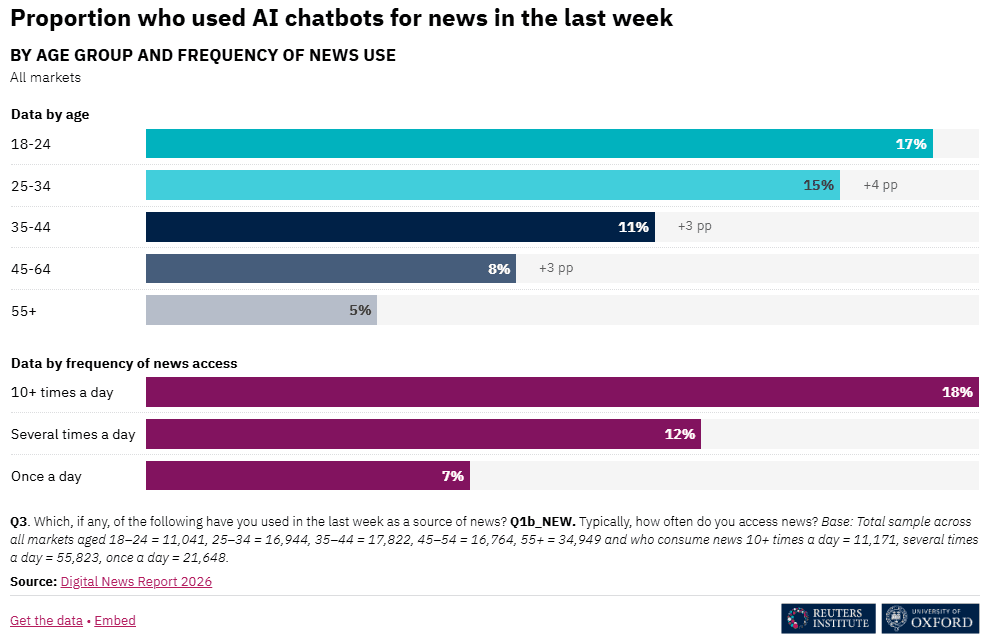
The demographic split is stark. Among 18-to-24 year-olds, 17% use chatbots for news weekly. That drops to 5% for the oldest age group. The 25-to-34 bracket saw the fastest growth, jumping 4 percentage points year over year.
Self-described "news lovers" use chatbots at 18%, more than double the 7% rate among casual news consumers. People with extreme political views also show higher adoption: 16% on the far left and 15% on the far right. Researcher Dr. Amy Ross Arguedas attributes this to those groups simply being more interested in news overall, not to any ideological feature of the chatbots themselves.
Growth is concentrated in Asia, Africa, Latin America, and Southern and Eastern Europe. Western Europe and North America lag behind.
What are people actually doing with AI chatbot news?
Asking follow-up questions tops the list at 42% of users. Getting current news comes second at 35%, followed by summaries (34%), checking source reliability (33%), and simplifying complex topics (30%).
That reliability-checking use case spikes in countries with low press freedom or low trust in traditional media. In Hong Kong, Turkey, Hungary, and Romania, users turn to chatbots specifically to fact-check other sources. There's an irony here: using a tool known for hallucinations to verify information.
Globally, 42% of users say they want more depth or explanation from chatbots, while 39% cite speed as the main draw.
The trust gap between users and non-users
Trust in AI chatbot news sits at just 20% among the general population. But among people who actually use chatbots for news, that number more than doubles to 44%. Non-users? Only 17% trust the output.
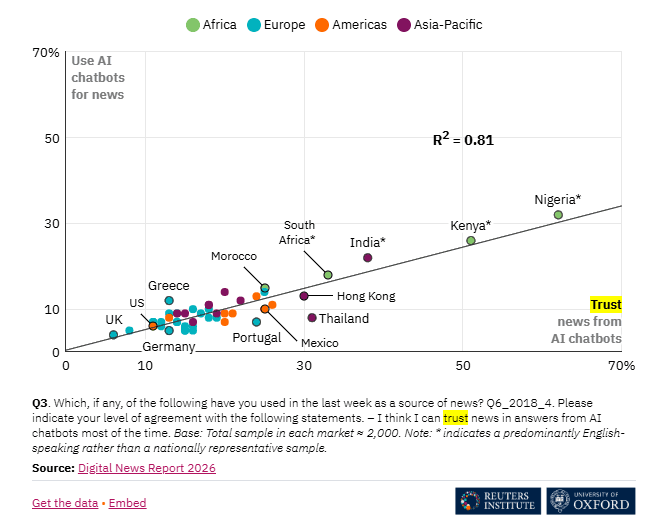
At the country level, the correlation between trust and usage is remarkably strong, with an R² of 0.81. Nigeria, Kenya, India, and South Africa rank high on both metrics. The US, UK, and Germany cluster at the bottom.
The Reuters researchers argue this connection is stronger than what we see with social media because chatbot news use is a deliberate choice. People actively type a query. On social media, news often just appears in a feed. That intentionality seems to breed more trust.
Why almost nobody clicks through to sources
Only 4% of chatbot users always or often click through to original articles. Compare that to 19% for search engines and 17% for social media.
The explanation is partly structural. When a chatbot gives you an answer directly, there's no blue link begging for a click. You got what you came for. But this creates a real problem: users accept information without verifying it, and publishers lose the traffic that funds their journalism.
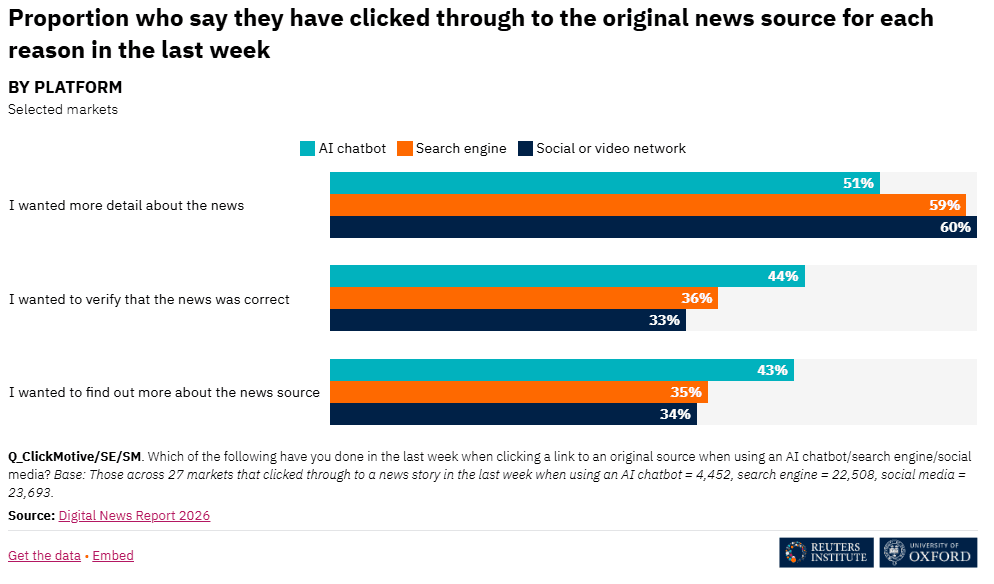
When chatbot users do click, their motivations differ from search or social users. They're more likely to verify facts (44%) or check the source (43%) and less likely to seek additional detail (51% versus 59% for search users). In other words, they click out of suspicion, not curiosity.
This complicates Google's legal defense of its AI Overviews. The company argues users can simply verify false claims by clicking to the source. They can. But the data says they don't. And as the report notes, the cited sources don't always match the answer anyway.
The fragmentation risk
Chatbots can misrepresent source material. That's a known problem. But the report raises two other concerns: confirmation bias and a splintering public sphere.
Hyper-personalized responses could reinforce what people already believe, making it harder to build shared understanding of basic facts. If my chatbot tells me one thing and yours tells you another, we lose common ground.
The flip side: chatbots can also make complex topics more accessible and expose people to perspectives they'd never encounter in their usual media diet. Whether the technology leans toward filter bubbles or broader horizons depends on how companies build it, and how users approach it.
What should publishers do?
The Reuters Institute's advice is blunt: don't compete with AI platforms on their turf. Chatbots excel at summarizing, simplifying, and answering quick questions. Publishers should focus on what chatbots can't deliver: original reporting, investigative work, and journalistic credibility.
That's easier said than done when traffic from AI answers increasingly bypasses your site entirely. But the alternative, trying to out-summarize a summarization engine, looks like a losing strategy.
Logicity's Take
The 4% click-through rate is the real story here. It suggests chatbot users treat AI-generated news as a finished product, not a starting point for deeper reading. For publishers, that's existential: how do you monetize an audience that never visits? The trust-usage correlation also raises a chicken-and-egg question. Do people trust chatbots because they use them, or use them because they trust them? If it's the former, expect trust to climb as adoption spreads. If it's the latter, we may be seeing ceiling rather than floor.
Frequently Asked Questions
How many people use AI chatbots for news in 2026?
About 10% of global internet users access news via AI chatbots weekly, up from 7% the previous year. Just 1% consider chatbots their main news source.
Do people trust news from AI chatbots?
Trust varies by experience. Only 20% of the general population trusts AI chatbot news, but 44% of active chatbot users trust it. Non-users show just 17% trust.
Which age groups use AI chatbots for news most?
18-to-24 year-olds lead at 17% weekly usage. The 25-to-34 bracket showed the fastest growth with a 4 percentage point increase.
Do AI chatbot users verify the information they receive?
Rarely. Only 4% of chatbot news users always or often click through to original sources, compared to 19% for search engines and 17% for social media.
Which countries have the highest AI chatbot news usage?
Nigeria, Kenya, India, and South Africa show higher adoption rates than Western countries. The US, UK, and Germany rank lower on both trust and usage.
Need Help Implementing This?
Whether you're a publisher adapting to AI-driven news consumption or a tech company building news features into your chatbot, Logicity can help you navigate the strategic implications. Contact us for analysis tailored to your market.
Source: The Decoder / Matthias Bastian
Huma Shazia
Senior AI & Tech Writer
Produced with AI assistance and reviewed by the Logicity editorial team. Learn more in our Editorial Policy.