Key Takeaways

- The Big Dipper serves as your starting point for navigating the entire spring night sky
- May's fading moon creates darker skies ideal for spotting fainter stars
- Star-hopping builds a mental map that stays with you, unlike app-dependent learning
Stargazing apps are useful. They're also a crutch that keeps you from actually learning the sky. The real skill is naked-eye star-hopping: starting with something obvious, moving to something less so, and building a mental map that sticks.
May is the perfect month to try it. The moon fades toward last quarter this weekend, opening up darker skies each night. The Big Dipper hangs high overhead after sunset, and its seven bright stars provide direct lines to everything else worth seeing.
Why Star-Hopping Beats Apps
Beginners often try to match the entire sky to a chart on their phone. It doesn't work. The sky is too big. You have to navigate it piece by piece, building chains of recognition that eventually become instinctive.
Apps have their place. If you get stuck, check one. But defaulting to a screen after it's done its job prevents the learning that makes stargazing rewarding. The goal isn't avoiding technology entirely. It's avoiding dependency on it.
1. Find Polaris from the Big Dipper
Start with the two stars at the edge of the Big Dipper's bowl. These are called the Pointer Stars. Draw an imaginary line through them, extending it about five times the distance between them. That line leads directly to Polaris, the North Star.
Polaris isn't the brightest star in the sky. Many beginners expect it to be. But it's bright enough to spot once you know where to look, and it sits almost exactly at the celestial north pole. Every other star appears to rotate around it throughout the night.

2. Arc to Arcturus, Spike to Spica
This is the most famous star-hop in the northern hemisphere. Follow the arc of the Big Dipper's handle and keep going. That curve leads you to Arcturus, a brilliant orange star in the constellation Boötes. It's the fourth-brightest star visible from Earth.
Now extend that arc further, roughly the same distance again. You'll hit Spica, a blue-white star in Virgo. The mnemonic is simple: arc to Arcturus, spike to Spica. Once you've done it a few times, you'll find these stars automatically.
3. Find Leo from the Big Dipper
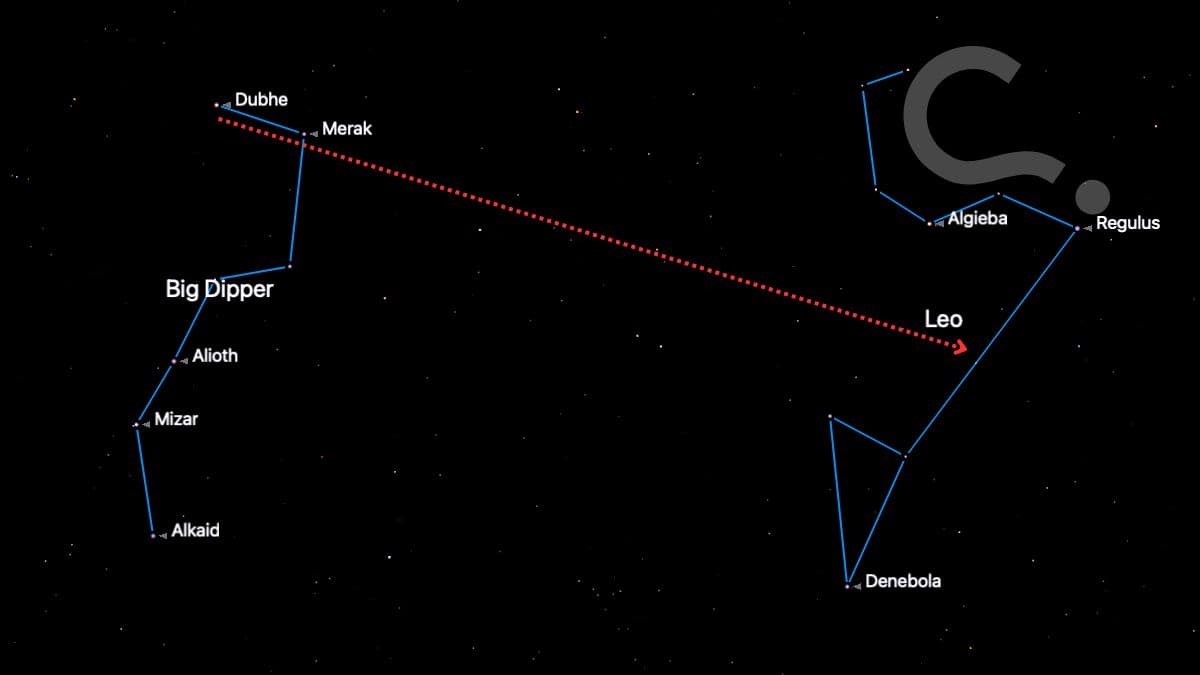
The Big Dipper also points to Leo, the lion. Draw a line through the two stars at the bottom of the bowl (opposite the pointer stars). Follow that line and you'll reach Leo's brightest star, Regulus.
Leo is one of the few constellations that actually looks like its namesake. A backward question mark forms the lion's head and mane, with Regulus at the base. A triangle of stars to the east makes up the hindquarters.

4. The Spring Triangle
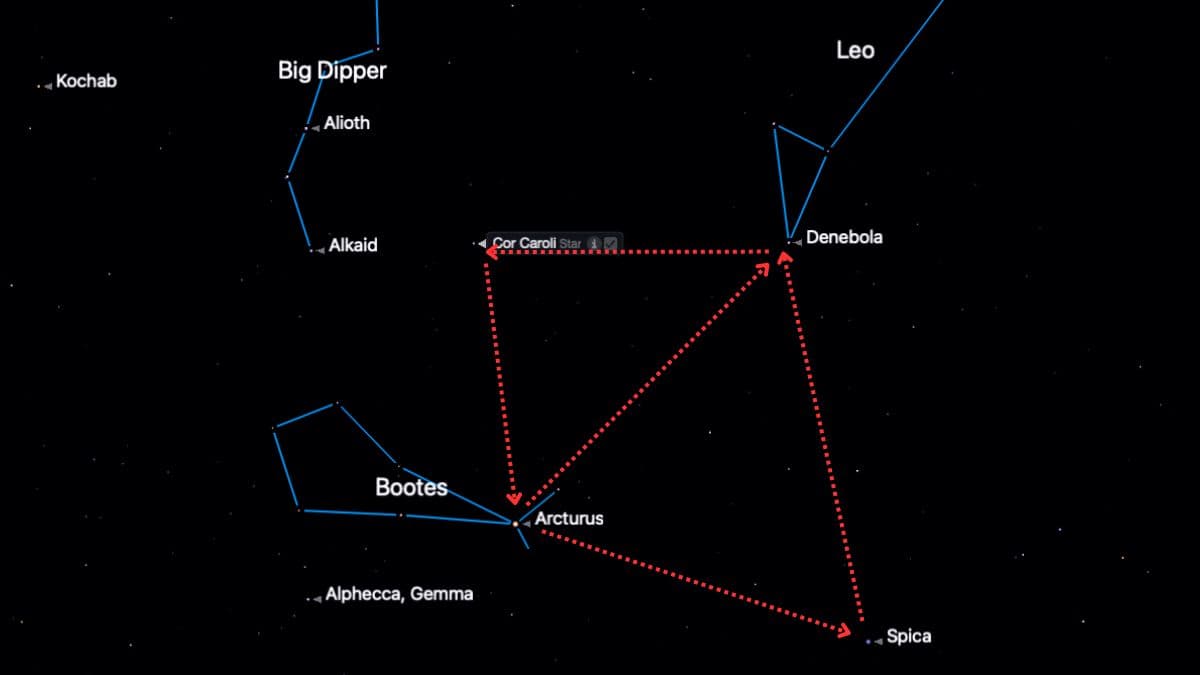
Once you've found Arcturus, Spica, and Regulus, connect them. They form the Spring Triangle, a large asterism that dominates the evening sky in May. It's not an official constellation, but it's a useful landmark for orienting yourself.
Asterisms like this are how experienced stargazers think. They're shortcuts that let you place yourself in the sky quickly, without scanning for individual constellations.
5. The Spring Diamond
Add one more star to the Spring Triangle and you get the Spring Diamond. The fourth point is Cor Caroli, a fainter star in Canes Venatici (the Hunting Dogs). It sits between Arcturus and the Big Dipper's handle.
The Spring Diamond is harder to see from light-polluted areas because Cor Caroli is dimmer than the other three stars. But from a dark site, it completes a satisfying geometric pattern across the spring sky.
Constellation of the Week: Boötes
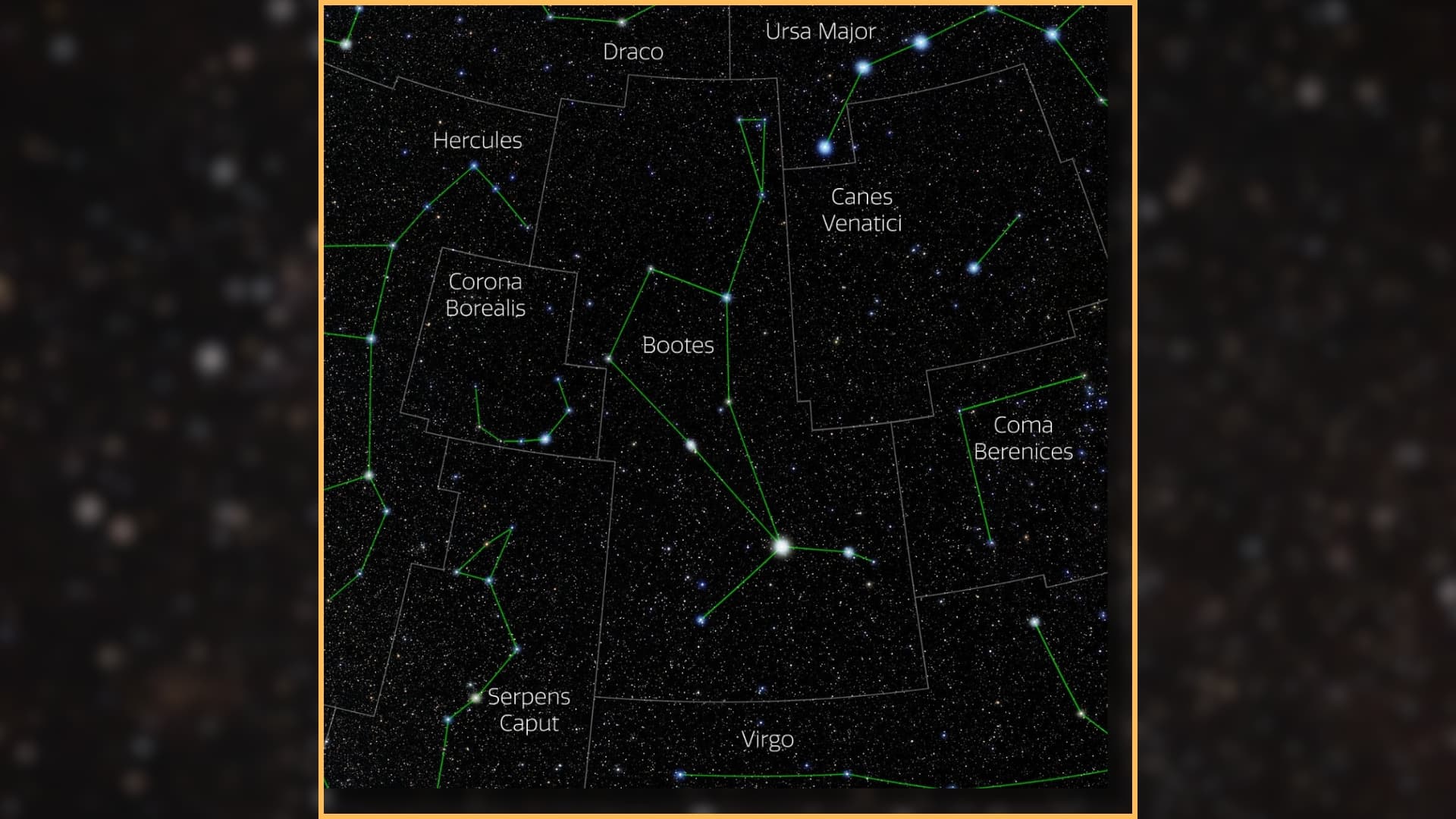
Boötes (pronounced boh-OH-teez) is the constellation anchored by Arcturus. Its name means "herdsman" in Greek, and it's been recognized since ancient times. The constellation looks like a kite or ice cream cone, with Arcturus at the bottom.
Finding Boötes is easy once you've arced to Arcturus. The rest of the constellation stretches northward toward the Big Dipper. It's not as dramatic as Orion or Scorpius, but it's a reliable spring fixture.
Tips for Your First Star-Hop
- Give your eyes 20-30 minutes to adapt to darkness before you start
- Avoid looking at your phone. If you must check an app, use red-light mode
- Start on a moonless night or after the moon has set
- Get away from streetlights. Even a backyard is better than a parking lot
- Don't try to learn everything at once. Master one star-hop before adding another
The night sky will reveal itself slowly if you let it. Each pattern you learn connects to the next. After a few sessions, you'll navigate instinctively, and you won't need to look down at a screen to find what's up.
Frequently Asked Questions
Why is the Big Dipper so important for stargazing?
The Big Dipper is one of the most recognizable star patterns in the northern hemisphere. It's visible year-round and provides direct lines to Polaris, Arcturus, Spica, and Leo, making it the ideal starting point for learning the sky.
Is Polaris the brightest star in the sky?
No. Polaris is only the 48th-brightest star visible from Earth. Its importance comes from its position near the celestial north pole, not its brightness.
What's the difference between a constellation and an asterism?
Constellations are officially defined regions of the sky. Asterisms are informal patterns that may span multiple constellations or be part of one. The Big Dipper is an asterism within the constellation Ursa Major.
How long does it take to learn the night sky?
You can learn the major spring star-hops in a single clear evening. Building a full mental map of the seasonal sky takes months of casual observation, but each session adds to your knowledge.
Do I need a telescope to star-hop?
No. Star-hopping is done with naked eyes. Telescopes and binoculars are useful for observing details once you've found something, but navigation is purely visual.


Logicity's Take
Need Help Implementing This?
Source: Latest from Space.com
Manaal Khan
Tech & Innovation Writer
Produced with AI assistance and reviewed by the Logicity editorial team. Learn more in our Editorial Policy.