Key Takeaways
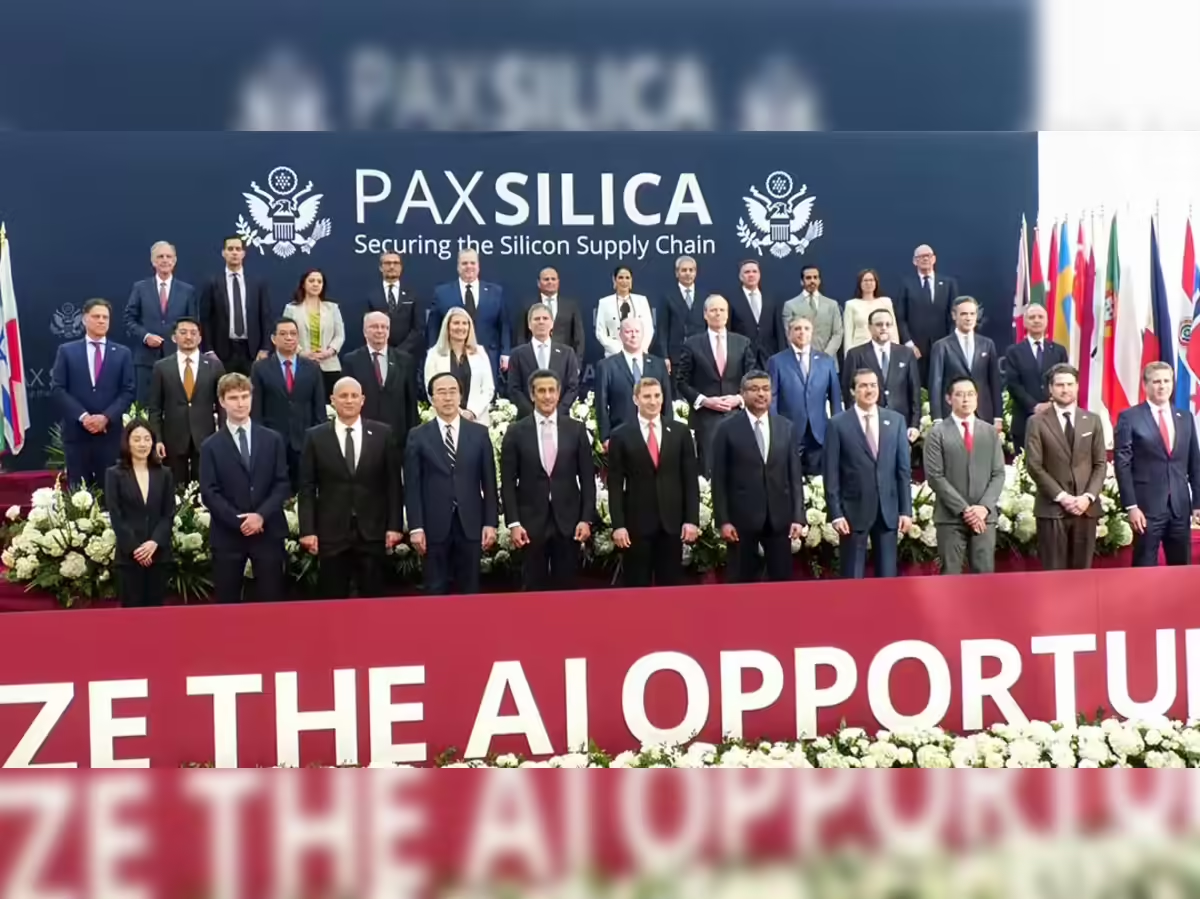
- 35 nations signed the Joint Statement on AI Opportunity, committing to pro-growth AI regulation
- India participated with senior officials from IT and External Affairs ministries
- The US-led initiative focuses on trusted supply chains for AI infrastructure and semiconductors
Thirty-five nations, including India, signed the Joint Statement on AI Opportunity at the second Pax Silica Summit in Washington on Thursday. The declaration commits signatories to a pro-growth, pro-innovation regulatory framework for artificial intelligence, with a focus on building trusted supply chains for semiconductors and compute infrastructure.
Jacob Helberg, US Under Secretary of State for Economic Affairs, framed the initiative as a race to build rather than regulate. "The future of AI will not be determined by who regulates first. It will be determined by who builds first and builds the most capacity," he said. "More energy. More compute. More chips. More talent. More builders."
What did India commit to at the Pax Silica Summit?
India's delegation included S. Krishnan, Secretary of the Ministry of Electronics and Information Technology, and Nagraj Naidu, Additional Secretary for the Americas in the Ministry of External Affairs. Industry representatives also attended. The team engaged with other governments on advancing collaboration in semiconductors, AI development, and resilient technology supply chains.
India joined the Pax Silica initiative in February, on the sidelines of the AI Impact Summit in New Delhi. The original group launched in December 2024 with a small number of countries. This week's summit expanded the coalition significantly, adding Argentina, Germany, the Netherlands, Chile, Costa Rica, Greece, Kazakhstan, Panama, and the European Union.
Why is the US pushing this AI coalition now?
The Pax Silica name, Latin for "Silicon Peace," signals American ambitions to unite allied nations around AI governance and semiconductor security. The initiative addresses concerns about technological competition with China and the concentration of chip manufacturing in Taiwan. By building a coalition of democracies, the US aims to coordinate standards and investment in AI infrastructure.
Helberg emphasized infrastructure over bureaucracy. "A commitment to trusted supply chains, to mobilising the private sector, and the infrastructure that will power the next century," he said. The statement explicitly welcomes private investment and positions itself against heavy-handed AI regulation.
“Together, we aspire to build an AI future that serves our peoples, strengthens our economies, and empowers entrepreneurship, innovation, and the rule of law.”
— Jacob Helberg, US Under Secretary of State for Economic Affairs
What does the AI Opportunity statement actually require?
The joint statement outlines principles rather than binding obligations. Signatories align behind pro-growth regulation, meaning they favor policies that encourage AI development over precautionary restrictions. The focus on trusted supply chains suggests coordination on semiconductor sourcing and potentially on AI export controls.
For India, the commitment connects to its broader push to attract chip manufacturing and develop domestic AI capabilities. The country has been positioning itself as an alternative destination for semiconductor production, though building fabrication capacity takes years and billions of dollars.
Who else joined the Pax Silica coalition?
The summit brought the total to 35 nations. New members this week included Argentina, Germany, the Netherlands, Chile, Costa Rica, Greece, Kazakhstan, Panama, and the European Union. The EU's participation is notable because the bloc has taken a more regulatory approach to AI than the US, passing the AI Act with strict rules for high-risk applications.
The coalition's composition suggests the US is prioritizing breadth over ideological purity. Countries with different domestic AI policies can still coordinate on supply chains and infrastructure investment. Whether this loose alignment translates to concrete action remains to be seen.
Frequently Asked Questions
What is the Pax Silica Summit?
A US-led diplomatic initiative focused on building international coalitions around AI governance and semiconductor supply chain security. The name means "Silicon Peace" in Latin.
Which countries signed the AI Opportunity statement?
35 nations including India, Argentina, Germany, the Netherlands, Chile, Costa Rica, Greece, Kazakhstan, Panama, and the European Union.
When did India join the Pax Silica initiative?
India joined in February 2025, during the AI Impact Summit in New Delhi.
What does the Joint Statement on AI Opportunity commit signatories to?
The statement aligns countries behind pro-growth, pro-innovation AI regulation, with emphasis on trusted supply chains and private sector investment in AI infrastructure.
Logicity's Take
The Pax Silica initiative is a diplomatic play dressed as tech policy. The US is building a coalition to counter China's AI ambitions, but the real question is whether pro-growth rhetoric translates to coordinated action. India's participation makes sense strategically, but the country's chip fabrication ambitions are years from reality. Watch whether this coalition produces investment commitments or just statements.
For context on how Indian startups are navigating infrastructure investment priorities
Need Help Implementing This?
Navigating AI policy and supply chain decisions for your business? Logicity covers the intersection of technology and business strategy. Subscribe for weekly analysis on the moves that matter.
Source: Tech-Economic Times / ET
Manaal Khan
Tech & Innovation Writer
Produced with AI assistance and reviewed by the Logicity editorial team. Learn more in our Editorial Policy.




