Key Takeaways
- Six Indian startups including Emo Energy and Baaz Bikes are raising a combined $65 million in fresh funding
- VCs are pivoting from pure EV bets to infrastructure plays like charging networks and energy storage
- Overall EV sector funding dropped 70% last year, but rising fuel costs and grid instability are reigniting investor interest
Six early-stage battery-tech and energy transition startups in India are raising a combined $65 million, marking early signs of revival in a sector where funding collapsed more than 70% last year. The startups span fast-charging networks, electric tractors, and industrial heat-storage batteries.
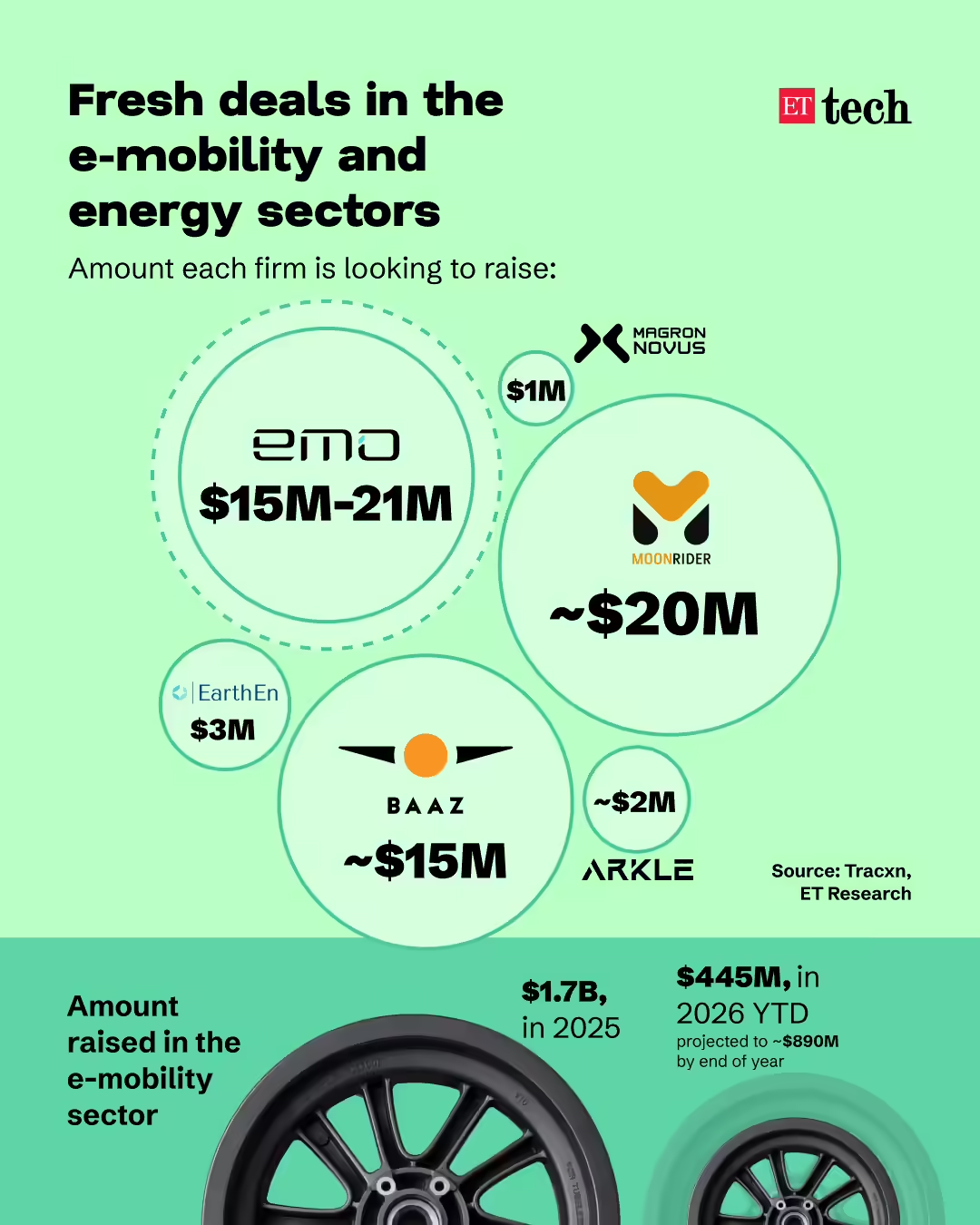
Emo Energy, Baaz Bikes, EarthEn Energy, Arkle Energy, Magron, and Moonrider are all in various stages of investor discussions, according to sources familiar with the deals. The activity signals a clear pivot: VCs are pulling back from pure electric-vehicle bets and redirecting capital toward EV infrastructure and energy storage.
Which startups are raising and how much?
Bengaluru-based Emo Energy leads the pack, seeking Rs 150-200 crore ($16-21 million). The company builds fast-charging battery systems for electric two-wheelers used by gig workers. It has existing backing from Gruhas and Subhkam Ventures and is also evaluating a debt raise.
Baaz Bikes, an electric mobility startup backed by Rakuten Capital, Kalaari Capital, and BIG Capital, is close to securing nearly $15 million. Sources say a lead investor is already committed, with additional investors being brought into the round.
Electric tractor startup Moonrider is targeting $20 million. Magron Novus, which makes electric motorcycles, is raising a $1 million bridge round (with $400,000 already secured) ahead of a larger $3-4 million round before its mid-2027 commercial launch.
In the energy storage segment, EarthEn Energy is raising a $3 million seed round for its heat-storage batteries targeting industrial customers. Arkle Energy, which develops vanadium redox flow batteries, is seeking about Rs 20 crore ($2 million) after previously raising $460,000.
Why are VCs shifting from EVs to infrastructure?
The numbers tell the story. So far this year, electric mobility startups have raised $445 million across 36 rounds, per Tracxn data. Last year, the sector pulled in $1.7 billion across 121 rounds, but nearly $1 billion of that came from a single company, Erisha E Mobility. Strip that out, and the underlying funding picture looks far weaker.
VCs now see infrastructure as offering more defensible positions. Charging networks, battery swapping, and storage systems create recurring revenue and lock-in effects that pure vehicle manufacturers struggle to match. Rising fuel costs and grid instability have made energy storage not just attractive but essential.
Shantanu Chaturvedi, Partner at Transition VC, explained the complexity: "The requirements vary significantly by application. A drone prioritises energy and power density, while a data centre focuses on cost and battery life cycles."
What's driving the renewed interest?
Founders point to geopolitical turbulence as a factor. One founder noted: "With the current geopolitical turbulence, the interest is certainly returning to this space, as we are seeing a lot of inbound interest."
Rising fuel costs and the broader push toward electrification remain fundamental drivers. Abhishek Srivastava, partner at Kae Capital, noted that EV adoption is changing consumer awareness: "EV adoption has also made consumers more aware of peak demand and supply constraints. As EV charging rises, households are increasingly experiencing the realities of energy consumption cycles."
Kae Capital has made energy transition one of its major investment theses, already backing Arkahub and Enerzolve. TDK Ventures is also actively evaluating investments, with Ravi Jain, investment director, highlighting a particular focus on new battery chemistries. The push for indigenous battery technologies has accelerated amid rising global headwinds.
How are listed EV players performing?
Listed EV companies continue raising institutional capital even as private funding tightens for smaller players. Ola Electric raised Rs 780 crore earlier this year through an oversubscribed issue. Ather Energy is seeking up to Rs 2,500 crore to fund expansion and growth plans.
This divergence matters. Public markets are providing capital to scaled players, while VCs are now picking infrastructure bets over the next generation of EV manufacturers. The implication: startups building vehicles face a harder fundraising path than those building the systems that vehicles depend on.
Frequently Asked Questions
How much are Indian EV infrastructure startups raising in 2024?
Six early-stage startups are collectively seeking approximately $65 million in fresh funding, with individual rounds ranging from $1 million to $21 million.
Why are VCs shifting from EV vehicles to EV infrastructure?
Infrastructure plays like charging networks and energy storage offer more defensible business models with recurring revenue, while pure EV manufacturing faced a 70%+ funding decline last year.
Which Indian EV startups are currently fundraising?
Emo Energy ($16-21M), Baaz Bikes ($15M), Moonrider ($20M), Magron ($1M bridge), EarthEn Energy ($3M), and Arkle Energy ($2M) are all in active discussions with investors.
What is driving renewed interest in Indian energy storage startups?
Rising fuel costs, geopolitical turbulence, increasing power consumption from EVs and data centers, and a push for indigenous battery technologies are all contributing factors.
Logicity's Take
This funding wave reveals a maturing investor thesis. The 2021-22 EV hype cycle chased vehicle sales numbers; the 2024 approach targets infrastructure bottlenecks that constrain adoption. Energy storage startups like EarthEn and Arkle are particularly interesting. They're not competing with Chinese battery giants on cell manufacturing, but building application-specific solutions where localization and customization matter. That's a smarter wedge into a market dominated by scale players.
Infrastructure investment decisions mirror the EV sector's shift toward supporting systems over end products
Need Help Implementing This?
Whether you're a startup navigating the EV infrastructure funding landscape or an investor evaluating battery-tech opportunities, Logicity tracks the deals and trends shaping India's energy transition. Subscribe to our newsletter for weekly analysis, or reach out directly if you're building in this space.
Source: Tech-Economic Times / ET
Huma Shazia
Senior AI & Tech Writer
Produced with AI assistance and reviewed by the Logicity editorial team. Learn more in our Editorial Policy.