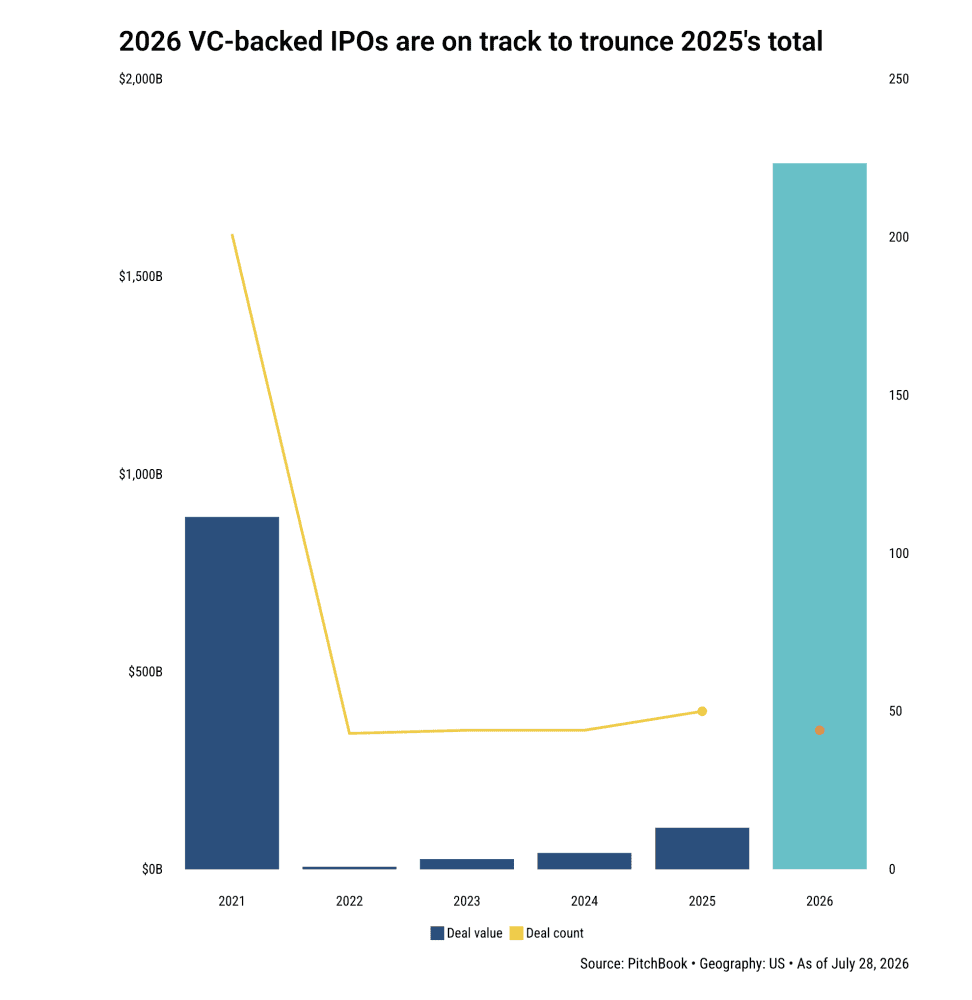
Through July 28, US VC-backed IPOs have generated $1.787 trillion in value, according to PitchBook. That number is not a record. It is five prior years stacked and doubled. But subtract SpaceX's June 12 debut at a $1.77 trillion valuation, and you're left with $17 billion across 43 other companies. That's 2023 with a trillion-dollar asterisk.
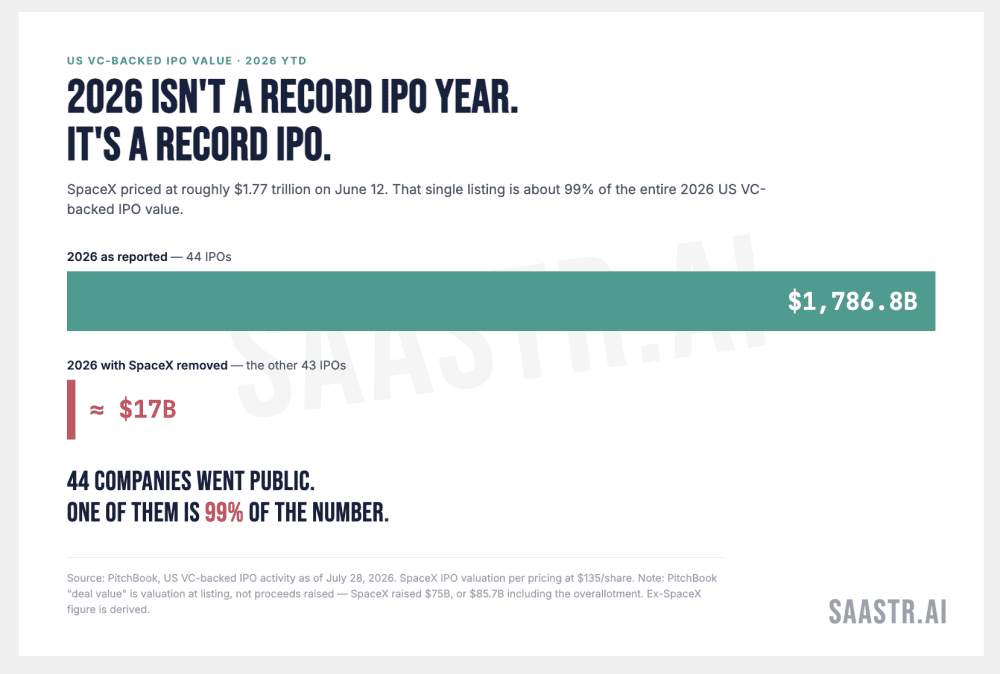
The headline says record. The composition says one company. And for B2B software founders watching this market? Not a single enterprise SaaS unicorn has even filed paperwork in 2026.
What the IPO count hides
Forty-four VC-backed IPOs through late July versus 50 for all of 2025. Annualize it and you land around 75, a meaningful uptick. But count was never the problem. 2023 and 2024 both produced 40-45 IPOs. The issue has always been quality: the best companies stayed private.
That pattern persists. SpaceX raised $85.7 billion including overallotment, the largest IPO in history by a wide margin. It sold 555.56 million shares at $135 each. The remaining 43 companies? Rounding errors against that bar.
A clarification matters here. PitchBook's "deal value" is post-money valuation at listing, not cash raised. Nobody handed $1.8 trillion to founders and LPs this year. The actual proceeds figure is a fraction of that headline.
The 2026 class is bleeding
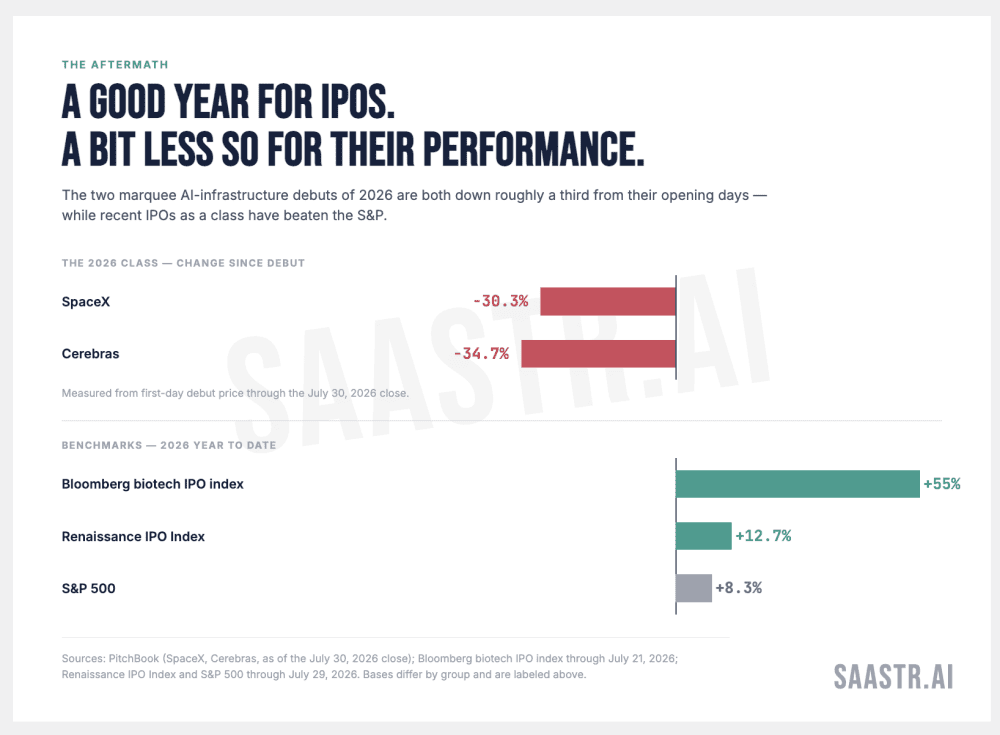
Post-IPO performance tells a different story than the valuations. SpaceX is down roughly 30% from its debut as of last Thursday's close. Cerebras has fallen 34.7%, and that's after a 19.9% single-day gain. The excuse being offered is macro: the Iran conflict, Chinese chipmakers threatening US AI compute.
But look at what these companies share. Enormous capex requirements. Long roads to revenue. Business models whose entire story is "the AI market keeps going up."
SpaceX spent $10.1 billion on capex in the three months ending March, up from $4.1 billion the year before. Most of that went to AI infrastructure. The company lost nearly $5 billion in 2025. CFRA initiated coverage with a sell rating, citing capital intensity and elevated valuation expectations.
“We will be a public company. I just think this is a terrible year to go public.”
— Ali Ghodsi, CEO of Databricks, on Bloomberg in June 2026
Public investors are doing what they always eventually do. They're pricing cash flows, not narratives.
The private-public gap didn't close
For four years the story was "the IPO window is shut." It wasn't exactly shut. What was shut was public investors' willingness to pay 2021 private-round prices.
2026 tested that thesis at scale. A handful of the most-hyped private companies in the world went public at or near their last private valuations. The market marked them down 30% or more within weeks. The gap between private round pricing and public market reality hasn't closed. It got tested with better companies at larger scale, and the answer came back the same.
Zero B2B software companies in the 2026 class
Go down the 2026 IPO list. SpaceX. Cerebras. Quantinuum. X-Energy. HawkEye 360. Space, AI silicon, quantum computing, nuclear energy, geospatial intelligence. Zero application software companies. Zero B2B SaaS.
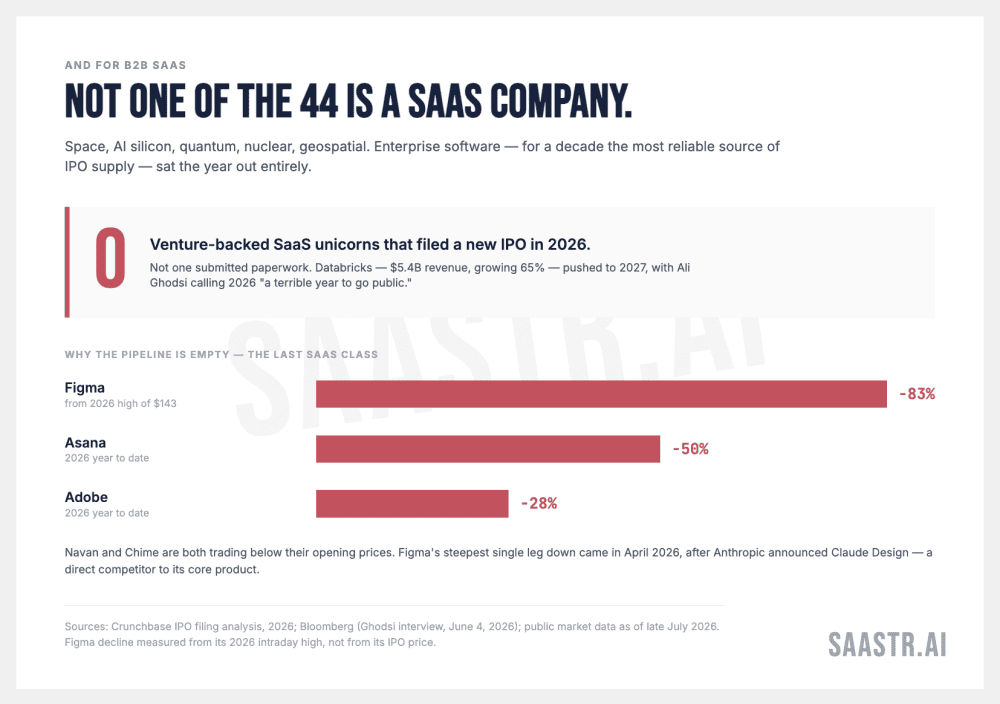
This isn't a timing coincidence. Crunchbase examined new IPO filings and found no venture-backed B2B unicorn had submitted paperwork at all in 2026. Not one.
Databricks was supposed to be the one. The company has $5.4 billion in revenue growing 65%, a $134 billion valuation, exactly the profile that used to get you out. When Ghodsi says the market isn't there, the market isn't there.
Why SaaS founders are staying private
The real reason the pipeline is empty has nothing to do with Iran. It's Figma.
Figma went public in July 2025 at $33. It hit $115 on day one, ran to $143. It now trades around $20-21. That's down 83% from the high, and below its IPO price.
The proximate cause wasn't rates or macro. It was Anthropic announcing Claude Design in April 2026, a direct competitor to Figma's core product. The stock fell 28% in March alone on general AI-disruption fear before that announcement even landed.
Figma isn't alone. Navan and Chime trade below their opening prices. Asana is down roughly 50% in 2026. Adobe has dropped 29%. ServiceNow is off more than 30%. Salesforce fell 35% over six months.
Disclosure
Some links in this post are affiliate links — Logicity earns a commission if you sign up, at no extra cost to you. We only link products we have used or actively recommend.
That's the mechanism. Public markets aren't just declining to pay 2021 prices for SaaS. They're actively pricing in the possibility that foundation models could disrupt entire product categories. A design tool, a CRM, a project tracker, an email platform. If an AI can do 80% of what the software does, what's the multiple?
Every SaaS founder watching this market is doing the same calculation. Stay private, where your valuation is a negotiation. Or go public, where Figma is your case study.
Logicity's Take
The 2026 IPO market reveals a clean split. Deep-tech bets (space, quantum, nuclear) can still go public because their moats aren't obviously threatened by foundation models. B2B SaaS cannot, because public investors now price AI disruption risk into every horizontal software company. For founders running SaaS businesses, the implication is stark: if you're planning an exit, M&A may be the only liquid path for the next 18-24 months. Companies like Salesforce and Adobe, despite their declines, are still acquirers. Getting bought at a discount beats going public into a market that's actively betting against your category.
What happens next
The SaaS IPO window isn't closed. It's closed for companies that can't answer the AI question. Public markets are now stress-testing every software company against a simple scenario: what happens when Claude or GPT can do your core job?
Companies with genuine data moats, deep workflow integration, or infrastructure-level lock-in may still find buyers. But "we grew 65% last year" is no longer enough. You need a defensibility story that survives a foundation model launch.
SpaceX's trillion-dollar IPO makes 2026 look like a boom. Strip it out and you see the real market: 43 companies worth $17 billion combined, zero enterprise software names, and a generation of SaaS founders watching Figma and deciding to stay private.
For context on which startups are raising in the current climate
Need Help Implementing This?
If you're a SaaS founder navigating exit timing or building defensibility against AI disruption, reach out to Logicity's advisory network. We connect operators with investors and M&A advisors who understand the current market dynamics.
Source: SaaStrAI
Manaal Khan
Tech & Innovation Writer
Produced with AI assistance and reviewed by the Logicity editorial team. Learn more in our Editorial Policy.