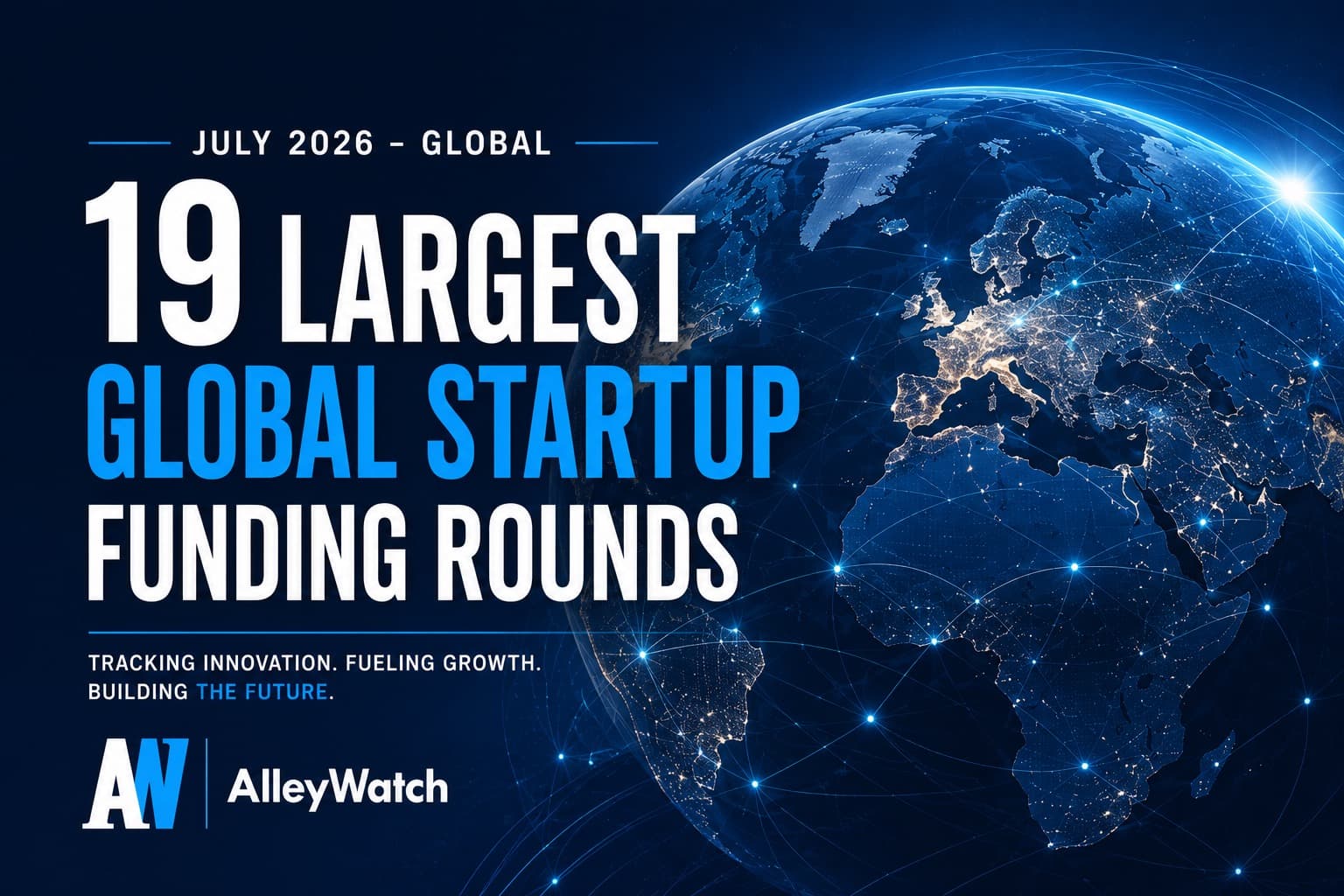
July 2026 saw 19 startup rounds cross the $300 million threshold, with AI infrastructure, quantum computing, and robotics commanding the largest checks. The month's biggest raise went to Etched, a San Jose company building custom chips for AI inference, which closed a $925.4 million Series C. The pattern across these deals: investors are betting that the next wave of value creation sits in the physical layer, hardware that runs AI models faster and cheaper than general-purpose alternatives.
Logicity's Take
The mix tells a story. Seven of July's top 19 rounds went to companies building physical infrastructure: chips, robots, quantum hardware. Investors are done betting purely on software wrappers around foundation models. For founders, the signal is clear: if your startup can reduce the cost or latency of running AI workloads at scale, capital is abundant. If you're building another fine-tuned GPT application, expect tougher conversations.
Etched leads with $925M for AI inference chips
Indian AI Startup Funding 2X in Q1 2026 - The Real Story Behind the Numbers | Front Page
Etched, founded in 2022 by Chris Zhu, Gavin Uberti, and Robert Wachen, designs hardware systems optimized specifically for AI model inference. The company has now raised $925.4 million in total equity. Andreessen Horowitz and Sequoia Capital led the Series C, with SK Hynix (a major memory chip supplier) and Jane Street Capital joining the round.
The thesis behind Etched is straightforward. General-purpose GPUs from NVIDIA dominate AI training, but inference, running a trained model to generate outputs, has different constraints. Purpose-built silicon can run inference workloads at a fraction of the cost and power consumption. SK Hynix's participation hints at tight integration with advanced memory architectures, which often bottleneck inference speed.
Xsight Labs closes $400M Series E for data center chips
Kiryat Gat-based Xsight Labs manufactures chipset semiconductors for data centers and automotive applications. Founded in 2017 by Erez Shaizaf, Gal Malach, and Guy Koren, the company has now raised $400 million total. The Series E round brought in Valor Equity Partners, Battery Ventures, T. Rowe Price, Intel Capital, and Fidelity.
Xsight sits in a different slot than Etched. Rather than competing directly with NVIDIA on compute, the company targets the networking and interconnect layer that links GPUs together in massive clusters. As AI training clusters grow to tens of thousands of chips, the fabric connecting them becomes a critical bottleneck.
Oratomic raises $310M seed for quantum computing
Oratomic, a South Pasadena startup founded in 2026, closed a $310 million seed round, one of the largest seeds on record. The company develops neutral-atom quantum hardware and error-correction architectures for fault-tolerant quantum computers.
The investor syndicate reads like a who's who of deep-tech capital: General Catalyst, Index Ventures, Khosla Ventures, ARCH Venture Partners, Spark Capital, and Bezos Expeditions. Scott Aaronson, a prominent quantum computing researcher at UT Austin, participated personally. Infleqtion, itself a quantum computing company, also invested, suggesting either strategic alignment or a bet on compatible approaches.
Neutral-atom systems represent one of several competing approaches to building quantum computers, alongside superconducting qubits (Google, IBM) and trapped ions (IonQ, Quantinuum). The technology uses laser-cooled atoms held in optical tweezers, which proponents argue scales more naturally to large qubit counts.
Walden Robotics pulls $300M seed for semi-humanoid robots
Cambridge-based Walden Robotics raised $300 million in seed funding to build wheeled, two-armed semi-humanoid robots for manufacturing and logistics. The founding team includes Russ Tedrake, a well-known robotics researcher from MIT, alongside Adrien Gaidon, Ben Burchfiel, Dave Johnson, Kerri Fetzer-Borelli, and Rareș Ambruș.
The round attracted a mix of financial and strategic investors. NVIDIA, Boeing, Toyota, and Toyota Ventures all participated, as did Prologis Ventures (the venture arm of the world's largest logistics real estate company) and CoreWeave Ventures. Samsung Ventures rounded out the strategic participation.
The "semi-humanoid" designation matters. Rather than building fully humanoid robots that walk on two legs, Walden uses wheels for mobility, a simpler engineering problem, while focusing on dexterous manipulation with two arms. The company cites "Physical AI" as its core technology, a term increasingly used to describe neural networks trained to control robots in the real world rather than simulated environments.
AdvanCell secures $439M for radiopharmaceutical cancer therapies
AdvanCell, a Sydney-based biotech, closed a $439.5 million Series D to develop targeted alpha radiopharmaceutical therapies for cancer. The company was founded in 2019 by Andrew Adamovich.
Eli Lilly and Sanofi Ventures both participated in the round, alongside Alpha Wave Global, Bain Capital Life Sciences, Catalio Capital Management, Fidelity, and T. Rowe Price. The presence of two major pharmaceutical companies signals potential future acquisition interest or partnership deals.
Radiopharmaceuticals attach radioactive isotopes to molecules that target cancer cells, delivering localized radiation doses. Alpha particles, in particular, cause more DNA damage per hit than the beta particles used in earlier radiopharmaceuticals, potentially improving efficacy against solid tumors. The approach has gained momentum after Novartis's 2018 acquisition of Advanced Accelerator Applications and subsequent success with Pluvicto for prostate cancer.
What the July rounds reveal about investor priorities
Three themes dominated the month's largest rounds.
First, the AI infrastructure bet is real and expensive. Etched and Xsight Labs together raised over $1.3 billion to build alternatives to general-purpose compute. Investors are pricing in a future where AI inference costs need to drop by an order of magnitude to make many applications economically viable.
Second, quantum computing is attracting serious capital again. Oratomic's $310 million seed suggests investors see a path to utility-scale quantum systems within a reasonable time horizon, not the "20 years away, always" skepticism that dominated 2022-2024.
Third, strategic investors are active. NVIDIA, Boeing, Toyota, SK Hynix, Intel, Eli Lilly, and Sanofi all participated in July's top rounds. These aren't passive financial bets. They're positioning moves by companies that expect to be customers, partners, or acquirers.
For founders building in adjacent spaces: the capital is there, but it's concentrating in companies with hard-to-replicate technical moats. Software-only plays face tougher scrutiny. Hardware, biology, and deep physics are back in favor.
Need Help Implementing This?
Logicity can help you plan your next funding round or benchmark your startup against these market signals. Reach out to our team for a strategy session.
Source: AlleyWatch
Manaal Khan
Tech & Innovation Writer
Produced with AI assistance and reviewed by the Logicity editorial team. Learn more in our Editorial Policy.