Key Takeaways
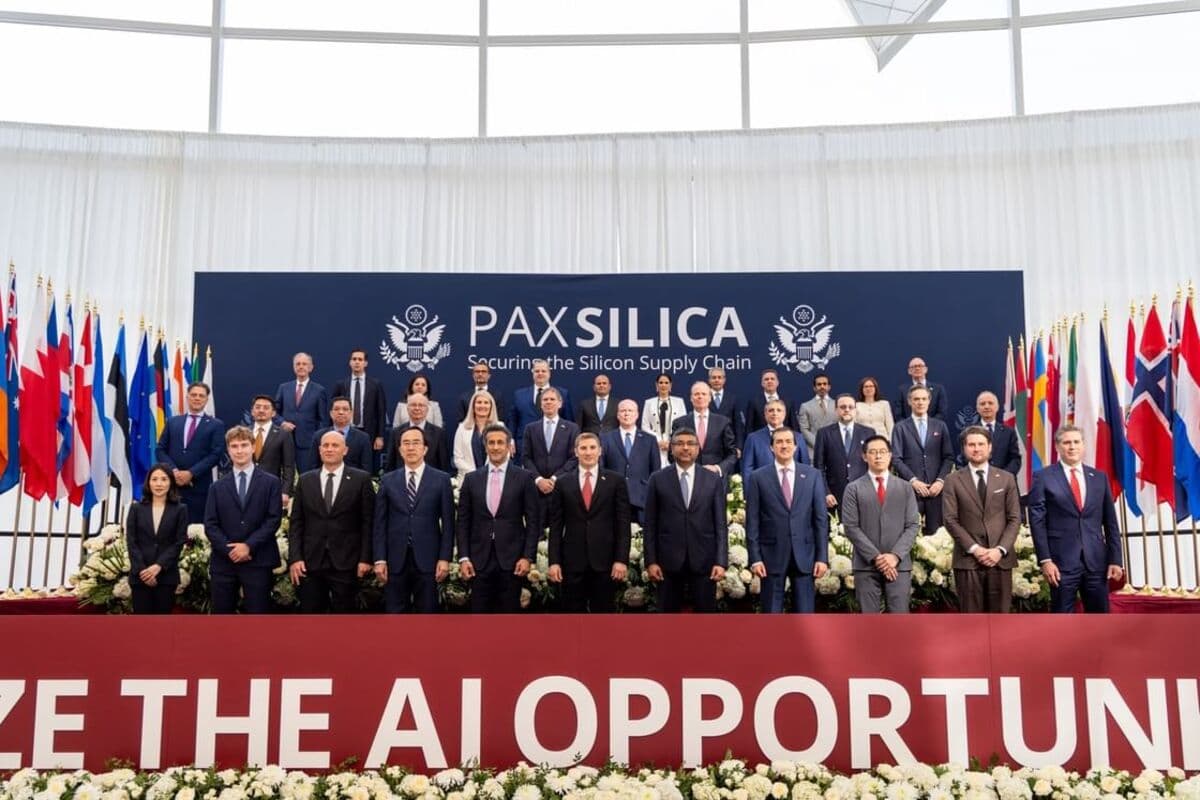
- UAE signed Joint Statement on AI Opportunities with 35 countries, committing to trusted AI infrastructure and supply chain collaboration
- Delegation included G42, Core42, MGX representatives alongside government officials, signaling private sector integration in AI diplomacy
- Bilateral meetings with US, EU, India, Singapore, South Korea focused on data governance and resilient digital supply chains
The UAE joined 35 countries in signing a Joint Statement on AI Opportunities at the second Pax Silica Summit in Washington D.C. this week, committing to build trusted cross-border AI infrastructure and resilient supply chains. The agreement marks a concrete step in the Gulf state's push to position itself as a preferred partner for Western nations seeking to diversify their AI and semiconductor dependencies.
Who represented the UAE at Pax Silica?
Minister of State Saeed Al Hajeri led the delegation, joined by Omran Sharaf, Assistant Foreign Minister for Advanced Science and Technology. The team also included executives from G42, Core42, MGX, and the Telecommunications and Digital Government Regulatory Authority. That mix of government officials and private sector AI companies reflects the UAE's approach: government sets the diplomatic framework, but companies like G42 and Core42 bring the compute infrastructure and technical credibility.
G42, in particular, has become the UAE's flagship AI company, having secured partnerships with Microsoft and OpenAI while navigating U.S. scrutiny over its China ties. Its presence at a summit explicitly focused on "trusted" AI infrastructure signals the company has passed muster with allied nations, at least for now.
What does the joint statement actually commit to?
The 35-nation statement emphasizes three pillars: inclusive innovation, resilient infrastructure, and trusted cross-border collaboration. The language is deliberately broad, focusing on principles rather than binding obligations. Think of it as a framework for future bilateral deals rather than a treaty with enforcement mechanisms.
The practical value lies in signaling. By joining, the UAE gets counted among "trusted" AI partners alongside the U.S., EU, Japan, South Korea, and others. For a country that has faced questions about its technology relationships with China, that stamp of approval matters. It opens doors to more sensitive AI and semiconductor collaborations that might otherwise be off-limits.

Bilateral meetings covered data governance and supply chains
Beyond the joint statement, the UAE held bilateral meetings with the United States, Qatar, Finland, India, Israel, the European Union, South Korea, Norway, the Philippines, Costa Rica, Singapore, and the United Kingdom. Officials said these conversations focused on trusted AI development, data governance, and resilient digital supply chains.
Al Hajeri framed the U.S. relationship specifically: "The UAE and the United States share a strong strategic partnership built on long-standing cooperation and a shared vision for technological advancement. Pax Silica serves as a practical platform to translate that ambition into real-world projects."
The "real-world projects" language hints at what comes next. The UAE wants to move from statements to contracts, whether that means hosting AI compute infrastructure, participating in allied semiconductor supply chains, or co-developing AI systems with Western partners.
How this fits the UAE's AI Strategy 2031
The UAE's national AI Strategy 2031 aims to position the country as a global hub for AI development. That requires two things: domestic compute infrastructure and international legitimacy. The UAE has spent heavily on the first, building data centers and GPU clusters through entities like G42 and Core42. Pax Silica addresses the second.
For AI builders and product teams, the pattern here is worth noting. The UAE is building itself as an alternative to hyperscaler regions in the U.S. and Europe, particularly for companies that want Middle East presence or need compute closer to markets in South Asia and Africa. Whether those ambitions pan out depends on whether the "trusted" label from summits like Pax Silica translates into actual regulatory access and partnership deals.
Logicity's Take
The UAE's presence at Pax Silica is less about the summit itself and more about what it enables afterward. G42 and Core42 are positioning themselves as "trusted" alternatives to Chinese AI infrastructure providers. If that positioning holds, expect to see them competing for enterprise AI workloads in regulated industries that can't touch Chinese cloud providers. For product teams building AI applications, this creates a potential third option beyond AWS/Azure/GCP and Chinese hyperscalers. The question is whether UAE data centers will meet the compliance requirements of European and American enterprises. That's still unproven.
Frequently Asked Questions
What is the Pax Silica Summit?
Pax Silica is a diplomatic forum where allied nations coordinate on AI infrastructure, semiconductor supply chains, and trusted technology partnerships. The name combines Latin for 'peace' with 'silica,' the base material for semiconductors.
Which countries participated in the Pax Silica Summit 2026?
The summit included 35 countries that signed the Joint Statement on AI Opportunities. Confirmed participants include the UAE, United States, EU, India, Israel, South Korea, Japan, Singapore, UK, Norway, Finland, Philippines, Costa Rica, and Qatar.
What companies represented the UAE at Pax Silica?
G42, Core42, MGX, and the Telecommunications and Digital Government Regulatory Authority sent representatives alongside government officials.
How does Pax Silica affect AI developers and startups?
The framework could expand options for AI compute infrastructure by legitimizing UAE-based providers as trusted alternatives to U.S. and Chinese hyperscalers. This matters for companies needing regional data residency or lower-latency access to Middle East and South Asian markets.
South Korea, another Pax Silica participant, announced major AI chip investments as part of its supply chain strategy
Need Help Implementing This?
If you're evaluating cloud providers or AI infrastructure options for your product, reach out to the Logicity team. We help AI builders navigate regional compute options, compliance requirements, and vendor selection.
Source: Economy Middle East
Manaal Khan
Tech & Innovation Writer
Produced with AI assistance and reviewed by the Logicity editorial team. Learn more in our Editorial Policy.