Key Takeaways
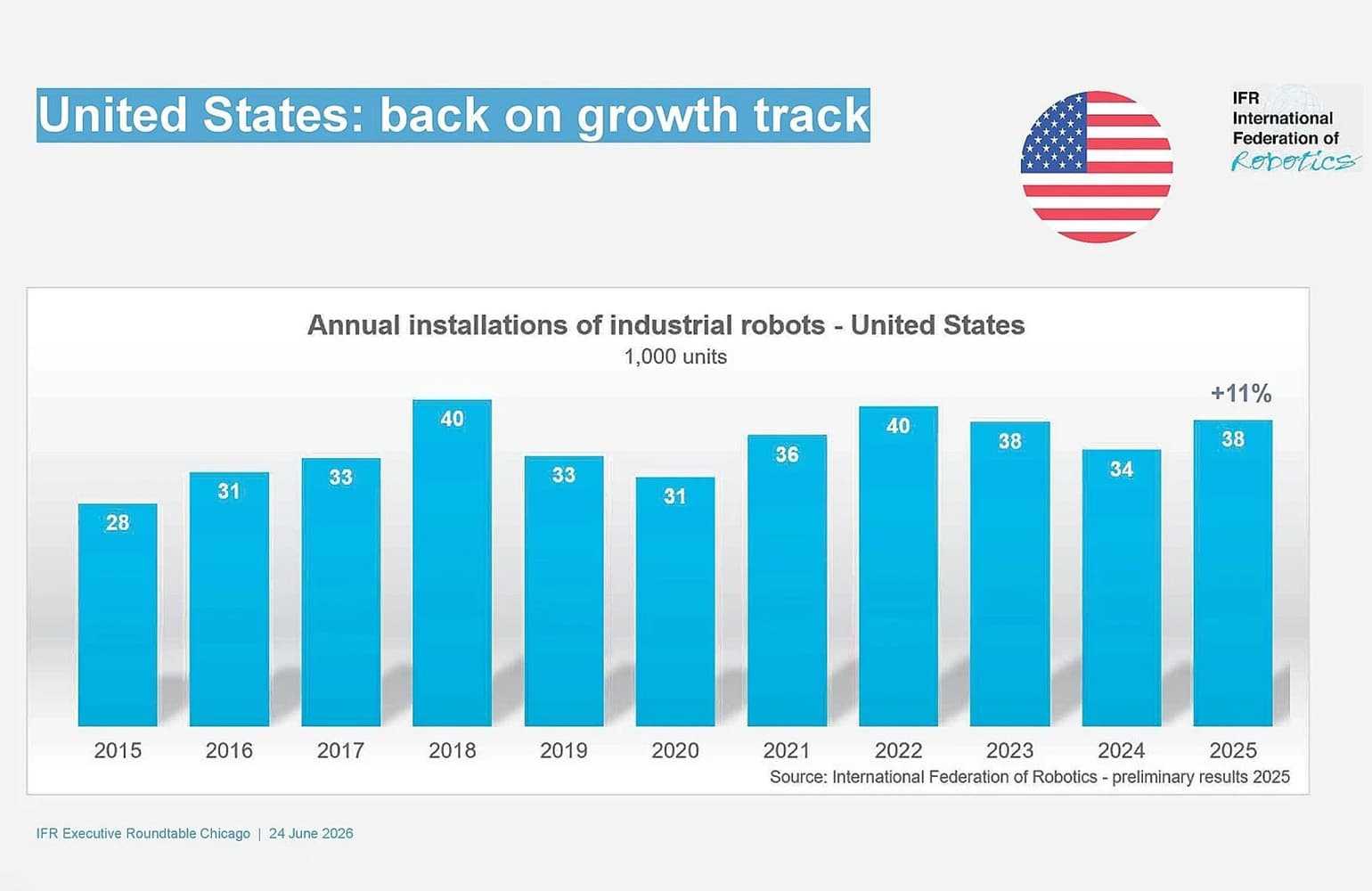
- U.S. installed 38,000 industrial robots in 2025, an 11% increase over last year
- Food industry robot adoption surged 30%, now matching metal, machinery, and electronics sectors
- China installs roughly 10x more robots annually, prompting calls for a U.S. national robotics strategy
The United States installed 38,000 industrial robots in 2025, an 11% jump from the previous year, according to new data from the International Federation of Robotics. The growth marks a recovery for the American robotics market, driven largely by a 30% surge in food industry adoption.
Automotive remains the largest sector, accounting for 13,500 units. That figure came in just 1% below last year's result, representing the sector's third-best performance in seven years. But the real story lies in the diversification happening outside traditional manufacturing.
“The United States is back on the growth track. While automotive achieved its third-best result in seven years, the data highlights a growing demand for flexible automation in the food industry: Adoption in this sector surged by 30%, now ranking alongside metal and machinery and electrical-electronics, all with approximately 3,000 installations in 2025.”
— Takayuki Ito, President, International Federation of Robotics
Where does the U.S. rank globally in robot density?
The IFR measures automation levels through robot density: the number of industrial robots per 10,000 manufacturing employees. The U.S. now stands at 307 robots per 10,000 workers, placing it eighth globally. That's two spots higher than last year.
The gap with leading nations remains substantial. South Korea tops the list at 1,220 robots per 10,000 employees. Germany and Japan follow at 449 and 446 respectively. The U.S. does rank ahead of China, which sits at 166 robots per 10,000 workers despite its manufacturing dominance.
China installs 10 times more robots annually
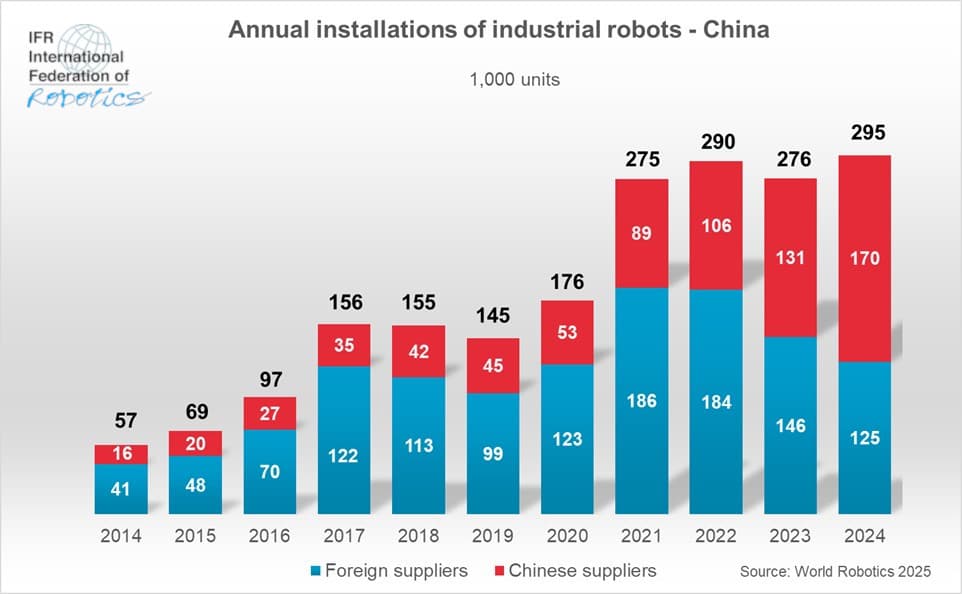
Robot density tells only part of the story. In raw installation volume, China dwarfs every other market. Annual installations in China reached 295,000 units in 2024, capturing 54% of the global market. The IFR estimates China's 2025 figures will run about ten times higher than U.S. installations.
This dominance stems from a national robotics strategy China launched a decade ago. The country's recently published 15th Five-Year Plan, covering 2026 to 2030, places robotics at the center of its industrial modernization. Beijing is directing AI research toward physical applications, positioning robots as a primary engine of economic growth.
A3 pushes for a U.S. national robotics strategy
The gap has not gone unnoticed in Washington. The Association for Advancing Automation, known as A3, has formally presented its "Vision for a National Robotics Strategy" to lawmakers. The trade group proposes creating a Federal Robotics Office and a national commission to coordinate policy across government agencies.
A3's framework calls for market-driven tax incentives to encourage automation adoption, expanded technical workforce retraining programs, and updated safety standards. The proposal also includes a federal mandate requiring government agencies to purchase domestic robotics technology, aiming to accelerate commercial deployment and reduce dependence on foreign suppliers.
What's driving U.S. robotics growth?
Two factors underpin the IFR's positive outlook for North American automation. First, factory reshoring initiatives continue to accelerate as companies move production back from overseas. Second, persistent skilled labor shortages are forcing manufacturers to automate tasks they previously filled with workers.
The IFR projects these structural conditions will sustain long-term growth in the region's automation sector. Demand is diversifying beyond automotive and electronics into food processing, logistics, and other non-manufacturing applications. Companies are increasing automation investments specifically to address workforce gaps that show no signs of closing.
The food industry's 30% jump stands out. With roughly 3,000 installations in 2025, it now matches metal and machinery manufacturing and electrical-electronics. For an industry historically slow to automate due to variable products and challenging handling requirements, this signals a turning point.

Logicity's Take
The U.S. has the capital, the engineering talent, and the manufacturing base to compete in robotics. What it lacks is coordination. China's 10x installation advantage did not happen by accident. It resulted from sustained government investment and clear industrial policy over a decade. A3's proposed Federal Robotics Office may sound like bureaucracy, but without some mechanism to align research funding, workforce training, and procurement policy, the U.S. will keep celebrating 11% growth while China captures the majority of the global market.
Frequently Asked Questions
How many industrial robots did the U.S. install in 2025?
The U.S. installed 38,000 industrial robots in 2025, representing an 11% increase over the previous year according to IFR data.
Which industry leads U.S. robot adoption?
Automotive remains the largest sector with 13,500 robot installations in 2025. However, the food industry grew fastest at 30%, reaching approximately 3,000 units.
What is the U.S. robot density ranking?
The U.S. ranks eighth globally with 307 industrial robots per 10,000 manufacturing employees, behind South Korea (1,220), Germany (449), and Japan (446).
How do U.S. robot installations compare to China?
China installed 295,000 industrial robots in 2024, capturing 54% of the global market. The IFR estimates China's annual installations run about 10 times higher than U.S. figures.
What is A3's proposed national robotics strategy?
A3 advocates for a Federal Robotics Office, tax incentives for automation, expanded workforce retraining, updated safety standards, and federal mandates to purchase domestic robotics technology.
Explores how automation and AI are reshaping workforce requirements for new ventures
Need Help Implementing This?
If your organization is exploring industrial automation or robotics adoption, Logicity can connect you with implementation partners and industry analysts. Contact our team for vendor comparisons and integration guidance tailored to your sector.
Source: The Robot Report / The Robot Report Staff
Huma Shazia
Senior AI & Tech Writer
Produced with AI assistance and reviewed by the Logicity editorial team. Learn more in our Editorial Policy.




