Key Takeaways

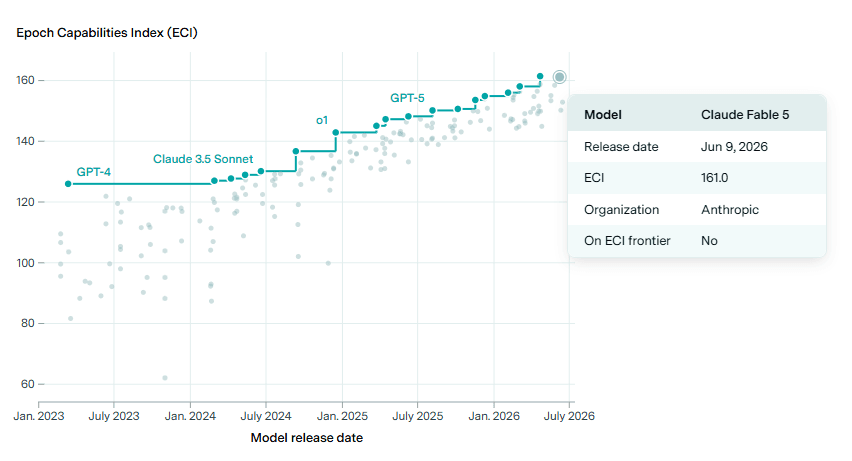
- GPT-4 held the #1 spot on the Epoch Capabilities Index for about a year, far longer than any model since
- Since Claude 3 Opus dethroned GPT-4 in February 2024, the leaderboard has changed hands 17 times
- The median reign at the top has shrunk to roughly seven weeks, signaling fiercer competition and smaller capability gaps
GPT-4 sat atop the Epoch Capabilities Index for about 365 days. That year-long reign now looks like an anomaly. Since Claude 3 Opus displaced it in February 2024, the number-one position has changed hands 17 times, and the median stay at the top has collapsed to roughly seven weeks.
The data comes from Epoch AI researcher Jaeho Lee, who charted leadership transitions on the ECI, a composite score that aggregates language-model performance across multiple benchmarks. OpenAI's o1, released in fall 2024, managed the second-longest lead at about three months, still less than a third of GPT-4's run.
Why did GPT-4 stay on top so long?
GPT-4 was a genuine outlier at launch. OpenAI shipped it in March 2023 with capabilities that outpaced anything else available by a wide margin. Anthropic, Google, and other labs needed nearly a full year to close that gap. The chart can be read as a measure of how far ahead GPT-4 was, or as evidence that no lab has managed a comparable lead since.
Part of the explanation is timing. GPT-4 arrived before the current wave of reasoning-focused models. Once Claude 3 Opus matched its scores, the industry entered a new phase: incremental gains shipped faster, but each jump was smaller. The era of one model dominating for a year appears to be over.
What the seven-week cycle means for product teams
For teams building on top of frontier models, the compressed leadership cycle carries practical consequences. Locking into a single provider's API now looks riskier. A model that is best-in-class today may sit at second or third place within two months.
Abstraction layers and model-agnostic architectures become more valuable when the leaderboard shuffles this quickly. Some teams already route requests to whichever model scores highest on a task-specific benchmark, swapping providers without rewriting application code.
Pricing leverage shifts, too. When multiple models trade the top spot, no single vendor can command a premium for long. OpenAI, Anthropic, Google, and a growing list of open-weight contenders will compete on cost and latency as much as raw capability.
Are capability gains slowing down?
The faster churn does not mean progress has stalled. It suggests the opposite: labs are shipping improvements more frequently, but no single release opens a gap wide enough to hold for a year. Each transition now represents a narrower capability jump compared to the leap GPT-4 made in 2023.
Reasoning models like o1-preview, released in fall 2024, marked a shift in how labs chase the top spot. Rather than scaling parameters alone, OpenAI introduced chain-of-thought inference at serving time. That technique spread quickly. Anthropic, Google, and open-source projects adopted similar approaches within months, accelerating the catch-up cycle.
How the Epoch Capabilities Index works
The ECI is not a single benchmark. Epoch AI aggregates scores across a range of tasks, from coding and math to general knowledge and instruction-following, weighting them into a composite number. That approach smooths out quirks of any one test and gives a broader view of overall capability.
Because the index tracks public models, it may lag behind internal checkpoints at major labs. A company could have a model that scores higher internally but has not released it. Still, the ECI captures what builders can actually use, which is what matters for product decisions.
Logicity's Take
The seven-week cycle is a signal, not a crisis. For AI builders and product teams, the takeaway is architectural: design for portability. Abstraction layers like LiteLLM or LangChain let you swap model providers without rewriting core logic. Embed evaluation harnesses into your CI pipeline so you can test new releases against your own use cases, not just public benchmarks. The days of betting everything on one model for 12 months are gone.
Frequently Asked Questions
What is the Epoch Capabilities Index?
The ECI is a composite score created by Epoch AI that aggregates language-model performance across multiple benchmarks, including coding, math, and instruction-following tasks.
How long did GPT-4 hold the top AI benchmark spot?
GPT-4 held the number-one position on the Epoch Capabilities Index for approximately one year, from its March 2023 launch until February 2024.
Which model currently leads the Epoch Capabilities Index?
The source does not specify the current leader. Given the rapid turnover, the top spot changes roughly every seven weeks on average.
Why are AI models losing their lead faster now?
Competition has intensified. Multiple labs ship incremental improvements more frequently, so each capability jump is smaller and rivals close the gap faster than they did with GPT-4.
Should product teams switch AI providers every time a new model tops the benchmark?
Not necessarily. Building abstraction layers lets teams swap models when it makes sense for their use case, but chasing every leaderboard change adds complexity without guaranteed gains.
Explores how new entrants are challenging dominant AI labs with specialized models.
Need Help Implementing This?
Building a model-agnostic stack or evaluating which frontier model fits your product? Logicity's consulting team helps startups and enterprises design AI architectures that stay flexible as the leaderboard shifts. Reach out at consulting@logicity.in.
Source: The Decoder / Matthias Bastian
Manaal Khan
Tech & Innovation Writer
Produced with AI assistance and reviewed by the Logicity editorial team. Learn more in our Editorial Policy.