
The world of tech is abuzz with the latest developments in AI, from humanoid robots trained by gig workers to new benchmarks for evaluating AI performance. OpenAI has just closed a record-breaking funding round, and the implications are profound. As we navigate this brave new world, one thing is clear: the future of tech is arriving faster than we thought.
Key Takeaways
- Humanoid robots are being trained by gig workers around the world
- New benchmarks are needed to evaluate AI performance in real-world scenarios
- OpenAI has closed a record-breaking funding round, paving the way for major advancements in AI
In This Article
- The Rise of Humanoid Robots
- The Need for New AI Benchmarks
- OpenAI's Record-Breaking Funding Round
- The Promise of Quantum Computing
- The Future of Tech: What's Next?
The Rise of Humanoid Robots
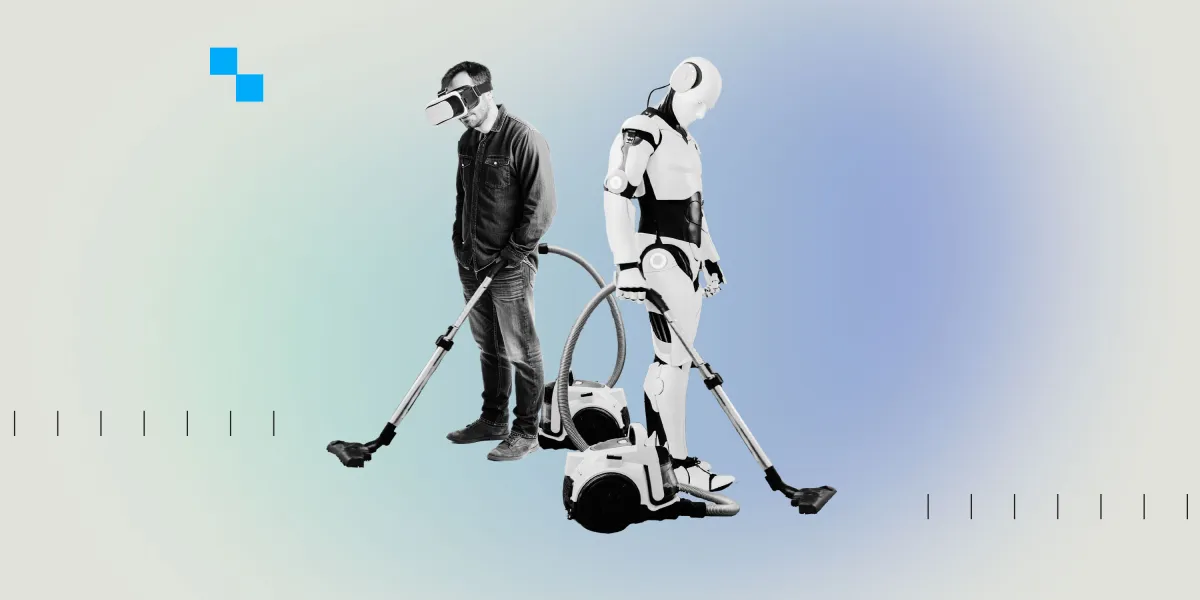
Imagine a world where robots can perform tasks with the same ease and agility as humans. This is the promise of humanoid robots, and it's becoming a reality thanks to the work of gig workers around the world. These workers are recording themselves performing everyday tasks, which are then used to train the robots.
- Gig workers are recording themselves doing chores and other tasks to train humanoid robots
- This data is being used to help robots learn how to perform tasks in a more human-like way
- The implications are profound, from healthcare to manufacturing and beyond
The Need for New AI Benchmarks
For decades, AI has been evaluated based on its ability to perform specific tasks in isolation. But this approach is limited, as it doesn't take into account the complexities of real-world scenarios. According to Angela Aristidou, professor at University College London, 'we need new benchmarks that assess AI's performance over longer horizons within human teams, workflows, and organizations'
- Current AI benchmarks are limited and don't reflect real-world scenarios
- New benchmarks are needed to evaluate AI performance in a more nuanced way
- This will help us better understand the capabilities and limitations of AI
OpenAI's Record-Breaking Funding Round
OpenAI has just closed a record-breaking funding round, raising $122 billion ahead of its planned IPO. This is a major milestone for the company, and it's sure to have a profound impact on the development of AI. As one expert noted, 'this is a game-changer for the industry'
- OpenAI has raised $122 billion in funding, a record for Silicon Valley
- This funding will be used to drive innovation and development in AI
- The implications are far-reaching, from improved language models to enhanced decision-making capabilities
The Promise of Quantum Computing
Quantum computing has the potential to revolutionize a wide range of fields, from healthcare to finance. A recent competition is aiming to harness the power of quantum computing to solve real-world problems, with a prize of $5 million on offer
- Quantum computing has the potential to solve complex problems that are currently unsolvable
- A recent competition is aiming to harness the power of quantum computing to solve real-world problems
- The winner will receive a prize of $5 million, a significant incentive for innovation
The Future of Tech: What's Next?
As we look to the future, one thing is clear: the world of tech is changing fast. From humanoid robots to quantum computing, the pace of innovation is accelerating. So what's next? How will these developments shape the world of tomorrow?
- The future of tech is arriving faster than we thought
- Humanoid robots, quantum computing, and AI will shape the world of tomorrow
- The implications are profound, from improved healthcare to enhanced decision-making capabilities
“we need new benchmarks that assess AI's performance over longer horizons within human teams, workflows, and organizations”
— Angela Aristidou, professor at University College London
Final Thoughts
As we navigate this brave new world of tech, one thing is clear: the future is arriving faster than we thought. From humanoid robots to quantum computing, the pace of innovation is accelerating. So what's next? How will these developments shape the world of tomorrow? One thing is certain: the future of tech is going to be exciting, and it's arriving sooner than we thought.
Sources & Credits
Originally reported by MIT Technology Review

Huma Shazia
Senior AI & Tech Writer
Produced with AI assistance and reviewed by the Logicity editorial team. Learn more in our Editorial Policy.




