Sarvam AI has raised $75 million from Nvidia, Glade Brook Capital, and others as part of an ongoing funding round that values the Bengaluru-based AI startup at $1.5 billion. The fresh capital is part of a larger $300-310 million round, according to filings with the Registrar of Companies.
This marks a significant jump from Sarvam's $41 million Series A in December 2024, led by Lightspeed Venture Partners. In under two years, the company has moved from seed-stage to unicorn territory on the strength of its Indic-language large language models.
Who invested in the $75 million tranche?
The investor list reads like a strategic bet on India's AI infrastructure. Nvidia's participation signals hardware-level alignment. The chipmaker has been selectively backing AI model builders who could drive demand for its GPUs in emerging markets.
Glade Brook, a US venture firm, joins alongside private equity investor Gaja Capital and IndiGo Ventures. Several individual investors also participated. Sarvam had announced the first close of this larger round in June 2026, raising $234 million led by HCLTech, with Bessemer Venture Partners, Peak XV Partners, and Khosla Ventures also joining.
Sarvam's trillion-parameter ambitions
At its Epoch developer event on July 30, Sarvam unveiled plans to build a trillion-parameter model. The company also announced a San Francisco office and named Devendra Chaplot, a founding member of Thinking Machines Lab and Mistral, as an adviser.
Sarvam is positioning itself to compete with frontier AI labs. The company explicitly targets Anthropic's Claude, Google's Gemini, and OpenAI's ChatGPT. Whether an India-first AI company can reach parity with models trained on vastly larger compute budgets remains the core question. The Nvidia investment at least signals access to hardware will not be the bottleneck.

Ather Energy narrows Q1 loss to Rs 51 crore
Electric two-wheeler maker Ather Energy reported a sharply narrower loss for Q1 FY27. Net loss fell to Rs 51.1 crore from Rs 178.2 crore in the year-ago quarter. Revenue jumped 89% year-on-year to Rs 1,217 crore.
Total expenses grew to Rs 1,310.7 crore from Rs 851.1 crore, but scale is starting to work in Ather's favor. The company's FY25 net loss was Rs 1,060 crore on revenue of Rs 1,880 crore, a 5% improvement from FY24. Q1 suggests the trajectory is accelerating.
“Demand is significantly ahead of what we can currently produce. We believe that, based on current demand, we could have retailed another 13,000-15,000 scooters every month if capacity was available.”
— Tarun Mehta, CEO and co-founder, Ather Energy
Ather holds roughly 14% of India's electric two-wheeler market, which saw 2.1 million units sold in FY25. The capacity constraint Mehta describes is real. Whether it is a good problem or a missed opportunity depends on how fast Ather can expand production before competitors fill the gap.
Mobikwik posts third straight profitable quarter
Payments company Mobikwik reported net profit of Rs 7.6 crore in Q1, its third consecutive profitable quarter. Revenue rose 3.7% year-on-year to Rs 281.5 crore. The company had posted a loss of Rs 41.9 crore in the same period last year.
CEO Bipin Preet Singh attributed the turnaround to improving contribution margins. "The contribution margin is what drives our profits, which includes direct costs related to customer acquisition, cost of payments and banking, etc. So, that is 66% up year-on-year to nearly Rs 129 crore," he said.
Mobikwik's profitability arrives as the government considers reintroducing MDR (merchant discount rate) on UPI transactions. The levy was scrapped in January 2020 to encourage digital payments adoption. Sources indicate it could return at 5-7 basis points for large merchants. For fintechs like Mobikwik, MDR revenue would provide a structural boost.
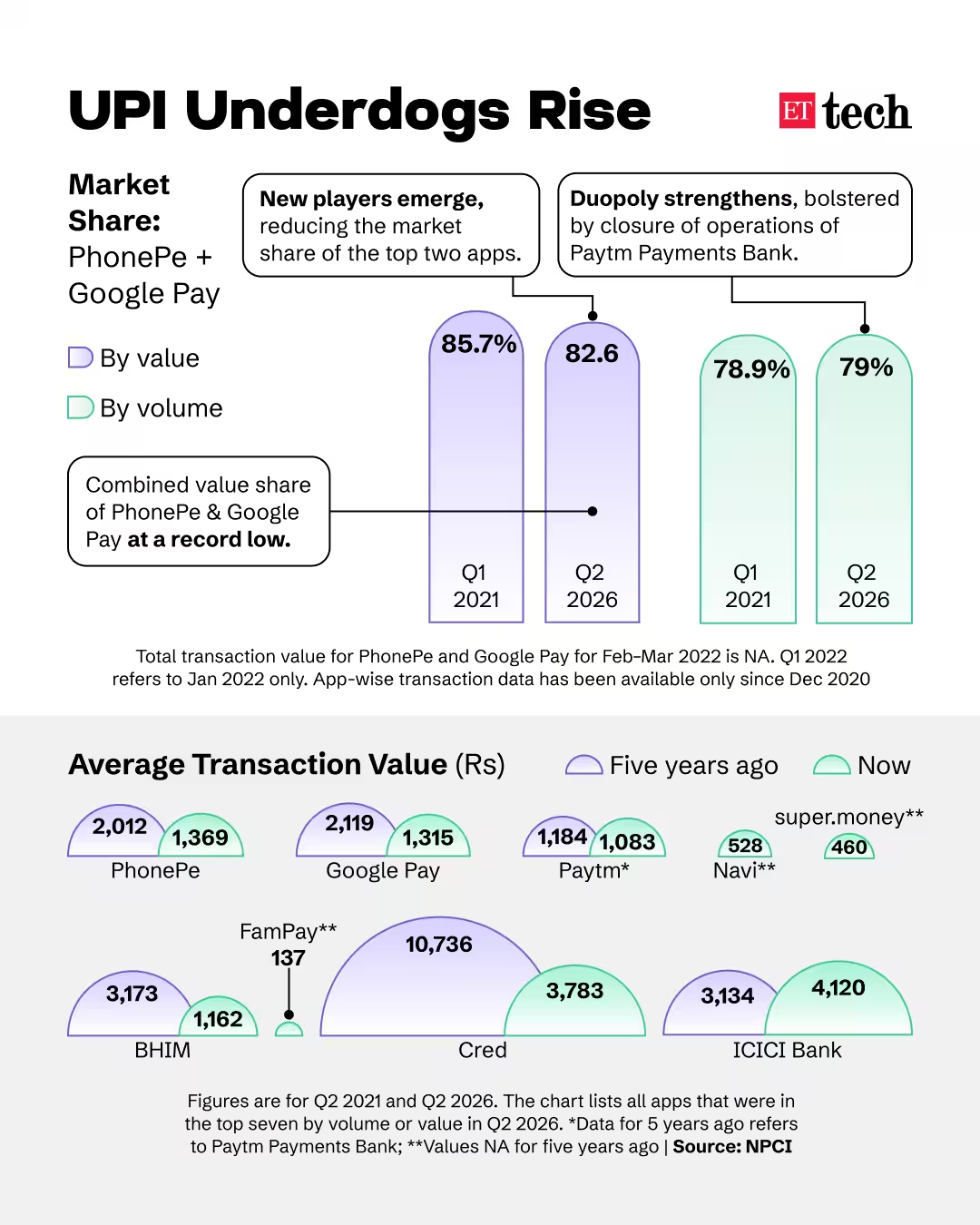
The UPI market itself is shifting. PhonePe and Google Pay's combined share has fallen to a five-year low: 82.6% by value and 79% by volume. Smaller apps like Supermoney, Navi, and FamPay are gaining ground, particularly for low-value transactions.
Logicity's Take
Sarvam's round shows Indian AI is attracting serious capital, but the trillion-parameter goal is a fundraising narrative until proven otherwise. The real test: can Sarvam deliver enterprise value before the next funding cycle? For Ather, demand-constrained growth is enviable but dangerous. Competitors like Ola Electric and Bajaj are expanding capacity. A 13,000-unit monthly shortfall is market share walking out the door.

In other developments, the government is expected to approve manufacturing centers for rare earth permanent magnets under the next tranche of its ECMS program. The move would reduce India's dependence on Chinese imports for components critical to EVs and wind turbines.

These funding and earnings updates arrive during a busy week for Indian tech. UPI volumes hit a record high in July, approaching Rs 30 lakh crore. The payments infrastructure continues to scale even as questions about its economics remain unresolved.
Related context on the AI industry's rapid expansion and its observable effects
Need Help Implementing This?
Logicity helps founders and CTOs navigate funding rounds, build investor narratives, and benchmark against comparable raises. Get in touch for a strategy session.
Source: Tech-Economic Times
Manaal Khan
Tech & Innovation Writer
Produced with AI assistance and reviewed by the Logicity editorial team. Learn more in our Editorial Policy.