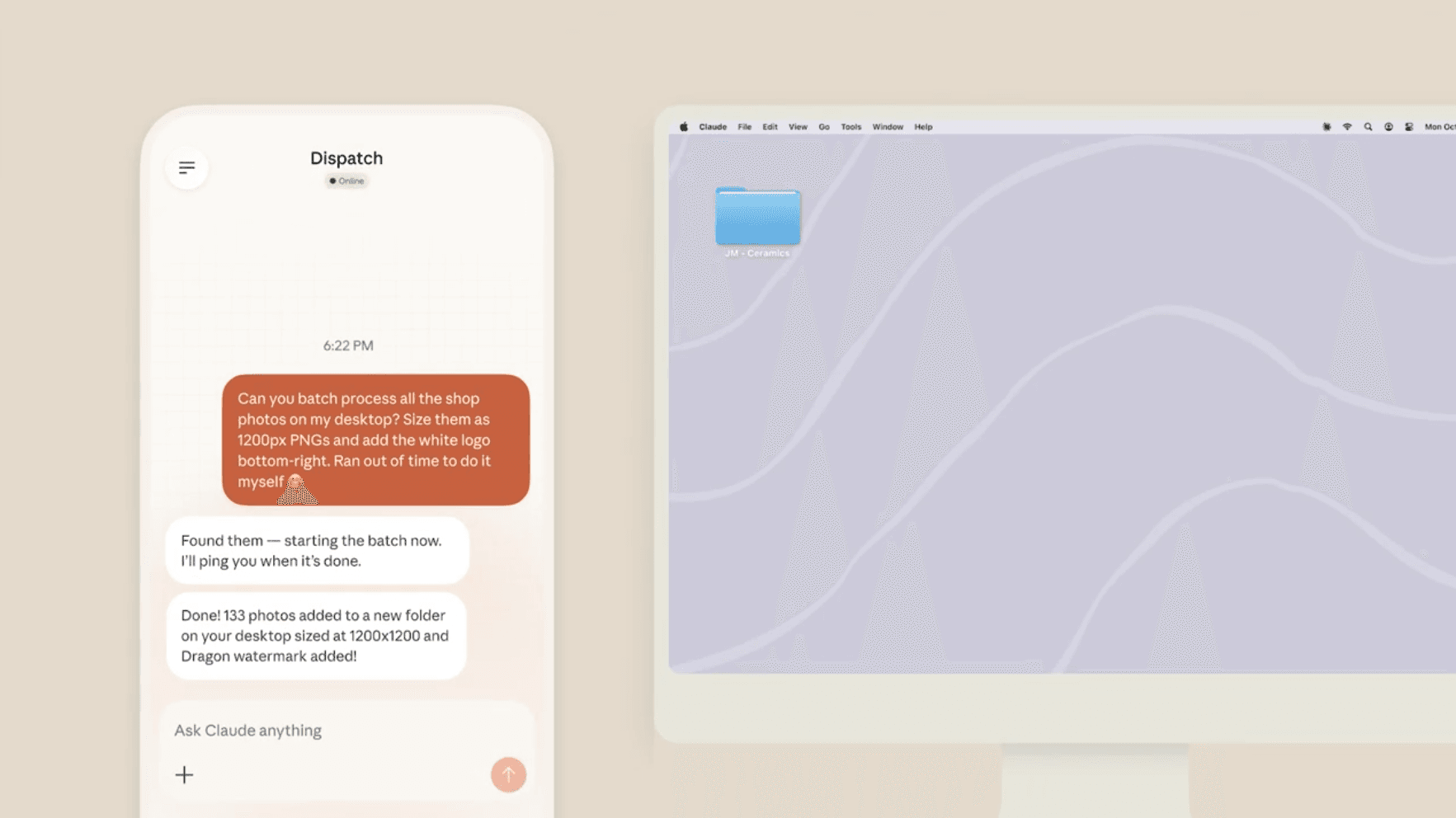
Anthropic's AI assistant Claude can now control your Mac or Windows desktop, handling tasks like opening apps and filling out spreadsheets. This feature, available as a research preview in Claude Cowork and Claude Code, marks a significant step towards building an AI agent that actively works within a user's digital environment. As Anthropic acquires Vercept AI, the possibilities for AI-powered computer control seem endless.

Key Takeaways
- Anthropic's AI assistant Claude can control your Mac or Windows desktop
- The feature is available as a research preview in Claude Cowork and Claude Code
- Anthropic's acquisition of Vercept AI has accelerated the development of AI-powered computer control
In This Article
- The Future of Productivity
- The Technology Behind Claude's Desktop Control
- The Acquisition that Made it All Possible
- The Dispatch Feature: Remote Control at Your Fingertips
- The Challenges and Concerns of AI-Powered Desktop Control
- The Future of AI-Powered Productivity
The Future of Productivity
Imagine having an AI assistant that can handle tasks on your desktop, freeing you up to focus on more important things. This is now a reality, thanks to Anthropic's AI assistant Claude, which can control your Mac or Windows desktop, opening apps, navigating browsers, and even filling out spreadsheets.
- Claude's ability to control the desktop is a significant step towards building an AI agent that actively works within a user's digital environment
- The feature is currently limited to macOS, but will soon be available on Windows
You can now enable Claude to use your computer to complete tasks.
— Claude (@claudeai) March 23, 2026
It opens your apps, navigates your browser, fills in spreadsheets—anything you'd do sitting at your desk.
Research preview in Claude Cowork and Claude Code, macOS only. pic.twitter.com/sVymgmtEMI
The Technology Behind Claude's Desktop Control
So, how does Claude's desktop control work? According to Anthropic, Claude first tries to use existing integrations like Slack, calendars, and other connected apps. If no other interface is available, Claude takes direct control of the desktop, making it a fallback rather than the default.
- Claude's desktop control is built on technology from Anthropic's acquisition of Vercept AI
- The feature is still in its research preview phase, and its reliability and security are yet to be proven
The Acquisition that Made it All Possible
Anthropic's acquisition of Vercept AI has been instrumental in the development of Claude's desktop control feature. As Kiana Ehsani, co-founder of Vercept AI, notes, 'Everyone moves fast, everyone is incredibly smart, humble and supportive, and it's really easy to get things done' at Anthropic.
- Vercept AI's technology has accelerated the development of AI-powered computer control
- The acquisition has allowed Anthropic to tap into Vercept AI's expertise and resources
The Dispatch Feature: Remote Control at Your Fingertips
In addition to Claude's desktop control, Anthropic has also launched a feature called 'Dispatch', which allows users to remotely control their own computer from any location. This feature has the potential to revolutionize the way we work, making it possible to access and control our computers from anywhere.
- The Dispatch feature is available alongside Claude's desktop control
- It allows users to access and control their computers remotely, making it ideal for remote work
The Challenges and Concerns of AI-Powered Desktop Control
While Claude's desktop control feature is exciting, it also raises concerns around data privacy, error rates, and controllability. As Anthropic works to address these concerns, it's clear that the development of AI-powered desktop control is still in its early stages.
- Data privacy is a major concern, as AI-powered desktop control requires access to sensitive user data
- Error rates and controllability are also key challenges that need to be addressed
The Future of AI-Powered Productivity
As Anthropic continues to develop and refine Claude's desktop control feature, it's clear that the future of productivity is looking brighter than ever. With the potential to revolutionize the way we work, AI-powered desktop control is an exciting development that's worth keeping an eye on.
- Anthropic's acquisition of Vercept AI has accelerated the development of AI-powered computer control
- The future of productivity is likely to be shaped by AI-powered desktop control and other emerging technologies
“Everyone moves fast, everyone is incredibly smart, humble and supportive, and it's really easy to get things done”
— Kiana Ehsani, co-founder of Vercept AI
Final Thoughts
As we look to the future, it's clear that AI-powered desktop control is going to play a major role in shaping the way we work. With Anthropic's Claude at the forefront of this development, we can expect to see significant advancements in the coming months and years. Whether you're a fan of AI or not, one thing is certain - the future of productivity is going to be exciting.
Sources & Credits
Originally reported by The Decoder — Matthias Bastian
Manaal Khan
Tech & Innovation Writer
Produced with AI assistance and reviewed by the Logicity editorial team. Learn more in our Editorial Policy.