Key Takeaways
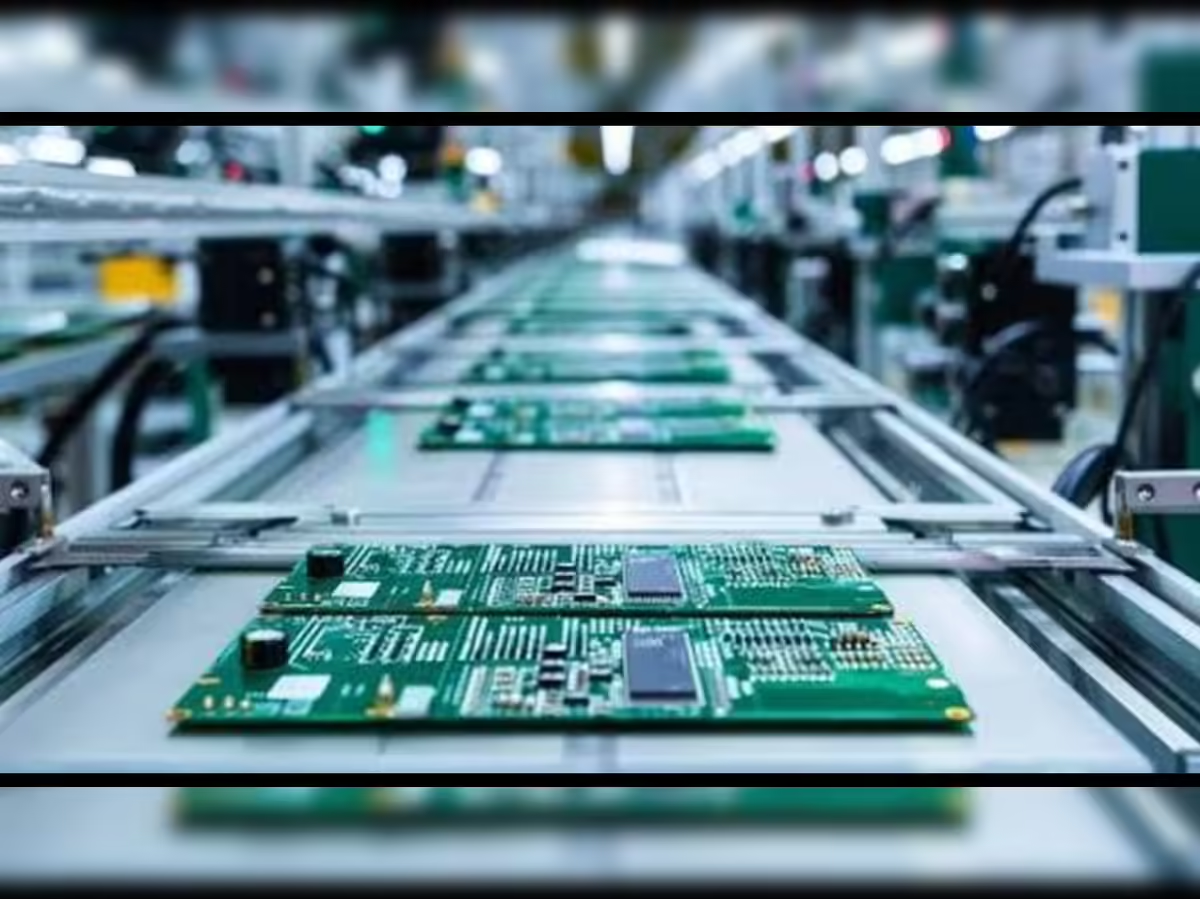
- Rebellions plans to list on the Korean stock exchange in H1 2026
- A US listing may follow the Korean IPO
- The startup has raised $124 million and merged with Sapeon in 2023
Rebellions, the South Korean AI chip startup backed by Samsung, plans to go public on the Korean stock exchange in the first half of 2026. CEO and co-founder Park Sunghyun told Reuters that a US listing could follow the domestic IPO, signaling the company's ambition to compete globally against dominant players like NVIDIA.
The timing is aggressive. Rebellions was founded just five years ago, and the AI chip market remains brutally competitive. But the company has momentum: a $124 million war chest from Series B funding, backing from Samsung and KT Corp, and a December 2023 merger with Sapeon, the AI chip unit spun off from SK Telecom.
Why a dual listing strategy?
Park's comments suggest Rebellions sees the Korean market as a proving ground before tackling US investors. That sequencing makes sense. Korean exchanges offer faster regulatory approval and a home audience familiar with the company's backers. A successful Seoul listing would give Rebellions a public valuation, trading history, and credibility before pitching American institutional investors.
A US listing, likely on NASDAQ, would unlock deeper capital pools and global visibility. It would also put Rebellions shares alongside AMD, Intel, and NVIDIA, the companies it ultimately needs to outcompete or complement.
What does Rebellions actually make?
The company builds AI inference processors, the chips that run trained AI models in production. This is distinct from training chips, where NVIDIA's dominance is near-total. Inference is a growing slice of the AI compute market because every chatbot query, image generation, or recommendation engine call requires inference. Rebellions' flagship products include ATOM for edge computing and REBEL for data center workloads.
The December 2023 merger with Sapeon consolidated two of Korea's most prominent AI chip efforts. Sapeon brought experience from SK Telecom's internal AI infrastructure, while Rebellions contributed venture backing and a team of former Samsung and Intel engineers. Park himself worked at Intel before founding the company in 2020.
Can Rebellions compete with NVIDIA?
Not directly. NVIDIA's CUDA software ecosystem locks in most AI developers, and its H100 and upcoming Blackwell chips dominate data center training. But inference is more fragmented. Cloud providers and enterprises are actively seeking alternatives to reduce costs and dependency on a single vendor. That creates openings for companies like Rebellions, AMD, Intel, and a growing list of startups.
Korean government support adds another factor. Seoul has made semiconductor independence a strategic priority, particularly after US export controls on advanced chips to China disrupted regional supply chains. Rebellions fits neatly into that national agenda, which could translate into procurement contracts, R&D subsidies, or favorable regulatory treatment.
The IPO context
AI chip companies are hot. SambaNova just raised $1 billion at an $11 billion valuation. Cerebras filed for a US IPO. Groq, another inference chip maker, has attracted significant venture interest. Public markets have rewarded AI infrastructure plays, with NVIDIA's market cap exceeding $3 trillion at its peak.
But the window could narrow. Interest rates remain elevated, and some AI valuations look stretched relative to actual revenue. A Korean IPO in H1 2026 gives Rebellions roughly 12 months to execute. That timeline assumes no major market corrections and continued investor appetite for AI hardware stories.
Recent mega-round shows investor appetite for AI chip alternatives to NVIDIA
Logicity's Take
Rebellions' dual-listing plan is smart sequencing, but execution risk is high. The company must prove its chips can win enterprise contracts against well-funded rivals like Groq, Cerebras, and AMD's Instinct line. For CTOs evaluating inference hardware, Rebellions is worth watching but not yet a safe bet for production workloads. The IPO will force transparency on revenue, customer count, and gross margins, data points that have been opaque for most AI chip startups. That alone makes the listing valuable for the industry.
Frequently Asked Questions
When will Rebellions go public?
CEO Park Sunghyun says the company targets a Korean IPO in the first half of 2026, with a potential US listing afterward.
How much funding has Rebellions raised?
The company has raised $124 million through Series B, with investors including Samsung and KT Corp.
What chips does Rebellions make?
Rebellions builds AI inference processors, including ATOM for edge devices and REBEL for data center workloads.
Who are Rebellions' competitors?
The company competes with NVIDIA, AMD, Intel, and startups like Groq, Cerebras, and SambaNova in the AI inference chip market.
Need Help Implementing This?
Evaluating AI infrastructure for your organization? Logicity covers the tools and vendors shaping enterprise tech. Subscribe for weekly analysis.
Source: Tech-Economic Times / ET
Manaal Khan
Tech & Innovation Writer
Produced with AI assistance and reviewed by the Logicity editorial team. Learn more in our Editorial Policy.