Key Takeaways
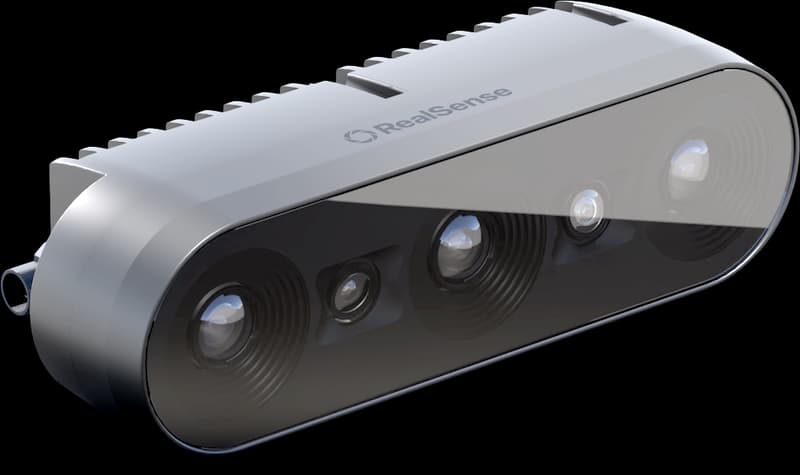
- The D585 Pro runs AI inference directly on a Gen 5 SoC, eliminating the need for host compute in many robotic applications
- Sub-15cm minimum range at full resolution opens bin picking and close-range inspection use cases that previous depth cameras could not handle
- IP65 protection comes standard on every unit, addressing long-standing durability complaints about earlier RealSense sensors
RealSense announced the D585 Pro depth camera at Automate 2026, positioning it as the first in a new class of sensors that run AI inference directly on the device. The camera combines a 120×100° field of view, sub-15cm minimum range at full resolution, and a proprietary Gen 5 system-on-chip that handles object detection and depth processing without taxing a robot's main compute. Shipping begins Q1 2027.
For robotics engineers, the pitch is straightforward: offload perception to the sensor. Humanoid robots, AMRs, collaborative arms, and inspection systems all share a common bottleneck. Their onboard computers juggle motion planning, task logic, and safety systems. Adding real-time depth processing and AI inference strains those resources. The D585 Pro aims to eliminate that tradeoff.
What's inside the Gen 5 SoC?
RealSense built the D585 Pro around a custom chip that bundles a depth engine, image signal processor, digital signal processor, dedicated AI accelerators, and a quad-core ARM processor. Dual IR projectors and high-resolution sensors feed the pipeline. The result, according to the company, is 2x better depth quality than the previous RealSense generation, with finer detail visibility, halved noise, and reduced temporal flicker.
At launch, the camera ships with on-device enhanced depth processing and person detection in beta. Neither requires host compute. Planned SDK updates will add Visual-Inertial Odometry, occupancy grid generation, auto-calibration, and face detection to existing D585 hardware after general availability.
“The D585 Pro is not just an update to what came before; it's the actualization of the Visual Cortex of Physical AI. For the first time, developers can deploy a single depth camera that operates from under 15 centimeters to more than 10 meters, indoors or outdoors, while gaining new capabilities over time through software updates rather than hardware replacement.”
— Nadav Orbach, RealSense CEO
Key specs: FOV, range, frame rate
The numbers matter for specific applications. A 120×100° FOV gives robots whole-scene awareness for Visual SLAM and navigation. Sub-15cm minimum range at full resolution, which RealSense claims is 2.5x better than the nearest competitor, enables bin picking, shelf scanning, and cobot arm inspection where targets sit close to the sensor. The camera sustains 60 FPS at 1280×960, double the 30 FPS of competing devices, which matters on fast-moving robots and high-speed conveyors.
Operating range extends beyond 10 meters at optimal accuracy, covering the navigation envelope for AMR fleets in warehouses. IP65 protection comes standard on every unit, not as a premium SKU. Connectivity options include GMSL2 and USB-C with hardware sync support for GPU and x86 deployments.
Why engineers care about IP65 as standard
Discussions on r/robotics zeroed in on the IP65 rating. Earlier RealSense depth sensors earned a reputation for fragility in factory environments. Dust, humidity, and occasional splashes killed units. Making IP65 standard, not optional, addresses that complaint directly.
The built-in IR filters solve a related headache. Depth sensors often struggle in bright outdoor sunlight or low-light indoor conditions. RealSense claims the D585 Pro delivers consistent depth performance in both extremes without configuration changes or auxiliary hardware.
Dual RGB and synchronized streams
Also shipping at launch: Dual RGB mode. The camera can output simultaneous 30 FPS RGB and 30 FPS depth streams at up to 1280×960, merged on camera with no host CPU overhead. RealSense targets humanoid robots, inspection pipelines, digital twins, and any workflow requiring synchronized color and depth data.
The feature ties into a broader industry push toward vision-language-action models. These models need both rich color imagery and precise depth to interpret scenes and plan manipulation. Running the merge on-device simplifies the data pipeline for robotics teams building those systems.
RealSense Perception Studio: beta access for developers
Alongside the D585 Pro, RealSense launched Perception Studio, a beta program within the RealSense 2.0 SDK. Registered developers can download binaries this month. Initial features include close-range depth performance extending to under 3cm on the D401 and D405, person detection, and Visual-Inertial Odometry with cuSLAM running on an NVIDIA host.
The SDK approach signals RealSense's bet on software-defined hardware. Buy the D585 Pro now, unlock new perception capabilities later via updates. Whether that promise holds depends on the SDK's maturity and how aggressively RealSense ships features post-launch.
Competitive context: edge AI in perception hardware
The D585 Pro enters a market where depth sensors have historically been dumb peripherals. Intel's original RealSense line, acquired and spun off over the years, competed on specs like resolution and range. Orbbec, Stereolabs, and others play in the same space. The shift to on-device AI inference represents a new front.
Running object detection and depth processing locally reduces latency, which matters for humanoids reacting to dynamic environments or AMRs navigating cluttered warehouses. It also cuts the compute bill on the main robot controller, freeing cycles for higher-level tasks. The tradeoff: more complex hardware and a higher unit cost, though RealSense has not announced pricing.
Frequently Asked Questions
When does the RealSense D585 Pro ship?
RealSense expects the D585 Pro to begin shipping in Q1 2027.
What robots is the D585 Pro designed for?
The camera targets humanoids, autonomous mobile robots, collaborative robot arms, industrial robotics, and inspection systems.
Does the D585 Pro require host compute for AI inference?
No. The Gen 5 SoC runs on-device AI processing, including depth processing and person detection, without requiring host compute.
What is the minimum sensing range of the D585 Pro?
Sub-15cm at full resolution, which RealSense claims is 2.5x better than competing depth cameras.
Is the D585 Pro waterproof or dustproof?
Yes. IP65 protection comes standard on every unit, covering dust and water spray resistance.
Logicity's Take
The D585 Pro's real value lies in the software-defined promise, not the launch specs. If RealSense delivers meaningful SDK updates through 2027 and 2028, robotics teams can treat the camera as a perception platform that grows with their stack. If updates stall, it's just another depth sensor with a premium price tag. Watch the VIO and occupancy grid releases as the first test.
Need Help Implementing This?
If you're evaluating depth sensors for your robotics project or planning an AMR deployment, Logicity's consulting team can help you compare options and architect the perception stack. Reach out at consulting@logicity.in.
Source: The Robot Report / The Robot Report Staff
Manaal Khan
Tech & Innovation Writer
Produced with AI assistance and reviewed by the Logicity editorial team. Learn more in our Editorial Policy.




