Key Takeaways
- ReactOS can now run the original Half-Life with 3D acceleration on physical hardware, a first for the project.
- The achievement validates 28 years of reverse-engineering work on Windows NT binary compatibility.
- A user ran the game on modest hardware: an Intel Core i5 2400 and NVIDIA GeForce 8400GS.
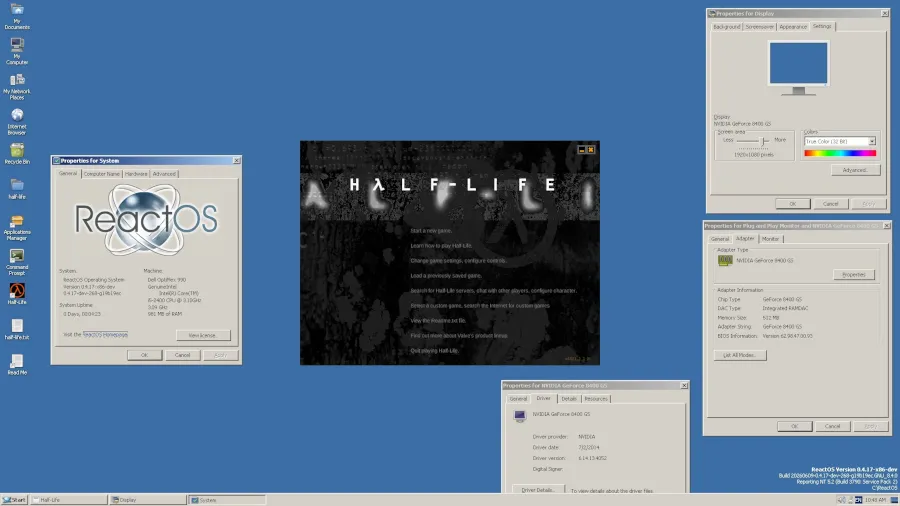
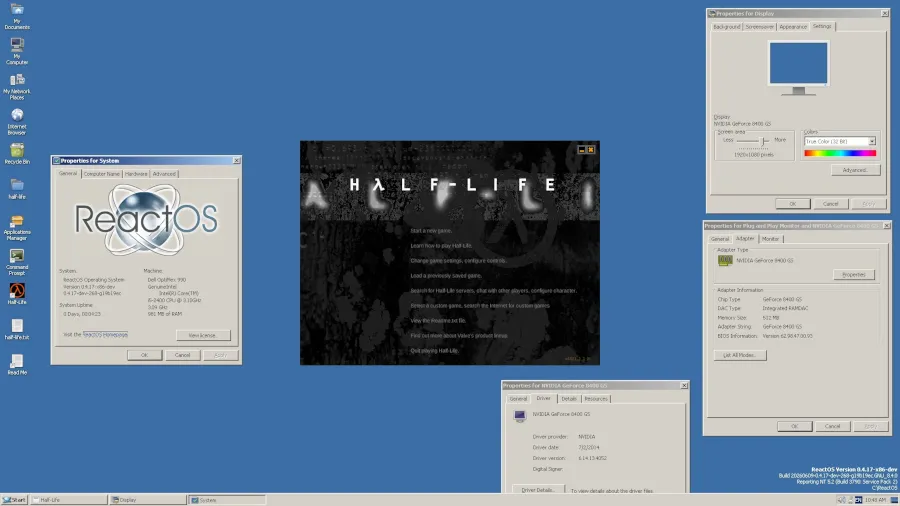
ReactOS, the open-source project attempting to clone Microsoft Windows from scratch, has finally run Half-Life on real hardware with 3D acceleration. A user got the 1998 shooter working on a Dell OptiPlex with an Intel Core i5 2400 and an NVIDIA GeForce 8400GS. For a project that has spent 28 years trying to achieve native Windows binary compatibility, this is a genuine milestone.
The announcement came via the official ReactOS account on X, where developers shared proof of the game running in-engine, not just initializing. Previous attempts over the years had gotten Half-Life to launch, but actually playing the game with hardware-accelerated graphics is new territory.
Why does running an old game matter for ReactOS?
Half-Life is not technically demanding by 2026 standards. But running it natively on ReactOS proves something harder than raw performance: the operating system's reimplementation of the Windows Display Driver Model (WDDM) is finally mature enough to handle real 3D workloads. WDDM is the kernel-mode driver framework that Windows has used for graphics since Vista. Reimplementing it without Microsoft's source code is an enormous reverse-engineering challenge.
ReactOS does not use Wine, the compatibility layer that Linux users rely on for Windows games. Instead, it aims to be a full, binary-compatible clone of Windows NT. That means Windows executables should run on ReactOS the same way they run on Windows, without translation. Achieving this with 3D graphics is orders of magnitude harder than running a simple desktop application.
The hardware that made it work
User "Zombiedeth" ran Half-Life on a Dell OptiPlex with a Sandy Bridge-era Core i5 2400 processor and an NVIDIA GeForce 8400GS graphics card. Neither component is modern, the GPU is from 2007, but that's partly the point. ReactOS is still in alpha, and its driver support lags behind contemporary hardware. Older NVIDIA cards with established driver behavior are easier targets for a project that must reverse-engineer everything.
The setup also reflects the community's interest in using ReactOS as a retro gaming platform. If the OS can run classic Windows games natively, it becomes a plausible option for vintage hardware enthusiasts who want to avoid relying on aging Windows XP installs.
28 years of reverse-engineering
ReactOS started in 1996, originally as FreeWin95, before pivoting to target the Windows NT architecture. The project has survived on volunteer contributions, with roughly 30 active core developers pushing toward an eventual Beta release. Its GitHub repository has accumulated around 17,600 stars, a sign of sustained community interest despite the glacial pace of progress.
“This is the 'Sagrada Família' of software—a project that seems to take a lifetime to complete, but remains a monument to what reverse engineering can achieve.”
— Hacker News commenter
The comparison to Antoni Gaudí's unfinished cathedral is apt. ReactOS is not a practical operating system for most users today. It crashes, it lacks drivers, and it cannot run most modern software. But the goal was never quick adoption. It was proving that Windows could be cloned legally through clean-room reverse engineering, without access to Microsoft's proprietary code.
What this means for the project's future
Running Half-Life does not mean ReactOS is ready for daily use. The project remains in alpha, and the gap between "can run a 1998 game" and "can run modern productivity software" is vast. But the achievement validates the core architectural work. If WDDM support has reached this level of maturity, other 3D applications become plausible targets.
Some Hacker News commenters suggested ReactOS could carve out a niche as a retro gaming OS, a way to run old Windows games on period-appropriate hardware without depending on Microsoft. Others pointed out the irony: faithfully cloning Windows NT means inheriting its historical security vulnerabilities too.
“Compatibility means compatibility. If we successfully clone Windows to this degree, we are also compatible with the bugs and the history of that era.”
— Anonymous community contributor on Hacker News
How does ReactOS compare to Wine?
Wine, the compatibility layer used on Linux and macOS, translates Windows API calls into native system calls at runtime. It does not try to be Windows; it tries to make Windows programs think they are running on Windows. ReactOS takes the harder path: reimplementing the entire operating system, kernel and all.
In practice, Wine is more mature for most use cases. It can run a wider range of modern software, including recent games via Proton on Steam Deck. ReactOS is a research project and a labor of love. Its value is proving that Windows can be recreated, not that it should replace your daily driver.
Logicity's Take
ReactOS will never compete with Windows or Linux for mainstream users. But that misses the point. This project is a 28-year stress test of clean-room reverse engineering, proving that proprietary systems can be understood and replicated without access to source code. For enterprise architects worried about long-term vendor lock-in, ReactOS is a proof of concept: if a volunteer team can clone Windows NT, the technical barriers to escaping any ecosystem are lower than vendors want you to believe.
Frequently Asked Questions
Can ReactOS run modern Windows software?
Not reliably. ReactOS is still in alpha and targets older Windows NT compatibility. Most modern applications will not work.
Is ReactOS legal?
Yes. The project uses clean-room reverse engineering, meaning developers study Windows behavior without accessing Microsoft's source code.
Can I use ReactOS for gaming?
For vintage games from the Windows XP era and earlier, ReactOS is becoming a viable option. Modern games are not supported.
How does ReactOS differ from Wine?
Wine translates Windows API calls on Linux or macOS. ReactOS reimplements the entire Windows NT kernel and runs Windows binaries natively.
Is ReactOS ready for daily use?
No. It remains an alpha project with limited driver support and stability issues.
Another look at how gaming platforms evolve beyond their original scope.
Need Help Implementing This?
If you're exploring open-source alternatives for legacy Windows applications or building compatibility layers for enterprise software, reach out to Logicity's consulting network. We connect you with engineers who specialize in systems-level reverse engineering and migration strategies.
Source: Hacker News: Best
Huma Shazia
Senior AI & Tech Writer
Produced with AI assistance and reviewed by the Logicity editorial team. Learn more in our Editorial Policy.