Key Takeaways
- Proception settled Tesla's trade secret lawsuit and raised an $11M seed round led by First Round Capital
- The startup ships 22-degree-of-freedom robotic hands with sensor-laden gloves for scalable data collection
- Founder Jay Li argues most robotics companies collect non-scalable training data, creating an opening for Proception's approach
Proception, the robotic hand startup founded by former Tesla Optimus technical lead Jay Li, has settled the trade secret lawsuit Tesla filed against it last year. Alongside the settlement, the company announced an $11 million seed round led by First Round Capital, with Y Combinator and BoxGroup participating. Proception is now shipping its first batch of high-dexterity robotic hands to researchers and robotics companies.
What did Tesla accuse Proception of doing?
Tesla sued Li in 2025, claiming he left the Optimus humanoid robot program with proprietary trade secrets and used them to start Proception. Li served as a technical lead on Optimus, Tesla's flagship humanoid robot effort. The lawsuit dragged on for months before reaching a settlement. Tesla dismissed the case earlier this month and did not respond to TechCrunch's request for comment.
Li frames the experience as a stress test. "I think it's kind of like a resilience test, or pressure test," he told TechCrunch. "People say that what doesn't kill you makes you stronger, right?"
First Round partner Bill Trenchard, who led Proception's seed round, said Li handled the lawsuit well. "He was very upfront with us when this came out, and I think the team did an amazing job of keeping their heads down. Jay's a very strong leader."
Why robotic hands are the hard problem in humanoid robotics
Humanoid robotics has attracted enormous funding in recent years, but Li argues that dexterous manipulation, the ability for a robot to handle objects with human-like precision, remains underfunded relative to its difficulty. His old boss agrees. Elon Musk has called robot hands one of the biggest unsolved engineering challenges.
Kevin Lynch, director of Northwestern University's Center for Robotics and Biosystems, told the Wall Street Journal last year that functional, human-equivalent robotic hands are likely a decade away. Li thinks Proception can get there faster.
The company's approach centers on how it collects training data. Most humanoid robot companies use teleoperation: a human wearing a VR headset controls a robot remotely, and the robot learns from those commands. Li sees two problems with this method. First, the human operator gets no tactile feedback from what the robot touches. Second, data collection scales only as fast as you can deploy physical robots.
How Proception's sensor glove changes data collection
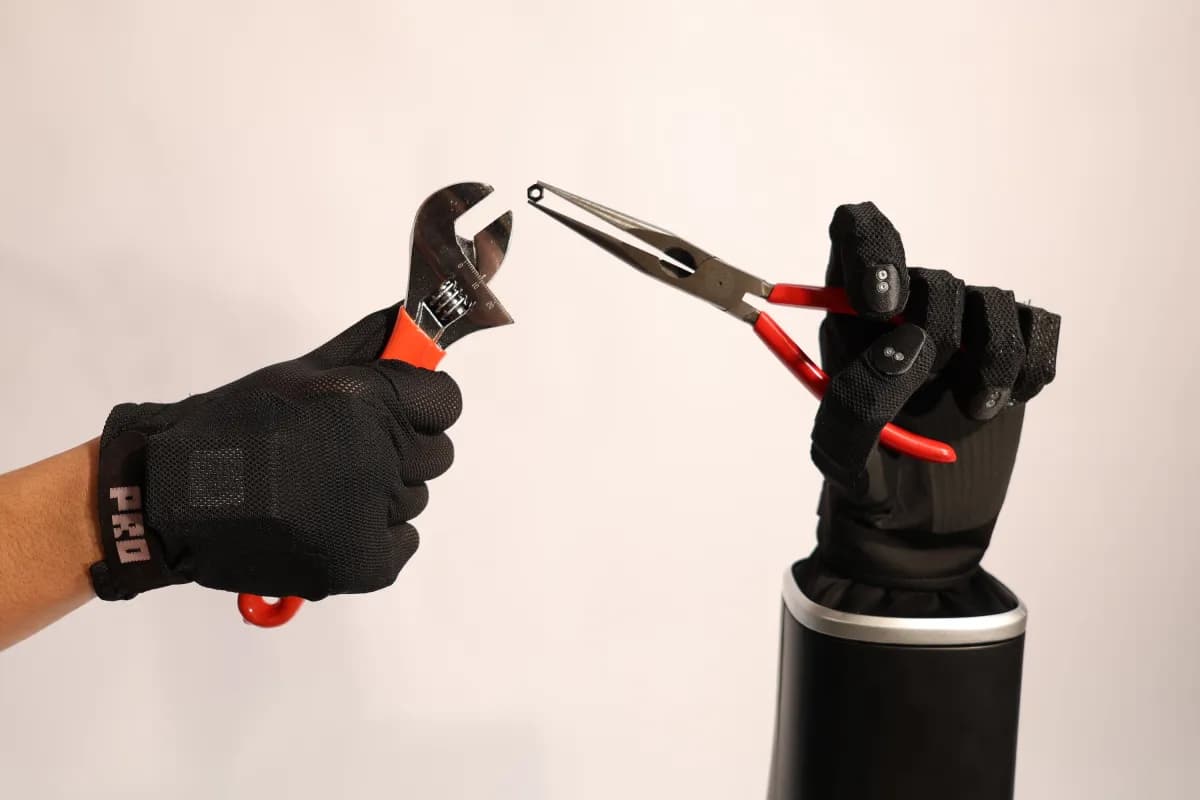
Proception's alternative is a sensor-laden glove. Human testers wear the glove along with a headset, capturing hand interaction data without needing a robot in the loop. The same glove also serves as the robotic hand's "skin," providing the sensor layer for the hardware itself.
The hand has 22 degrees of freedom and multiple joints per finger. Proception claims this enables a wide range of dexterous motions. More important to Li is that the glove approach lets the company and its customers gather task-specific data at scale.
“You need both hardware and data, and those need to come hand-in-hand to get [dextrous manipulation] to work. A lot of companies solely focus on hardware, or like hardware plus non-scalable data [collection]. We're working on this highly dexterous hardware plus highly scalable data. We believe that's a key combination to solve this problem.”
— Jay Li, Proception founder
Trenchard echoed that logic. "We think they will have the best hand in the market, maybe the most sophisticated hand today, and the underlying data and models to support that. Dexterous manipulation is a very, very, very important part of the whole humanoid story going forward, and as many people have said, it's sort of the last mile of getting these robots to be truly performant."
Who is buying Proception's hands?
Proception is positioning itself as a supplier, not a competitor to full-stack humanoid robot companies. The pitch: if you're building a humanoid robot but don't want to spend years developing your own dexterous hand, buy one from Proception.
The first batch is shipping to researchers and robotics companies now, with wider orders opening up. Li did not disclose pricing or the number of units in the initial shipment.
Logicity's Take
Proception's bet is that the humanoid robot market will fragment into specialized suppliers rather than consolidating around vertically integrated players like Tesla. That's a reasonable thesis if you believe dexterous manipulation is genuinely harder than locomotion or perception, as many researchers do. The risk: Tesla, Figure, Agility, and other well-funded competitors may not want to outsource a component this central to robot capability. Li's seed round is small relative to the capital flooding into humanoid robotics, but if Proception's data collection method produces measurably better hand performance, it could become an acquisition target or a de facto standard. For robotics buyers evaluating vendors, the company's approach to scalable data, not just hardware specs, is worth interrogating.
What the lawsuit signals about Tesla's IP posture
Tesla has been aggressive about protecting Optimus-related intellectual property. The company faces a wave of startups founded by former engineers who worked on the humanoid robot program. Settling with Proception rather than pursuing a trial suggests either that Tesla's claims were weaker than they appeared, or that continuing the lawsuit wasn't worth the distraction. Tesla declined to comment.
For founders considering exits from Tesla's robotics division, the Proception case offers a data point: Tesla will sue, but settlements are possible. Whether that discourages or emboldens future departures depends on what the undisclosed settlement terms actually require.
Frequently Asked Questions
What is Proception?
Proception is a robotics startup founded by Jay Li, a former Tesla Optimus technical lead. It develops high-dexterity robotic hands and a sensor-glove system for collecting human hand interaction data.
Why did Tesla sue Proception?
Tesla alleged that Jay Li took trade secrets from the Optimus humanoid robot program when he left to start Proception. The lawsuit was filed in 2025 and settled in June 2026.
How much funding has Proception raised?
Proception raised an $11 million seed round led by First Round Capital, with participation from Y Combinator and BoxGroup.
How does Proception's data collection differ from teleoperation?
Most robotics companies train humanoid robots via teleoperation, where a human controls a robot remotely. Proception uses a sensor-laden glove that captures hand interaction data without requiring a robot, making data collection more scalable.
When will dexterous robotic hands match human capability?
Northwestern University's Kevin Lynch estimates a decade before robotic hands are functionally equivalent to human hands. Proception's Jay Li believes his company can accelerate that timeline.
Need Help Implementing This?
If you're evaluating robotics suppliers or building automation workflows for your business, reach out to Logicity for vendor comparisons and integration guidance.
Source: TechCrunch / Sean O'Kane
Manaal Khan
Tech & Innovation Writer
Produced with AI assistance and reviewed by the Logicity editorial team. Learn more in our Editorial Policy.




