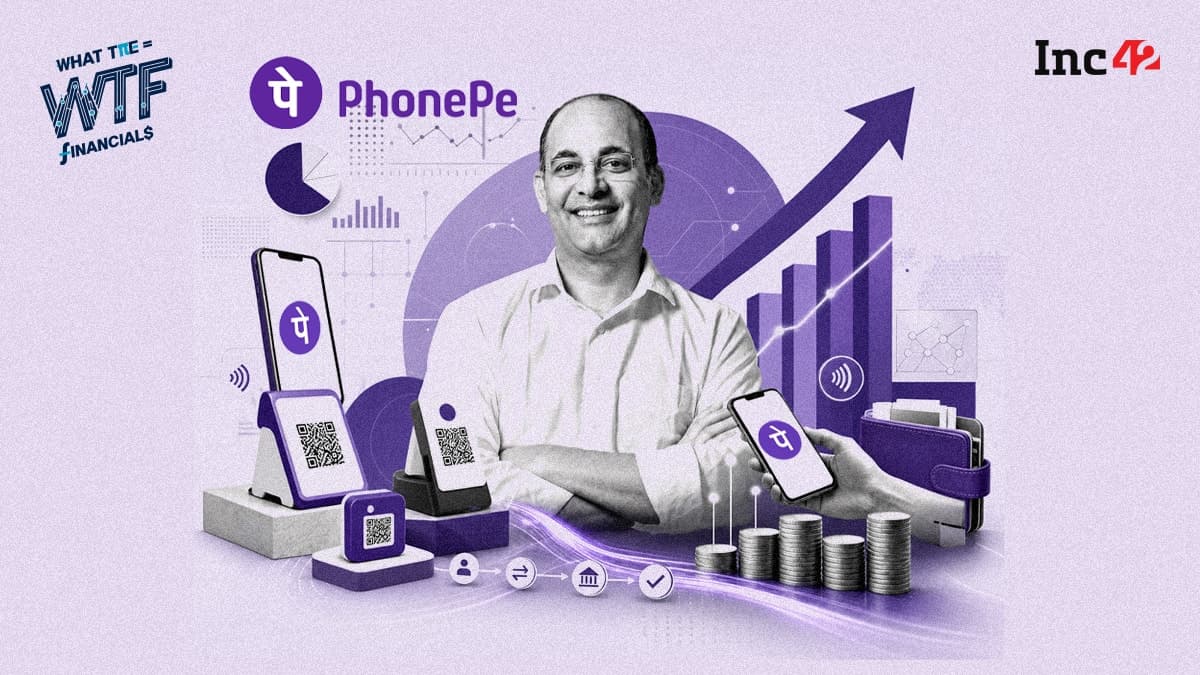
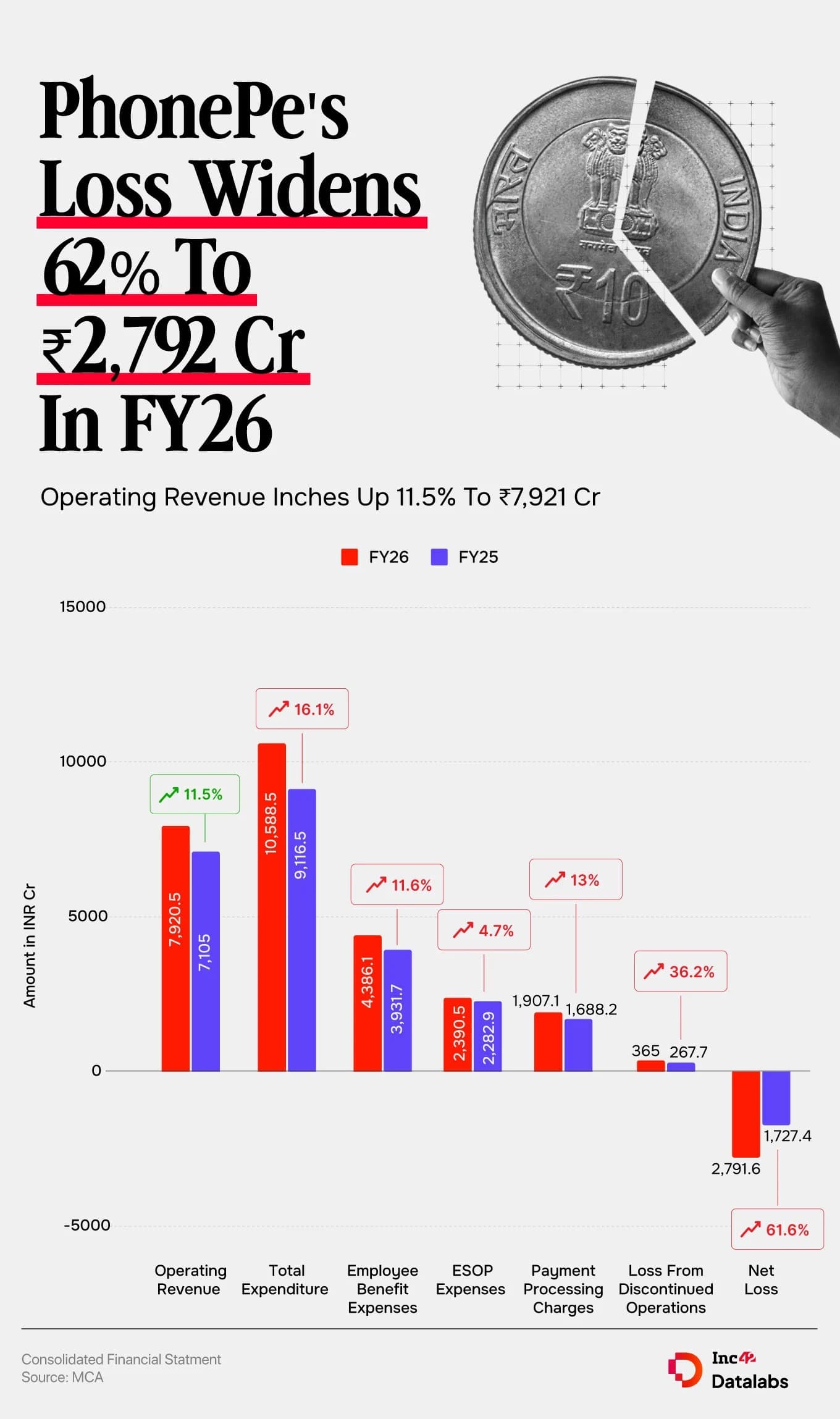
PhonePe's net loss widened 62% year-on-year to ₹2,792 Cr in FY26, even as the fintech giant grew operating revenue 11.5% to ₹7,920.5 Cr. The numbers land at an awkward moment: the company shelved its IPO earlier this year and has offered no new timeline.
Three one-time charges explain most of the damage. A ₹684.7 Cr goodwill impairment on Indus Appstore, a ₹364.7 Cr loss from shuttering hyperlocal commerce app Pincode, and ₹2,390.5 Cr in non-cash ESOP expenses together dwarfed the modest topline gains.
Where did the money go?
Total expenses climbed 16% to ₹10,588.5 Cr. Employee benefit costs rose to ₹4,386.1 Cr, with ESOP charges accounting for more than half that figure. Payment processing fees hit ₹1,907.1 Cr, up 13%, reflecting the sheer volume of UPI transactions PhonePe handles as India's largest player by transaction count.
Marketing spend nearly doubled to ₹956 Cr from ₹496 Cr. Customer acquisition in payments is a treadmill: the moment you stop spending, market share erodes. Subcontracting and customer support costs jumped 36% to ₹782.4 Cr.
The Indus Appstore impairment deserves attention. PhonePe acquired the app marketplace in 2023 hoping to challenge Google Play. In its audited statements, the company admitted the unit remains "pre-revenue" and that "future economic benefits from investments in the legacy business are no longer expected to be realised." That is a polite way of saying the bet failed.
A partial offset came from divesting a 5% stake in MapmyIndia, which generated a ₹434.5 Cr exceptional gain. Still, divestiture gains are not a repeatable revenue strategy.
Why the IPO is on ice
PhonePe filed its updated draft prospectus in January for a pure offer-for-sale IPO. Walmart, Tiger Global and Microsoft planned to sell down stakes at an expected valuation of $9 Bn to $10.5 Bn. The company aimed to raise $900 Mn to $1.5 Bn.
Then geopolitical tensions and market volatility intervened. PhonePe shelved the listing and has gone silent on timing. Investors watching the FY26 numbers will note that the path to profitability looks no clearer than it did a year ago.
The monetisation puzzle
Consumer UPI payments generate almost no revenue. Merchant payments, which contributed 21.8% of operating revenue in H1 FY26, offer better margins through platform fees, lending partnerships and EMI tie-ups. PhonePe has been pushing merchant acceptance devices, and NPCI incentives of ₹286 Cr for credit-on-UPI deployments helped.
Financial services, covering lending and insurance distribution, accounted for just 6.3% of H1 revenue. Scale is there. Monetisation is not.
Logicity's Take
PhonePe's numbers underscore a hard truth for UPI-first fintechs: transaction volume is vanity, unit economics are sanity. The Indus Appstore write-off and Pincode shutdown suggest management is now pruning distractions. But until merchant payments and financial services contribute meaningfully more than single digits, profitability stays theoretical. Competitors like Paytm and Google Pay face similar structural constraints. The real test for IPO readiness is whether PhonePe can show margin expansion, not just revenue growth, in the next two quarters.
Another major IPO facing market headwinds and investor scrutiny
What comes next
PhonePe has raised over $2.3 Bn to date. Cash is not the immediate problem. Narrative is. Public markets in 2026 are punishing loss-making tech companies, and a 62% widening in net loss is not the story you want heading into roadshows.
The company's best move may be to absorb the ESOP cliff, stabilise costs for two quarters, and re-approach the market with a cleaner P&L. Whether Walmart and Tiger Global have the patience for that delay is another question entirely.
Need Help Implementing This?
Building a fintech product or scaling payments infrastructure? Logicity helps founders and finance teams navigate vendor selection, compliance frameworks and go-to-market strategy. Reach out at hello@logicity.in.
Source: Inc42 Media / Anjali Jain
Manaal Khan
Tech & Innovation Writer
Produced with AI assistance and reviewed by the Logicity editorial team. Learn more in our Editorial Policy.