Key Takeaways
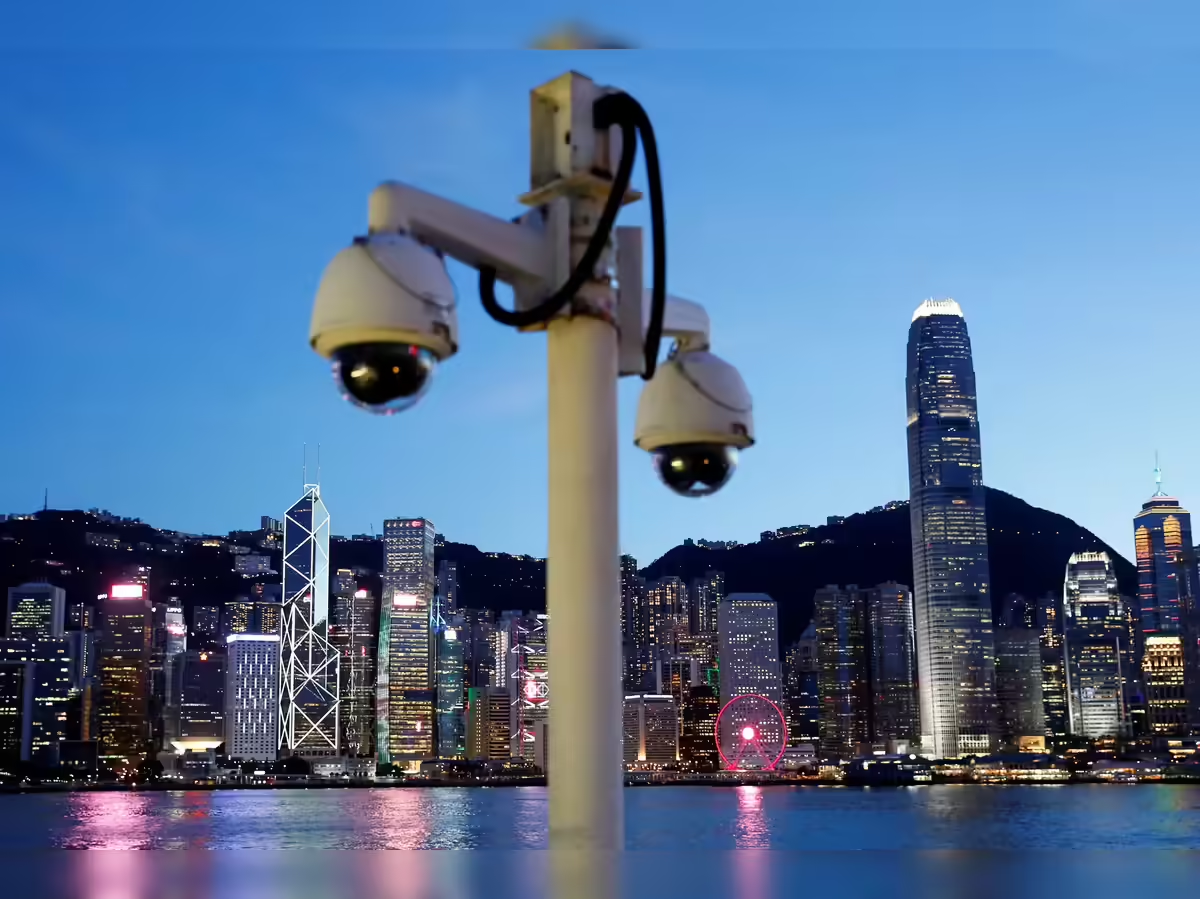
- Peter Diamandis predicts a trillion sensors will monitor Earth by 2030, calling it 'radical transparency'
- Larry Ellison made similar arguments at Oracle's 2024 Financial Analyst Meeting, drawing comparisons to China's social credit system
- The claims rest on 40 billion connected devices by 2030, each with multiple sensors feeding AI analysis
XPRIZE Foundation founder Peter Diamandis wants a trillion sensors watching everything on Earth, and he thinks that's a good thing. "Humans behave better when they're being watched," he wrote on X this week, predicting a near-future where cameras, satellites, drones, and connected devices monitor every square meter of the planet in real time.
Diamandis is not some fringe voice. He founded the XPRIZE competition that spurred private spaceflight. He co-founded Singularity University. When he talks about the future of technology, people in Silicon Valley listen. And right now, he's making the case for ubiquitous surveillance.
What exactly is Diamandis proposing?
In a Substack post expanding on his tweet, Diamandis described what he calls "radical transparency." The idea: a multi-layered sensor network running from home cameras to smartphones to autonomous vehicles to satellite constellations imaging the entire planet daily.
“Radical transparency is coming. A future where you can know anything, anytime, anywhere. A future where no one can hide.”
— Peter Diamandis, XPRIZE founder
The numbers he cites: 40 billion connected devices by 2030, each equipped with multiple sensors producing data that AI systems can analyze. The pitch is that this creates accountability. Bad actors cannot hide their actions when everything is recorded.
Oracle's Ellison made the same argument
Diamandis is not alone among tech executives making this case. At Oracle's Financial Analyst Meeting in 2024, co-founder Larry Ellison offered a similar vision. "Citizens will be on their best behavior, because we're constantly recording and reporting everything that is going on," he said, according to Fortune.
Fortune noted the obvious comparison: China's social credit system, which uses extensive camera networks and facial recognition to monitor citizens and assign behavior scores. Ellison did not shy away from the parallel.
The timing of Diamandis's comments appears connected to a recent podcast with Will Marshall, CEO of Earth-imaging company Planet. Marshall told Diamandis: "No one can hide anymore. If you build a school, we're going to see the school. If you build a data center, we're going to see the data center. And the accountability is going to be there for the whole world to see."
The surveillance infrastructure already exists
These predictions are not science fiction. The infrastructure is building now. An estimated one billion surveillance cameras operate worldwide. China alone has around 770 million CCTV cameras, with projections of one billion by 2030. In London, the average person is captured on camera 15 to 20 times daily.
The global video surveillance market is projected to reach $280 billion by 2027, according to Grand View Research. Satellite imaging companies like Planet already photograph every point on Earth's surface daily. The sensors exist. The AI to process the feeds is maturing. What Diamandis describes is less a prediction than an extrapolation of current trends.
The counterargument nobody mentioned
Security researcher Bruce Schneier has pointed out the obvious flaw in the "transparency improves behavior" argument: surveillance is rarely mutual. "The notion that surveillance improves behavior assumes equal surveillance, but historically, the powerful surveil the powerless, not vice versa," he has written.
Diamandis references David Brin's 1998 book "The Transparent Society," which argued that privacy is dead and the question is whether everyone watches everyone, or only authorities watch citizens. Brin advocated for mutual surveillance. But the sensor networks Diamandis describes are not owned by citizens. They are owned by corporations and governments.
The debate arrives as Meta faces lawsuits and complaints over its camera-equipped Ray-Ban smart glasses, a small taste of how consumers respond when recording becomes ambient rather than obvious.
What this means for enterprise tech
For CTOs and technology decision-makers, this debate has immediate practical dimensions. Workplace monitoring tools have exploded since 2020. Employee surveillance software from vendors like Teramind, Hubstaff, and ActivTrak promises the same behavioral improvements Diamandis describes: workers who know they are monitored stay on task.
The evidence is mixed. Some studies show productivity gains. Others show increased stress, decreased trust, and higher turnover. The question is whether the surveillance philosophy Diamandis advocates scales from orbiting satellites down to your engineering team, and whether the costs outweigh the gains.
Logicity's Take
Diamandis and Ellison are describing a world that is already arriving, not proposing one. The real question is governance. Enterprise leaders deploying monitoring tools face the same tradeoff in miniature: surveillance can reduce certain problems while creating others. Teramind and Hubstaff start around $10-15/user/month; the productivity gains need to outweigh the trust erosion they can create. Before implementing any monitoring stack, define what behavior you're trying to change and measure whether the tool actually changes it.
Frequently Asked Questions
What is radical transparency according to Peter Diamandis?
Diamandis uses the term to describe a future where a trillion sensors on the ground, in the air, and in space monitor all activity on Earth in real time, making it impossible to hide any action.
How many surveillance cameras exist worldwide?
Current estimates put the global total at over one billion cameras, with China operating approximately 770 million and projecting growth to one billion by 2030.
What did Larry Ellison say about surveillance?
At Oracle's 2024 Financial Analyst Meeting, Ellison said citizens would be on their best behavior because of constant recording and reporting, drawing comparisons to China's social credit system.
What is the main criticism of mass surveillance improving behavior?
Security researchers argue that surveillance historically flows one direction: the powerful watch the powerless. Without mutual surveillance, the behavioral improvement argument breaks down.
Need Help Implementing This?
If you're evaluating employee monitoring or workplace analytics tools, Logicity can help you assess vendors and implementation approaches. Contact us for an independent technology review.
Source: Tech-Economic Times / ET
Manaal Khan
Tech & Innovation Writer
Produced with AI assistance and reviewed by the Logicity editorial team. Learn more in our Editorial Policy.