Key Takeaways
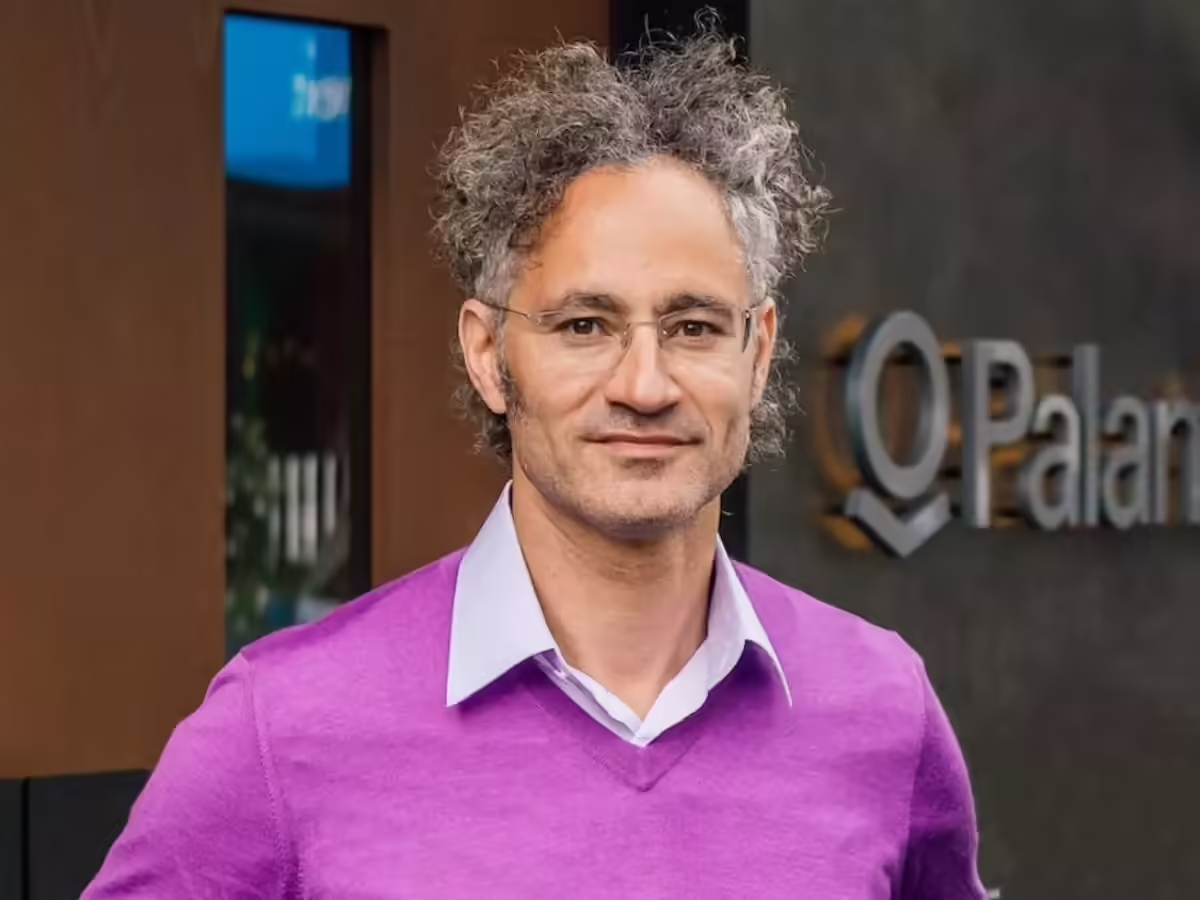
- Karp argues the token-based AI pricing model leaves enterprises spending without clear returns
- Companies are shifting toward open-weight models and building internal AI capabilities
- Palantir expanded its Nvidia partnership to help US government agencies build custom AI models
Palantir CEO Alex Karp went after OpenAI and Anthropic's business model in a CNBC interview this week, arguing that enterprises are burning cash on AI tokens without seeing proportional value. His core claim: the pay-per-token approach has left companies spinning their wheels instead of extracting real business outcomes from their AI investments.
"I'm not throwing shade at them, but something has gone completely wrong," Karp told CNBC's Squawk Box. "The basic view among enterprises in this country is I'm going to chillax and waste my time with tokens."
What's wrong with the token model?
OpenAI, Anthropic, and most major AI providers charge customers based on tokens, the small text units their models process when handling prompts and generating responses. As models grow more powerful, they demand more compute, which drives costs up. GPT-4 and Claude 3 Opus cost significantly more per token than their predecessors.
Karp's critique isn't about the absolute cost. It's about the disconnect between spending and outcomes. Enterprises can rack up substantial API bills without ever translating that usage into measurable ROI. The token meter runs regardless of whether the output moves the needle on actual business problems.
This framing positions Palantir's approach, outcome-focused enterprise platforms, as the alternative. Instead of selling raw model access, Palantir sells integrated solutions designed to deliver specific results. Whether that's a fair comparison or a competitive talking point depends on your perspective.
The shift toward ownership and control
Karp argued that enterprises are moving away from simply buying more tokens and toward a different question: does this AI spending produce a clear return? That shift is pushing companies toward open-weight models, which make their trained parameters available so organizations can customize them and run them on their own infrastructure.
"What aligns me with Nvidia, and I think is what the technical customers want, is control over their compute, their models, their data stack, and their alpha," Karp said. "They want to know they own the means of production. It's not being transferred to someone else."
The "own the means of production" line is striking language for a tech CEO. It reflects a growing sentiment among enterprise buyers: dependency on external AI labs creates strategic risk. If your competitive advantage runs on someone else's API, you're one pricing change or policy update away from trouble.
Palantir's play with Nvidia
Karp's comments landed the same week Palantir expanded its partnership with Nvidia to help US government agencies build custom AI models using Nvidia's computing infrastructure. The arrangement lets agencies train AI on their own data while retaining ownership of the models and the knowledge embedded in them.
This matters for government customers who face strict data sovereignty requirements. But it also signals where Palantir sees the enterprise market heading: away from SaaS-style AI consumption and toward bespoke, in-house capabilities.
Palantir reinforced this message by publishing a nine-point manifesto on X advocating "AI sovereignty," the idea that organizations and governments should own and control their AI systems and data. The post coined the term "tokenmaxxing" to mock the consumption-based model. The company is clearly trying to define the terms of debate.
China's progress adds pressure
Karp also warned that companies should not underestimate China's pace of AI development. Chinese models are improving rapidly, he said, which increases pressure on US AI firms. DeepSeek's recent open-weight releases demonstrated that competitive models can emerge from outside the OpenAI-Anthropic-Google cluster.
For enterprises, this creates an interesting dynamic. If capable open-weight models proliferate, the case for paying premium prices to closed-model providers weakens. Companies can fine-tune open alternatives on their own data and run them on their own infrastructure, or on cloud providers like AWS and Azure that offer model hosting without per-token fees.
Is Karp right?
There's truth in the critique. Many enterprises did throw money at AI APIs in 2023 and 2024 without clear metrics for success. The enthusiasm phase often precedes the accountability phase, and we're now entering the period where CFOs ask what all that spending actually produced.
But Karp's framing also serves Palantir's interests. The company sells high-touch enterprise contracts, not API access. Of course the CEO of Palantir thinks the API model is broken. That's the competitor's model.
The real question isn't whether tokens are good or bad. It's whether enterprises have the discipline to connect AI spending to business outcomes, regardless of pricing model. A company can waste money on Palantir's platform just as easily as on OpenAI's API if it doesn't have clear goals and measurement frameworks.
Logicity's Take
Karp's critique lands at a moment when enterprise AI budgets face genuine scrutiny. But his argument conflates pricing structure with strategic discipline. The token model isn't inherently wasteful; undirected experimentation is. Companies using tools like [Zapier](https://logicity.in/r/zapier) or [n8n](https://logicity.in/r/n8n) to build AI-powered workflows with clear automation goals can extract value from token-priced APIs. The enterprises wasting money are typically those without defined use cases or success metrics, and that problem follows them regardless of vendor. Palantir's AIP platform starts at enterprise contract pricing, often seven figures annually, which means the ROI bar is just as high.
Disclosure
Some links in this post are affiliate links — Logicity earns a commission if you sign up, at no extra cost to you. We only link products we have used or actively recommend.
Frequently Asked Questions
What is the token pricing model in AI?
AI providers like OpenAI and Anthropic charge based on tokens, small units of text their models process. Users pay for both input tokens (prompts) and output tokens (responses). More powerful models typically cost more per token.
What are open-weight AI models?
Open-weight models release their trained parameters publicly, allowing companies to download, customize, and run them on their own infrastructure. This contrasts with closed models accessible only via API. Examples include Meta's LLaMA and Mistral's releases.
Why is Palantir partnering with Nvidia?
The partnership helps US government agencies build custom AI models using Nvidia's computing hardware while retaining ownership of the models and data. It supports Palantir's pitch for AI sovereignty over dependency on external providers.
How much does enterprise AI spending typically cost?
Global enterprise AI spending reached an estimated $200+ billion in 2024-2025. Individual company costs vary widely, from thousands on API usage to millions on custom enterprise platforms like Palantir's AIP.
Another enterprise tech company navigating growth and valuation pressures
Need Help Implementing This?
If you're evaluating enterprise AI platforms or trying to measure ROI on your current AI spending, reach out to the Logicity team for vendor-neutral guidance on building an AI strategy that connects to actual business outcomes.
Source: Tech-Economic Times / ET
Huma Shazia
Senior AI & Tech Writer
Produced with AI assistance and reviewed by the Logicity editorial team. Learn more in our Editorial Policy.




