Key Takeaways
Dutch launch humanoid robot center to 'kickstart' race with China and US
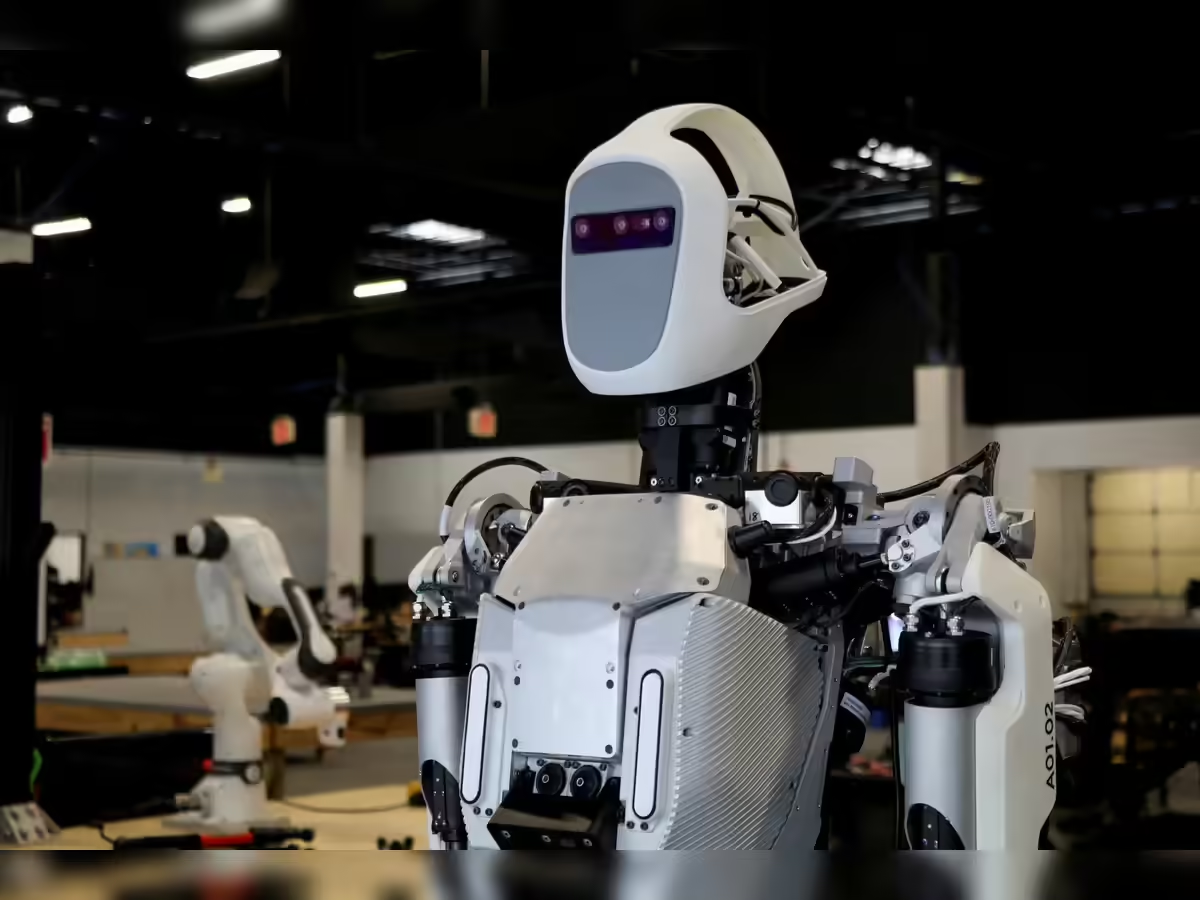
- The Netherlands opened Europe's first Humanoid Application Center to accelerate commercial robotics adoption
- China accounts for 85% of global humanoid robot installations, leaving Europe far behind
- A Dutch real estate firm plans to deploy humanoids on construction sites by year-end to address housing shortages
The Netherlands opened a Humanoid Application Center near Rotterdam on Thursday, a research and testing hub designed to help European companies catch up with China's commanding lead in humanoid robotics. China accounted for 85% of the world's humanoid robot installations last year, according to Barclays, while Europe remains a distant afterthought.
The center, housed in a business park outside Rotterdam, brings together firms, researchers, and technicians to solve commercial problems using humanoid robots. CEO Evert Jaap Lugt, 66, described the initiative as a "kickstart" for a European fightback in a domain where the continent has lost ground badly.
Why Europe lags so far behind
Lugt did not sugarcoat the situation. "Europe is almost nowhere, like always, with all these new technologies. And this is really terrifying," he told AFP. "Because this is about the future earning models of our society."
The numbers bear him out. China operates roughly 1.4 million industrial robots compared to about 400,000 across Europe. Chinese firms like Unitree and Fourier Intelligence have unveiled bipedal robots at aggressive price points, while US companies like Figure, Tesla, and Boston Dynamics dominate Western innovation. Europe's industrial robotics heritage, strong in Germany and elsewhere, has not translated into humanoid leadership.
Lugt sees one opening: application and adoption. "We are lagging behind. So the only opportunity we probably have is that we look at appliances and also the adoption of this technology. Maybe we can lead over that."
A real estate director's bet on construction robots
The center already has corporate partners with concrete plans. Niels Langenhuizen, a real estate director whose company builds pre-fab houses to ease the Netherlands' housing crisis, told AFP he will deploy the first humanoid robot on a building site by year-end.
His logic is blunt. "As long as we depend on manual labour, we're never going to reach 24/7 production and we're never going to get to 100,000 houses a year," he said, referring to the Dutch government's housing target. "We need humanoids to be able to speed up this process, to make housing more affordable, to make it more flexible, to make it quicker."
Europe's construction sector faces a roughly 30% labor shortage, a pressure point that makes robotics adoption attractive despite high unit costs. Current commercial humanoid robots run between $150,000 and $250,000 per unit, a steep investment that requires clear productivity gains to justify.
The five-year prediction: indistinguishable from humans
Lugt made a striking forecast about how fast the technology is moving. "In five years from now, you will not see the difference anymore between a human being and a robot if you are, let's say, five metres away from it," he said.
He went further, predicting a future where "companion robots" could replace deceased loved ones in the home, mimicking their appearance and behavior but powered by AI. Whether that future arrives, or whether consumers want it, remains an open question. But the underlying point stands: humanoid robotics is advancing at a pace that demands attention now, not in a decade.
What the center actually does
The Humanoid Application Center functions as a matchmaker. Companies bring problems. Technicians and researchers propose solutions using available humanoid platforms. The goal is practical deployment, not pure research.
Visitors to the center see white humanoid robots moving around alongside a grey robotic dog performing tricks. The emphasis is on showing what the technology can do today, not on distant prototypes.
China has embedded robots into daily life far more aggressively than Europe. Robots appear in Chinese hotels, shopping centers, and factories. That visibility normalizes the technology and accelerates iteration. Europe, by contrast, treats robotics as a factory-floor specialty rather than a general-purpose tool.
Logicity's Take
The center's premise, that Europe can win on adoption even if it loses on invention, is plausible but not guaranteed. Adoption requires more than a testing hub; it requires regulatory clarity, financing options for capital-intensive deployments, and a workforce willing to integrate alongside machines. The real estate pilot will be a useful proof point. If Langenhuizen's construction robots deliver measurable productivity gains by 2026, expect copycats across European industrial sectors. If they don't, the center risks becoming another well-intentioned lab with limited commercial impact. For tech leaders evaluating robotics, the key question is not whether humanoids will matter, but whether your industry will integrate them early enough to benefit.
The commercial stakes for Europe
Lugt framed the stakes in economic survival terms. Humanoid robotics is not a curiosity; it is, in his view, central to "the future earning models of our society." If European companies depend on Chinese or American robots, the value accrues elsewhere.
The global humanoid robot market is projected to reach $8 billion by 2028, according to Grand View Research. That figure will grow if adoption accelerates in construction, logistics, healthcare, and retail. China has invested $5.6 billion in robotics R&D over the past three years. Europe has not matched that commitment.
The Netherlands' center is a start, but a single hub in Rotterdam cannot offset a continental gap in investment and ambition. What it can do is prove that European companies are serious buyers, which might attract more development and manufacturing capacity over time.
Frequently Asked Questions
What is the Humanoid Application Center?
A Dutch hub near Rotterdam that connects companies with technicians and researchers to deploy humanoid robots for commercial applications. It opened in June 2025.
How far behind is Europe in humanoid robotics?
China accounted for 85% of global humanoid robot installations last year. Europe has minimal market share and limited domestic humanoid development.
How much do commercial humanoid robots cost?
Current commercial humanoid robots cost between $150,000 and $250,000 per unit, making them a significant capital investment.
When will humanoid robots be used in European construction?
A Dutch real estate firm plans to deploy its first humanoid robot on a construction site by the end of 2025 to accelerate pre-fab housing production.
What is the projected market size for humanoid robots?
The global humanoid robot market is projected to reach $8 billion by 2028, driven by adoption in construction, logistics, and other sectors.
Need Help Implementing This?
If you're exploring robotics integration or automation strategy for your business, contact Logicity's advisory network for introductions to qualified consultants and implementation partners.
Source: Tech-Economic Times / ET
Huma Shazia
Senior AI & Tech Writer
Produced with AI assistance and reviewed by the Logicity editorial team. Learn more in our Editorial Policy.