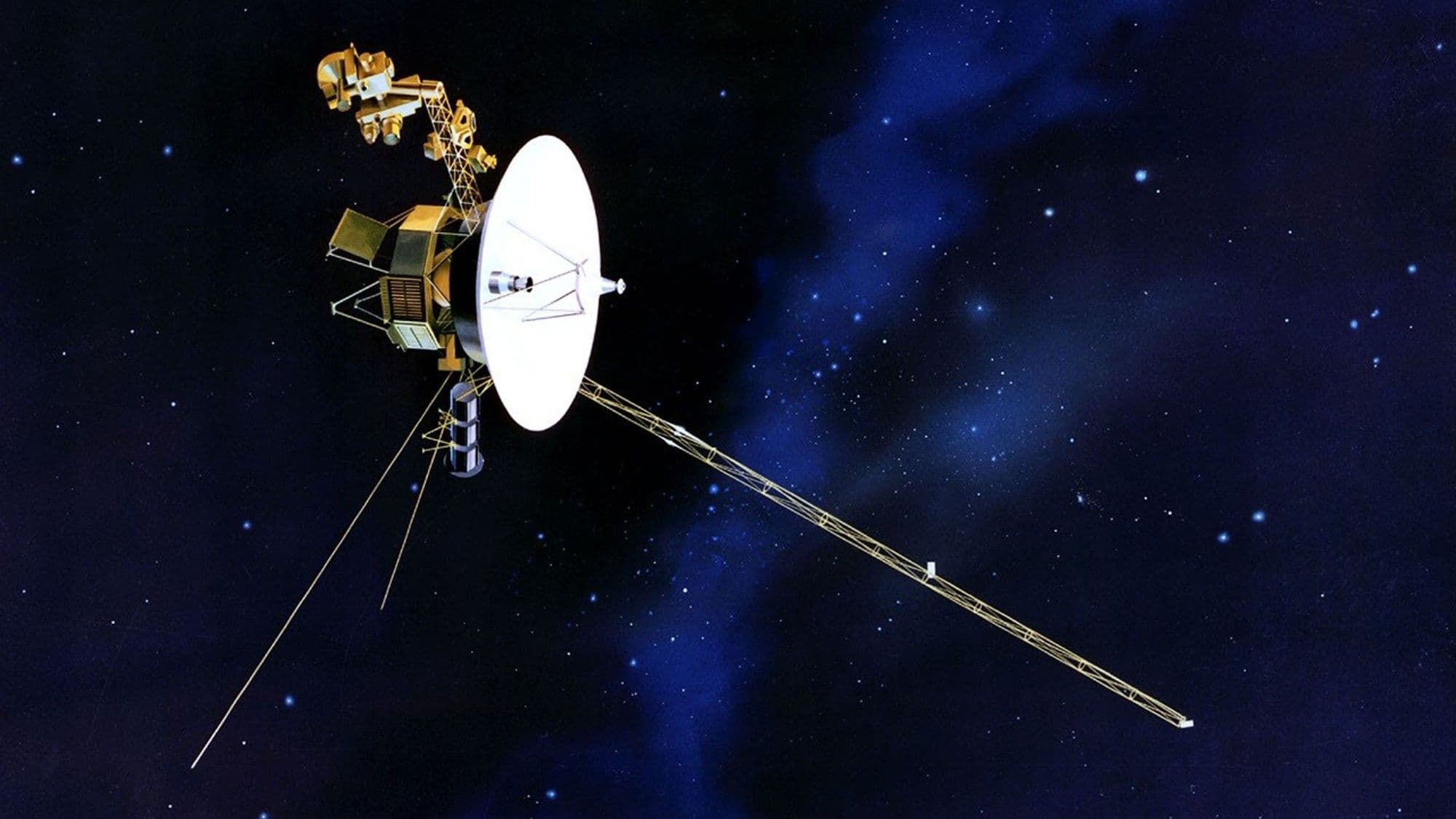
NASA's Voyager 2 probe, now 48 years into its mission and roughly 12.8 billion miles from Earth, will keep its last three science instruments running for at least another year. Engineers at the Jet Propulsion Laboratory implemented a power management change they call the "Big Bang," turning off non-essential systems and switching to lower-power alternatives that still keep the spacecraft warm enough to function in interstellar space.
Why the probe needed emergency surgery
NASA's Risky 'Big Bang' Maneuver Saves Voyager 2: Will It Work for Voyager 1?
Both Voyager probes run on radioisotope thermoelectric generators (RTGs), which convert heat from decaying plutonium-238 into electricity. When Voyager 2 launched in 1977, its RTG produced about 470 watts. Today that number sits around 220 watts, and it drops roughly four watts every year.
"The spacecraft power margins have grown razor thin, requiring the team to conserve energy by shutting off non-essential devices and systems," NASA officials wrote in announcing the fix. Without the Big Bang change, Voyager 2 would have needed to shut down one of its remaining science instruments later this year.
Each Voyager launched with 10 instruments. Voyager 2 is down to three. Both probes have turned off two instruments since 2024 alone, a pace that shows how aggressively the power curve is biting.
What happens when you debug from 24 light-hours away
Sending a command to Voyager 2 takes nearly 24 hours. Getting a response takes another 24. Any configuration change is a two-day feedback loop at minimum, with no undo button if something breaks.
Voyager 1, currently about 15.9 billion miles from Earth (roughly 171 astronomical units), is even harder to reach. NASA says it will apply the same Big Bang power change to Voyager 1 "in the coming months."
The science these instruments still deliver
Voyager 2 crossed into interstellar space in 2018, six years after its twin. Both continue transmitting data about the boundary between our solar system's bubble of charged particles and the interstellar medium. This is science no other spacecraft can provide. No probe has traveled farther, and the next mission to reach these distances is decades away.

The probes' planetary mission ended long ago. Voyager 2 completed its final flyby, past Neptune, in 1989. The image above shows Europa, Jupiter's icy moon, as Voyager 2 captured it in July 1979. These flybys gave humanity its first close look at the outer planets and their moons.
Logicity's Take
There is something founders can learn from this 48-year-old codebase still running on hardware nobody can physically touch. The JPL team cannot ship new silicon. They cannot roll back. Every optimization is software, and every change carries existential risk. If your infrastructure feels constrained, remember: these engineers are debugging a plutonium-powered computer from 1977, one light-day away, and they just bought another year.
How much longer can the Voyagers survive?
NASA has not set a hard end date. The agency has repeatedly squeezed extra years out of both probes through software changes and power rationing. At the current decay rate, Voyager 2's RTG will drop below usable levels sometime in the early 2030s. Each Big Bang-style intervention pushes that boundary a bit further.
When the power finally runs out, the spacecraft will go silent. They will keep drifting. Voyager 1 is headed toward the constellation Ophiuchus; Voyager 2 toward Sagittarius. Neither will pass near another star for tens of thousands of years.
Need Help Implementing This?
Running into infrastructure constraints of your own? Reach out to the Logicity team for technical strategy guidance.
Source: Hacker News: Best
Huma Shazia
Senior AI & Tech Writer
Produced with AI assistance and reviewed by the Logicity editorial team. Learn more in our Editorial Policy.