Key Takeaways
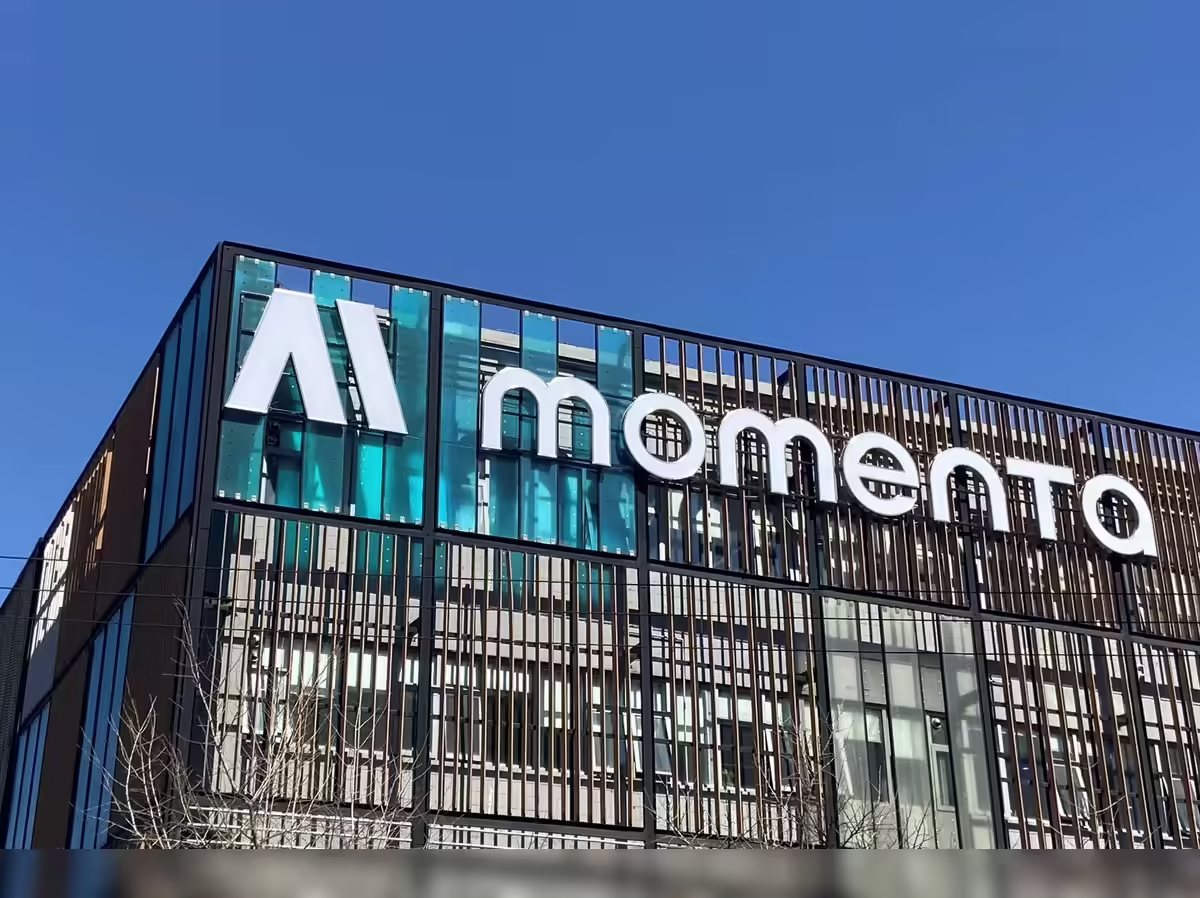
- Momenta seeks to raise up to HK$5.89 billion ($751 million) in its Hong Kong IPO, with trading set to begin July 8
- 60% of proceeds will fund R&D including AI computing power, while 20% goes toward Robotaxi expansion
- The company powers 680,000+ vehicles with its driver-assistance software and plans Robotaxi trials in Abu Dhabi and Munich
Chinese self-driving technology company Momenta Global launched its Hong Kong initial public offering on Monday, aiming to raise up to HK$5.89 billion ($751 million). The company is offering 19.9 million shares at HK$295.60 each, with trading scheduled to begin July 8.
The IPO arrives as Chinese tech firms return to public markets after a prolonged drought. Investor appetite for AI, chips, and automation plays has revived, and Beijing's push for homegrown technology amid US competition has created favorable conditions for domestic listings.
Where the money goes
Momenta plans to allocate roughly 60% of IPO proceeds to research and development. That includes AI computing power, data storage infrastructure, and engineering headcount. Another 20% will accelerate the rollout of its Robotaxi services, which the company is piloting with Uber and planning for commercial launch in Abu Dhabi and Munich this year, pending regulatory approvals.
The split reflects a company still in growth mode. Momenta posted a loss of 3.46 billion yuan ($509 million) in 2025, up from 3.21 billion yuan the year prior. Revenue, however, jumped 82.1% to 2.41 billion yuan. The widening loss suggests aggressive investment in technology and market expansion rather than a slide toward profitability.
Who's backing the deal
Cornerstone investors include some notable names. Mercedes-Benz, already a Momenta backer and customer, has committed to the IPO. BlackRock funds are participating, along with China's Boyu Capital. Other cornerstone investors include Singapore's GIC, Fidelity International, Oaktree, Franklin Templeton, and ChinaAMC.
The roster signals institutional confidence, though cornerstone commitments don't guarantee post-IPO performance. Mercedes-Benz's involvement is particularly interesting given its dual role as investor and partner. Momenta already provides driver-assistance software to the German automaker.
What Momenta actually does
Founded in 2016 by former Microsoft researcher Cao Xudong, Momenta sells driving-assistance software to automakers. The technology helps vehicles steer, brake, change lanes, and park, but still requires an alert human driver ready to take control. This distinguishes it from fully autonomous Level 4 systems, which can operate without human input in defined conditions.
By the end of 2025, vehicles using Momenta's software had topped 680,000. The customer list reads like an auto industry who's who: Toyota, Mercedes-Benz, SAIC, General Motors, BYD, and Audi. This OEM-focused approach differs from competitors like Waymo or Baidu's Apollo, which emphasize robotaxi fleets.
The Robotaxi play
Momenta isn't ignoring the robotaxi market entirely. The company says it's working with Uber on trials and plans commercial Robotaxi services in Abu Dhabi and Munich this year. These Level 4 vehicles could drive themselves in defined areas with minimal human input.
The international expansion is notable. Most Chinese autonomous driving firms have focused on domestic deployments, where regulatory frameworks and mapping data are more accessible. Launching in the UAE and Germany requires adapting to different road conditions, regulations, and consumer expectations. Success there would validate Momenta's technology beyond its home market.
Timing and market context
Chinese tech IPOs in Hong Kong have picked up after years of regulatory crackdowns and geopolitical tensions dampened activity. The AI boom has helped. Companies with credible connections to artificial intelligence, autonomous systems, or semiconductors are finding receptive investors.
Beijing's industrial policy plays a role too. The government has prioritized self-reliance in critical technologies as competition with the United States intensifies. Autonomous driving sits squarely in that priority list, making Momenta a beneficiary of both policy support and market enthusiasm.
Logicity's Take
Momenta's OEM partnership model offers a more predictable revenue path than pure robotaxi plays. Waymo and Cruise burn cash building fleets; Momenta gets paid by automakers embedding its software. The 82% revenue growth against widening losses suggests a classic SaaS-like trajectory where market share comes before margins. For decision-makers watching the autonomous space, the real signal here is Mercedes-Benz doubling down as both investor and customer. That's validation from an OEM with no shortage of alternatives.
What investors should watch
The July 8 trading debut will test whether institutional demand translates to broader market interest. Key metrics to monitor: how quickly Momenta converts its R&D spending into new OEM contracts, whether the Robotaxi pilots in Abu Dhabi and Munich proceed on schedule, and whether the loss trajectory stabilizes as revenue scales.
Competition remains fierce. Tesla's Full Self-Driving, Mobileye's solutions for traditional automakers, and domestic rivals like Pony.ai all target similar markets. Momenta's edge lies in its integration with Chinese automakers like BYD and SAIC, who dominate global EV production. If those partnerships deepen, the 680,000 vehicles running Momenta software could multiply quickly.
Frequently Asked Questions
When does Momenta begin trading on the Hong Kong Stock Exchange?
Momenta is scheduled to begin trading on July 8, 2025, following the completion of its IPO.
How much is Momenta trying to raise in its IPO?
The company is seeking up to HK$5.89 billion ($751 million) by offering 19.9 million shares at HK$295.60 each.
What automakers use Momenta's self-driving technology?
Momenta's customers and partners include Toyota, Mercedes-Benz, SAIC, General Motors, BYD, and Audi. Over 680,000 vehicles use its software.
Is Momenta profitable?
No. Momenta reported a loss of 3.46 billion yuan ($509 million) in 2025, though revenue grew 82.1% to 2.41 billion yuan.
Where is Momenta launching Robotaxi services?
The company plans commercial Robotaxi services in Abu Dhabi and Munich in 2025, working with Uber and pending regulatory approvals.
Need Help Implementing This?
If you're tracking autonomous vehicle investments or building technology partnerships in the mobility space, Logicity can help you stay ahead of market shifts. Contact us for strategic analysis and implementation guidance.
Source: Tech-Economic Times / ET
Manaal Khan
Tech & Innovation Writer
Produced with AI assistance and reviewed by the Logicity editorial team. Learn more in our Editorial Policy.




