Key Takeaways
- Mobileye will launch a 100-vehicle robotaxi fleet in an unnamed US city in 2027, scaling to 17,000 vehicles over five years
- The Intel subsidiary is shifting from pure supplier to operator, putting it in direct competition with its own customers
- Mobileye will use its Moovit app for consumer booking and create a separate operating business for the service
Mobileye, the Intel subsidiary that supplies autonomous driving technology to automakers worldwide, announced Tuesday it will launch its own robotaxi service in a US city in 2027. The company plans to start with 100 autonomous vehicles and scale to roughly 17,000 over the following five years. The move puts Mobileye on both sides of the autonomous vehicle business, selling technology to automakers while competing with them directly.
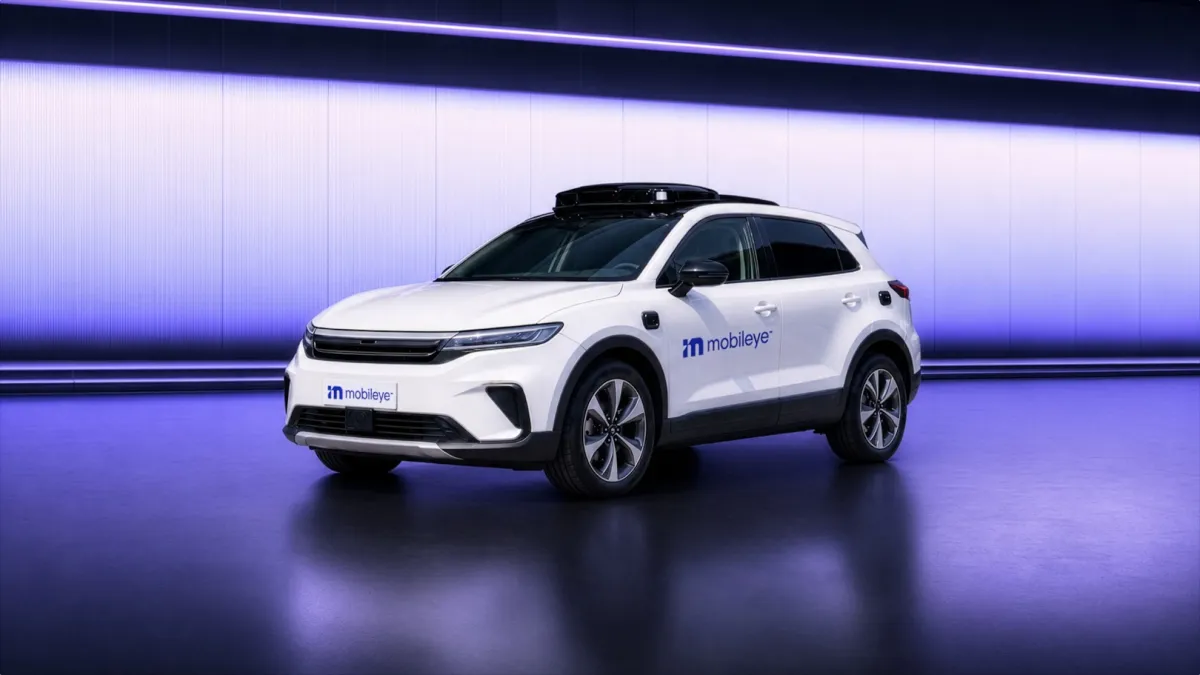
The company did not name the city. It also did not specify which vehicle would make up its fleet, though a press release image showed what appears to be a modified Ora iQ, an electric crossover from Chinese automaker Great Wall Motors. Mobileye said only that it would work with "AV-ready vehicle platform manufacturers."
Why is Mobileye becoming a robotaxi operator?
Mobileye built its reputation supplying computer vision chips for driver-assistance systems. The company says more than 230 million vehicles globally use its technology. It later expanded into full self-driving systems and now supplies its Mobileye Drive platform to Volkswagen and its MOIA subsidiary.
But CEO Amnon Shashua has long viewed robotaxis as a necessary step toward the real goal: consumer cars that drive themselves. In a 2020 interview with TechCrunch, he called fully autonomous consumer vehicles the "Holy Grail" and said the path runs through robotaxis first.
“The robotaxi revolution has only just begun, and its potential for transforming how we travel around the world continues to increase.”
— Amnon Shashua, Founder and CEO of Mobileye
Shashua also noted that the autonomous vehicle industry has become "increasingly dependent on a small number of technology providers and business models." Running its own service gives Mobileye direct operational data, a faster feedback loop for improving its technology, and a showcase for potential customers.
How will Mobileye structure the robotaxi business?
Mobileye will create a separate operating company for the robotaxi service. The company will manage the fleet directly and use Moovit, the transit and ride-hailing app it owns, for the consumer-facing booking experience. Moovit already aggregates public transit, bike-sharing, and ride-hailing options in cities worldwide, giving Mobileye an existing user base to tap.
Shashua framed the move as complementary rather than competitive with existing partnerships. "This initiative is not a replacement for our existing partnerships; it is an extension of them," he said. "We remain deeply committed to enabling automakers and mobility providers with Mobileye Drive."
Whether automakers see it that way is another question. Companies that buy Mobileye Drive now face the prospect of competing against their own supplier in the robotaxi market.
What does this mean for Waymo and other robotaxi operators?
Mobileye enters a market where Waymo holds a significant lead. Alphabet's autonomous vehicle unit operates commercial robotaxi services in Phoenix, San Francisco, Los Angeles, and Austin, with years of real-world data. Cruise, GM's robotaxi subsidiary, suspended operations in late 2023 after a pedestrian-dragging incident in San Francisco and has been slower to return.
Mobileye's advantage lies in its existing data. With technology in 230 million vehicles, the company collects vast amounts of real-world driving information, even from cars that are not fully autonomous. That data can train and validate self-driving systems at a scale most competitors cannot match.
The 2027 timeline also gives Mobileye room to watch how regulations evolve. California, Arizona, and Texas have emerged as friendlier jurisdictions for robotaxi testing and deployment, while other states remain more restrictive.
The risk of competing with your own customers
Mobileye's dual role creates tension. Automakers licensing Mobileye Drive may hesitate to share their roadmaps with a company that now competes for the same robotaxi market. Some may accelerate efforts to develop proprietary systems or switch to alternative suppliers.
Online discussions on Hacker News and Reddit have focused on this strategic risk. Several commenters noted that Nvidia, another major AV chip supplier, has avoided operating vehicles directly, preferring to remain a neutral technology provider.
Shashua is betting that the operational experience and data from running its own service will improve Mobileye Drive enough to offset any customer concerns. If the robotaxi service proves the technology works safely at scale, automakers may care less about competing with their supplier and more about accessing that proven system.
Logicity's Take
Mobileye's move mirrors what Nvidia has deliberately avoided. The calculus makes sense if you believe robotaxi operations are the only way to prove your technology at the level regulators and consumers demand. But it also signals that Mobileye sees limited growth in staying a pure supplier. If automakers develop their own stacks, or consolidate around Waymo's model of technology-plus-operations, a supplier without real-world proof points could become irrelevant. This is a defensive play as much as an offensive one.
Frequently Asked Questions
When will Mobileye launch its robotaxi service in the US?
Mobileye plans to launch in 2027, phasing in 100 autonomous vehicles throughout the year in an unnamed US city.
What app will Mobileye use for robotaxi bookings?
Mobileye will use Moovit, the transit and ride-hailing app it owns, for consumer-facing bookings.
Will Mobileye continue selling technology to automakers?
Yes. Mobileye says the robotaxi business will complement, not replace, its supplier relationships with automakers using Mobileye Drive.
What vehicles will Mobileye use in its robotaxi fleet?
Mobileye has not confirmed the vehicle, but a press release image showed what appears to be a modified Ora iQ from Great Wall Motors.
How does Mobileye's fleet size compare to Waymo?
Mobileye plans 100 vehicles at launch, scaling to 17,000 over five years. Waymo currently operates hundreds of vehicles across multiple US cities with years of operational data.
Need Help Implementing This?
If you're building in the autonomous vehicle space or evaluating AV technology partnerships, Logicity can connect you with analysts and engineers tracking this market. Reach out to our editorial team for introductions.
Source: TechCrunch / Kirsten Korosec
Huma Shazia
Senior AI & Tech Writer
Produced with AI assistance and reviewed by the Logicity editorial team. Learn more in our Editorial Policy.




