Key Takeaways
- Mistral OCR 4 adds semantic block classification to identify titles, tables, equations, and signatures automatically
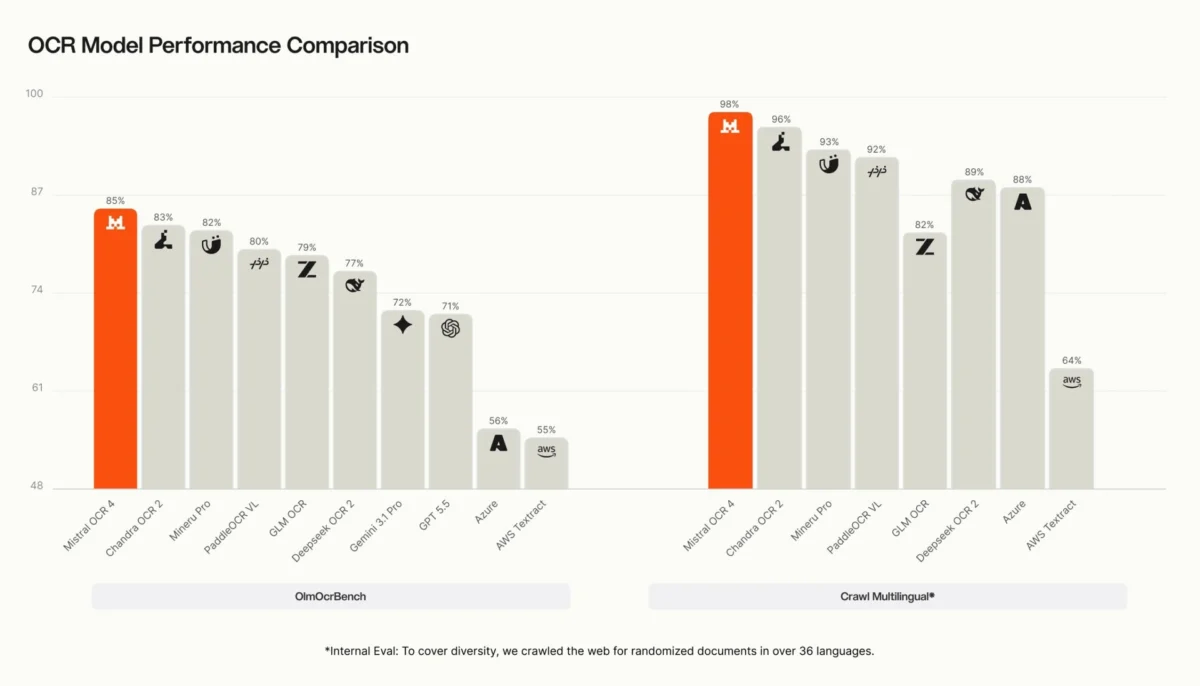
- Independent reviewers preferred OCR 4 over competitors in 72% of 600+ document tests, per Mistral
- Pricing sits at $4 per 1,000 pages via API, or $2 in batch mode, with 170 language support
Mistral AI has released OCR 4, a document-reading model that goes beyond raw text extraction. The model identifies what each element on a page actually is: a title, table, equation, or signature. In blind tests across 600+ documents, independent reviewers chose OCR 4's output over competitors 72% of the time, according to the company.
That last claim deserves scrutiny. Mistral ran the test and selected the competitors. Still, if the numbers hold, OCR 4 represents a meaningful jump for teams building document pipelines.
What does Mistral OCR 4 actually do differently?
Earlier OCR models extracted text and left you to figure out what it meant. OCR 4 adds block classification, automatically tagging each element by its role on the page. A header gets labeled as a header. A table stays structured as a table. Equations and signatures get their own tags.
This matters for downstream workflows. When you feed documents into RAG systems or let AI agents process them, knowing that line 47 is a section title and lines 48-52 are a data table changes how you chunk and retrieve information. Without semantic labels, you end up with brittle regex patterns or manual annotation.
OCR 4 also outputs confidence scores for each word and page. If the model is uncertain about a handwritten signature or a faded scan, you get a number telling you so. This lets you route low-confidence pages to human review instead of silently passing bad data downstream.
170 languages and the blind test methodology
Mistral claims strong performance across 170 languages, including less common ones. The company points to a blind test with over 600 documents where independent reviewers compared OCR 4's output against unnamed competitors. Reviewers preferred Mistral's results 72% of the time.
A few caveats. Mistral has not published the full methodology or named the competing models. "Independent reviewers" could mean many things. And 600 documents, while not trivial, may not capture edge cases that matter in specific industries. Teams evaluating OCR 4 should run their own tests on representative data before committing.
Pricing and availability
OCR 4 is available through Mistral's API, Mistral Studio, and Microsoft Foundry. Pricing lands at $4 per 1,000 pages, or $2 per 1,000 in batch mode. For comparison, Google Cloud Vision OCR charges roughly $1.50 per 1,000 pages for basic text extraction, but doesn't include the semantic block classification that Mistral emphasizes.
The batch discount makes sense for teams processing document archives. Real-time extraction at $4/1,000 pages will add up quickly if you're handling high volumes, but sits in a reasonable range for enterprise document workflows where accuracy matters more than cost.
Where OCR 4 fits in document AI pipelines
The immediate use case is preprocessing documents for search and retrieval systems. If you're building a knowledge base from PDFs and want clean chunks for a vector database, OCR 4's block classification handles the first pass. You get structured output without writing custom parsers for every document format.
For teams already using automation tools like Zapier or Make to route documents, OCR 4 could slot into workflows that trigger on document uploads, extract structured data, and push it to downstream systems. The confidence scores add a decision point: high-confidence extractions proceed automatically, low-confidence ones get flagged.
Disclosure
Some links in this post are affiliate links — Logicity earns a commission if you sign up, at no extra cost to you. We only link products we have used or actively recommend.
What Mistral isn't saying
The announcement doesn't address latency, a critical factor for real-time applications. It doesn't specify how OCR 4 handles degraded scans, unusual fonts, or documents with mixed layouts. And the 72% preference stat, while impressive, lacks transparency on what it was measured against.
Mistral's positioning as a European alternative to US AI labs adds strategic context. For companies with data residency requirements, running OCR through Mistral's infrastructure may satisfy compliance needs that GPT-4 Vision or Claude can't. But Mistral hasn't highlighted this angle explicitly.
Logicity's Take
OCR 4's block classification is the real story here. Raw text extraction is commoditized; knowing that a block is a table versus a paragraph is what makes document AI actually useful. The 72% claim needs independent verification, but if accurate, Mistral just made a strong case for teams building RAG pipelines or document automation. Compare pricing against Google Cloud Vision ($1.50/1K basic) and Azure Form Recognizer ($1.50-$7.50/1K depending on features) before committing. The batch discount at $2/1K pages makes archive processing competitive.
Frequently Asked Questions
How much does Mistral OCR 4 cost per page?
OCR 4 costs $4 per 1,000 pages through the API, or $2 per 1,000 pages in batch mode for larger processing jobs.
What languages does Mistral OCR 4 support?
Mistral claims OCR 4 supports 170 languages, including less common ones, though specific accuracy benchmarks per language have not been published.
How does OCR 4 differ from basic OCR tools?
OCR 4 adds block classification to identify element types like titles, tables, equations, and signatures, plus confidence scores for each extraction. Standard OCR outputs plain text without semantic labels.
Where can I access Mistral OCR 4?
OCR 4 is available through Mistral's API, Mistral Studio, and Microsoft Foundry.
Did independent testers verify Mistral's 72% win rate?
Mistral says independent reviewers preferred OCR 4 in 72% of 600+ document comparisons, but the company has not published full methodology or named the competing models tested.
Context on how AI companies like Mistral are valued and funded
Need Help Implementing This?
If you're evaluating OCR 4 for document processing or RAG pipelines, reach out to Logicity's consulting team for architecture guidance and integration support.
Source: The Decoder / Maximilian Schreiner
Manaal Khan
Tech & Innovation Writer
Produced with AI assistance and reviewed by the Logicity editorial team. Learn more in our Editorial Policy.