Key Takeaways
Meta's Brain Reading AI Just Hit 78% Accuracy : Brain-to-Text AI #meta #Brain2QwertyV2
- Brain2Qwerty v2 achieves 39% average word error rate using MEG scans, no surgery required
- Best participant hit 22% error rate, with 28% of sentences decoded perfectly
- Claude Opus 4.6 agents autonomously optimized the model, beating standard methods
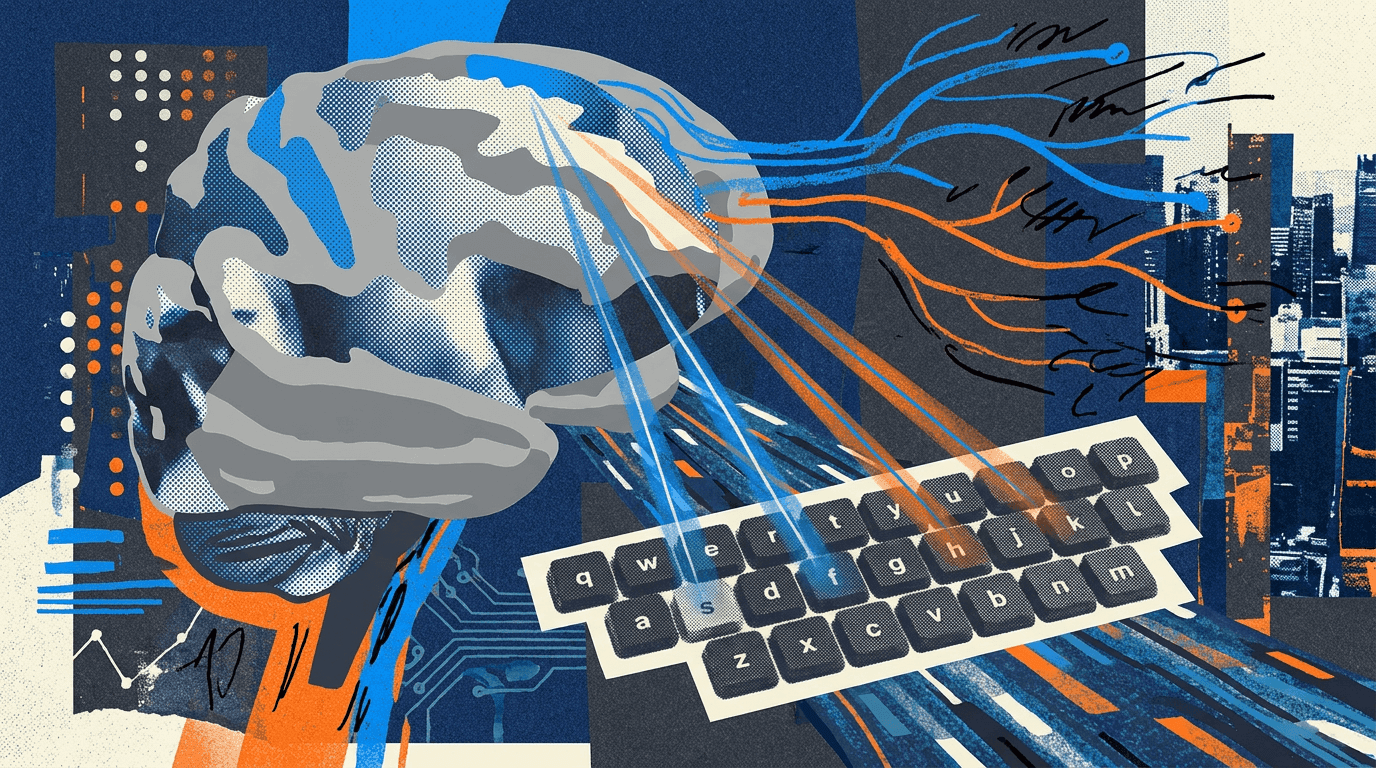
Meta's FAIR research team has released Brain2Qwerty v2, a non-invasive brain-computer interface that decodes typed sentences from magnetoencephalography (MEG) recordings. The system averages a 39% word error rate across participants, with the best subject hitting 22%. For people who lose the ability to speak after stroke or injury, this represents a potential path to communication without brain surgery.
How does Brain2Qwerty v2 work?
The setup is straightforward. Nine healthy volunteers wore MEG sensors, which detect magnetic fields outside the skull. Each participant completed ten hours of recordings and typed a combined 22,000 sentences. They heard a sentence, paused, then typed it on a keyboard without seeing their output. The model reconstructs the sentence purely from brain signals captured during typing.
According to the paper, the measurable activity comes mainly from the motor cortex, the region controlling finger movements. This is key: the system reads typing intentions, not abstract thoughts.
The original Brain2Qwerty v1 needed exact keystroke timestamps to align signals. Version 2 eliminates that requirement. It processes a continuous signal window and assigns characters on its own. This asynchronous approach removes a major barrier to real-time use, though the system hasn't crossed that threshold yet.
What made the accuracy jump possible?
Three factors drove the improvement. First, the dataset grew tenfold. Ten times more recordings per person, plus far more varied sentences. Second, deep learning replaced the hand-built recognition steps from earlier versions. Third, the team added a fine-tuned language model, Qwen3, to shape noisy brain signals into coherent sentences.
The model processes signals at three levels: characters, words, and full sentences. This hierarchical approach lets it correct errors at each stage. Without the language model, the raw encoder hits 55% word error rate. With Qwen3 smoothing the output, that drops to 39%.
For the best participant, 28% of sentences decoded perfectly. Another 47% contained at most one wrong word.
The language model's double-edged sword
Here's the catch. Brain2Qwerty v2 wins on word and semantic accuracy but loses on character accuracy. The v2 system hits 31% character error rate, worse than the raw encoder at 28% and the N-gram model from v1 at 26%.
The reason: Qwen3 is trained to produce fluent sentences. When the brain signal is ambiguous, it invents grammatically correct text that may be completely wrong. For the worst-performing participant, the model decoded "had she not fallen down the stairs" when the target was "cars are not allowed on this road." A total miss.
The N-gram approach corrects locally and stays closer to individual letters, but it rarely produces real words. Since communication depends on meaning rather than exact character matches, the team considers the improved word and semantic scores the more relevant progress.
AI agents that optimize AI research
The paper includes an auto-research component. Three independent agents based on Claude Opus 4.6 were tasked with lowering the error rate by modifying code and running experiments autonomously. They discovered techniques like label smoothing, modality dropout, and shorter prompts. These improvements held across all participants and beat a standard optimization method by a clear margin.
But the agents failed when given open-ended tasks. Their extensive code changes crashed most compute jobs. Human research remains essential, at least for now.
How does this compare to surgical implants?
Invasive brain-computer interfaces from companies like Neuralink and Blackrock Neurotech achieve much lower error rates. They tap into neural signals directly, providing cleaner data. But they require brain surgery, carry infection risks, and have limited longevity.
An earlier fMRI-based study hit 92 to 94% word errors. MEG-based systems like Brain2Qwerty v2 are now dramatically better. At 22% error rate for the best participant, the gap with surgical implants is narrowing.
The trade-off is clear: worse accuracy versus no surgery. For the roughly 5.4 million Americans living with paralysis, a 39% error rate with no surgical risk may be preferable to a 5% error rate that requires opening the skull.
What's still missing?
Real-time decoding. The current system works on recorded sessions, not live typing. The participants were healthy volunteers, not patients with motor impairments. And MEG machines cost millions of dollars and fill entire rooms. None of this is ready for home use.
Still, the trajectory matters. Each version has cut error rates substantially. If that continues, non-invasive BCIs could become clinically useful within a few years.
Frequently Asked Questions
What is Brain2Qwerty v2?
Brain2Qwerty v2 is Meta FAIR's non-invasive brain-computer interface that decodes typed sentences from MEG brain recordings without requiring surgery or keystroke timing information.
How accurate is Brain2Qwerty v2?
The system achieves a 39% average word error rate. The best participant reached 22% error rate, with 28% of sentences decoded perfectly.
Does Brain2Qwerty v2 require brain surgery?
No. It uses magnetoencephalography, which measures magnetic fields outside the skull. This avoids the surgical risks of implanted devices like Neuralink.
Can Brain2Qwerty v2 decode thoughts in real-time?
Not yet. The current system works on recorded sessions. Real-time decoding remains a goal for future versions.
Who could benefit from non-invasive brain-to-text technology?
People who lose the ability to speak or move after stroke, ALS, or brain injury. An estimated 5.4 million Americans live with paralysis.
Logicity's Take
For AI product teams, the auto-research angle is the buried lede. Claude Opus 4.6 agents autonomously found optimization techniques that outperformed manual tuning. This points to a near-term future where AI systems help design their own architectures. The failure on open-ended tasks suggests the sweet spot is constrained optimization problems with clear metrics. Teams building ML pipelines should watch this space closely.
More on enterprise deployments of Claude and Anthropic's AI agents
Need Help Implementing This?
Building AI products that interface with novel data sources? Our team covers the latest in ML architectures and deployment strategies. Subscribe to Logicity for weekly analysis on AI product development.
Source: The Decoder / Maximilian Schreiner
Huma Shazia
Senior AI & Tech Writer
Produced with AI assistance and reviewed by the Logicity editorial team. Learn more in our Editorial Policy.