Key Takeaways
- Mercedes-Benz's Bengaluru R&D center, with 8,500+ engineers, is the company's largest outside Europe and a key contributor to MB.OS development
- MB.OS is Mercedes' proprietary operating system that will power future S-Class models and enable Level 3 autonomy from 2028
- The automaker is partnering with Nvidia for autonomous driving and expanding collaborations with Indian firms including Infosys, KPIT, and Tata Elxsi
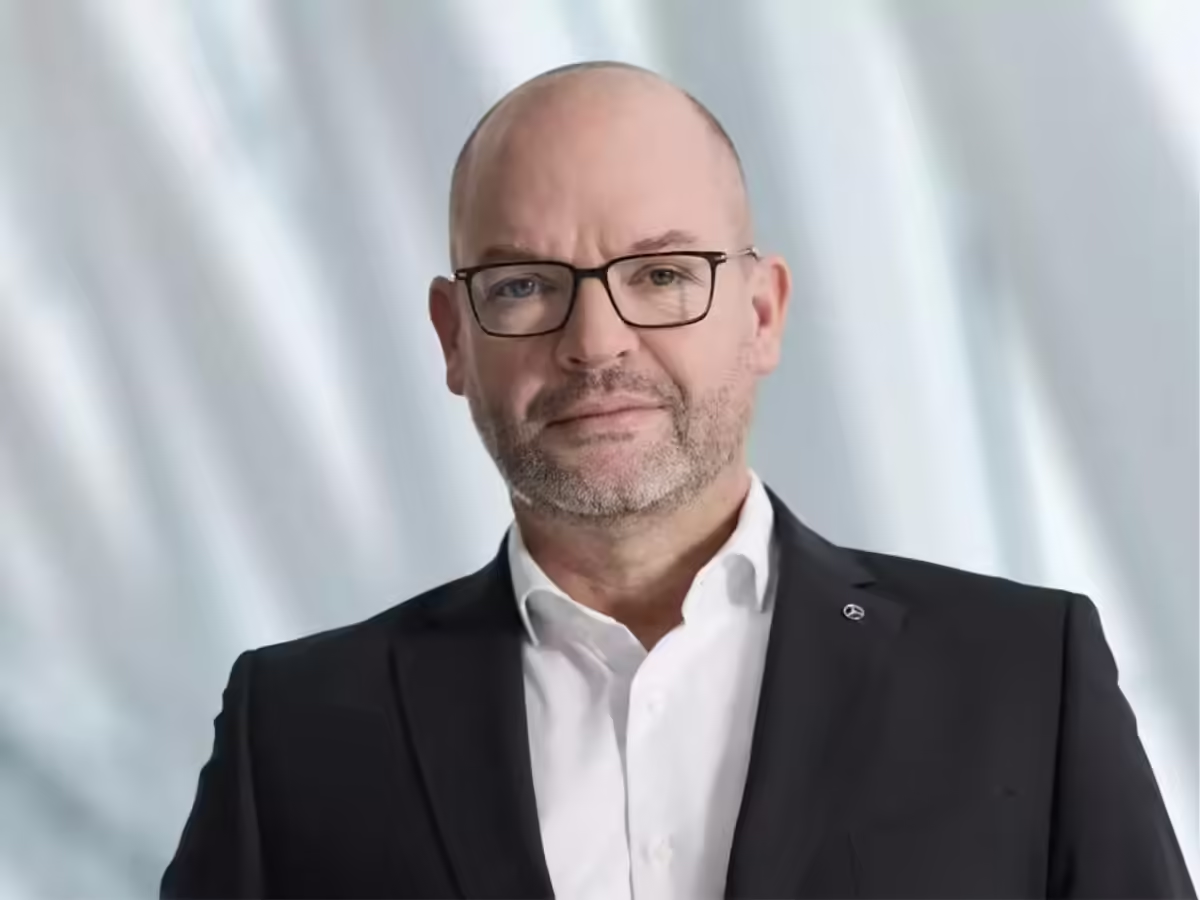
Mercedes-Benz's biggest software bet is being built, in large part, in Bengaluru. Speaking at the S-Class launch in Mumbai, CTO Jörg Burzer confirmed that India's R&D center plays a central role in developing MB.OS, the proprietary operating system that will underpin the automaker's shift to software-defined vehicles and autonomous driving.
"There is a piece of India in every Mercedes, and I hope to see even more of it in the future," Burzer told the Economic Times. The statement isn't marketing fluff. Mercedes-Benz Research and Development India employs more than 8,500 engineers and technologists, making it the company's largest R&D facility outside Europe.
What is MB.OS and why does it matter?
MB.OS is Mercedes-Benz's homegrown operating system, first unveiled in April 2025 with the Mercedes CLA BEV, an electric sedan built on the Mercedes Modular Architecture. The platform represents the company's most significant software transformation to date. It's designed to turn vehicles into software-defined platforms powered by artificial intelligence.
"Our philosophy is that we create a principal tech stack on our own," Burzer explained. "Then we always can decide if we select a partner and work with a partner or we do that on our own." This ownership model gives Mercedes control over its software destiny at a time when carmakers are racing to match Tesla's vertically integrated approach.
The Bengaluru lab has contributed to multiple pillars of MB.OS: digital engineering, advanced driver assistance systems, infotainment, battery technologies, charging ecosystems, and simulation through digital twins. These aren't peripheral features. They're the core components that will differentiate Mercedes vehicles over the next decade.
The path to Level 3 and Level 4 autonomy
Mercedes currently offers Level 2++ autonomous driving capabilities. The jump to Level 3, where the car handles driving in specific conditions without human supervision, is expected to roll out more broadly from 2028. Level 4 autonomy, where the vehicle can operate without a driver in defined areas, will follow.
The Bengaluru teams are working on the software stacks, testing frameworks, and automated parking systems that will make this timeline possible. Mercedes has partnered with Nvidia to accelerate these plans, combining the chipmaker's AI compute power with its own software expertise.
Burzer also outlined where this is heading: agentic AI systems that learn user behavior and make autonomous recommendations. "We will see more and more AI agents coming which you can easily update over the air," he said. "The agent basically knows if you are driving a commute every second day or once a week... and can say, 'Don't go to this coffee shop today because it's too crowded. Take the next one.'"
Expanding partnerships with Indian tech firms
Beyond its captive R&D center, Mercedes is scaling partnerships with Indian engineering service providers. Infosys, KPIT, and Tata Elxsi are all part of the company's expanding software development ecosystem. This isn't surprising. India's engineering services sector has deep automotive expertise, and these firms have been building capabilities in connected vehicles and ADAS for years.
The strategy reflects a broader trend. As vehicles become software platforms, automakers need software talent at a scale they can't build internally. India offers that talent pool at competitive costs, with English fluency and timezone overlap with European headquarters.
How software helped Mercedes weather supply chain chaos
Digital capabilities also helped Mercedes navigate the semiconductor shortages that disrupted the automotive industry. Visibility across supplier networks proved critical. "We were able to master that because we had transparency on the supply chain," Burzer said. "We knew exactly which quantity of semiconductor was available and where."
This kind of real-time supply chain intelligence isn't possible without the digital infrastructure and simulation capabilities that teams in Bengaluru have been building. The same tools used for vehicle development, like digital twins, can model supplier networks and flag risks before they become crises.
The new S-Class arrives in India
The immediate context for Burzer's comments was the launch of the 2026 S-Class facelift in India. The flagship sedan starts at ₹2.20 crore (ex-showroom), with the S 450 e plug-in hybrid offering 115 km of electric-only range. It's one of the early vehicles to feature MB.OS, making the India connection particularly fitting.
Mercedes' Chakan plant in India recently hit 200,000 engines produced, another marker of the country's growing importance to the company's global operations. The combination of manufacturing scale and software development capability makes India a strategic hub, not just a cost center.
Frequently Asked Questions
What is Mercedes MB.OS?
MB.OS is Mercedes-Benz's proprietary operating system designed to transform vehicles into software-defined platforms. It integrates AI capabilities and was first launched with the Mercedes CLA BEV in April 2025. The system is significantly developed by engineers at Mercedes' Bengaluru R&D center.
When will Mercedes offer Level 3 autonomous driving?
Mercedes expects to roll out Level 3 autonomous driving systems more broadly from 2028. The company currently offers Level 2++ capabilities and plans to follow Level 3 with Level 4 autonomy in subsequent years.
How many engineers work at Mercedes R&D India?
Mercedes-Benz Research and Development India employs more than 8,500 engineers and technologists. The Bengaluru facility is the company's largest R&D center outside Europe.
Which Indian companies partner with Mercedes on software?
Mercedes is expanding partnerships with Indian technology firms including Infosys, KPIT, and Tata Elxsi to scale its global software development capabilities.
What is the price of the new Mercedes S-Class in India?
The 2026 Mercedes S-Class facelift starts at ₹2.20 crore (ex-showroom) in India. The S 450 e plug-in hybrid variant offers 115 km of electric-only range.
Logicity's Take
Mercedes' India strategy reveals something larger about where automotive R&D is heading. The traditional model, where engineering happened in Stuttgart and everywhere else just assembled cars, is dead. Software development is too talent-intensive and too fast-moving to centralize. By embedding 8,500 engineers in Bengaluru and partnering with local service firms, Mercedes is building a distributed software organization that can iterate at the pace software demands. The question is whether German automotive culture can truly let go of central control, or whether India remains an execution center for decisions made in Europe.
Need Help Implementing This?
If you're building software-defined products or scaling engineering operations across geographies, Logicity can connect you with experts who've done it. Reach out at hello@logicity.in for introductions to our network of automotive and embedded systems specialists.
Source: Tech-Economic Times / ET
Huma Shazia
Senior AI & Tech Writer
Produced with AI assistance and reviewed by the Logicity editorial team. Learn more in our Editorial Policy.




